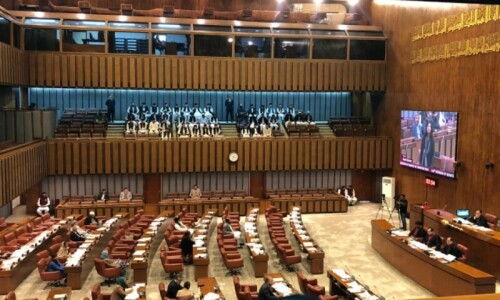
KARACHI: Debating on whether the media informing society or dumbing it down, panellists at the KLF on Sunday morning bravely discussed the capitalist interests that hold the media back, how it was used as a tool of propaganda as well as the responsibility of the viewer in this relationship.
Television show host Wusatullah Khan, who moderated the session, said that the timings of the session could not have been more pertinent with the recent stand-off between India and Pakistan, and the role the media played in both countries.
Journalist Shaheen Salahuddin remarked how watching the media in the largest democracy, India, changed a lot of her views regarding the role of the media. “The Pakistani media agreed dumps things on the viewers, but the media in India, even world renowned television channels, were behaving as if they were the ones who were out in the battlefield fighting the war instead of the soldiers.”
“We live in a post-truth era where the picture being made is fragmented, where there is chaos, confusion and bombardment of information from all sides. The consumer is confused and is looking for clarity. The debate is should the media offer clarity or allow the viewer to derive his own opinion,” questioned Ghazanfar Hashmi.
The Indian media in the past two weeks has created more confusion, he added, while in contrast the Pakistani media was more responsible and even government officials have lauded their efforts.
Ghazi Salauddin was of the opinion that the Pakistani media should not compare itself to the Indian media. In fact, he felt it should be more of an internal standard that must be lived up to.
“Our fight is here within our own society,” he said.
“Another thing we forget to look at is the state of the society the media is functioning in — the society, the ruling ideas within it, the level of awareness, and education background, etc. What can the media inform if college-going children do not even know much about Liaqat Ali Khan or what happened in 1971,” questioned Mr Salahuddin.
A society where the rule of law isn’t prevalent and freedoms to its citizens not provided are some factors that will impact the role of the media in society, he said.
Huma Baqai was of the opinion that media house took the term “dumbing down” as necessary as they believed that audiences were not well aware and so would not be interested in watching a more critical, analytical debate on television.
Today in an era of fake news, the media is inflicting a certain thought onto the audience and as we have seen in the recent few weeks, is being used to attack another country by spreading lies. “Media dumbing in today’s era has become an industry and a mafia,” she said.
Published in Dawn, March 4th, 2019