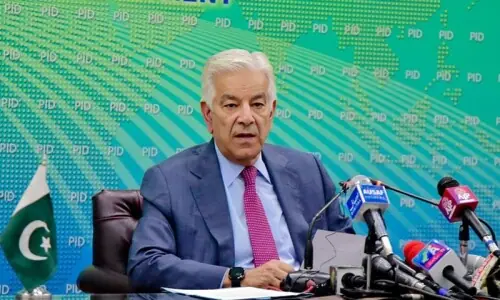
THE prime minister’s statement to the press after his three-hour-long appearance before the Panama Papers JIT was meant purely for his party’s voters. It wasn’t meant to change anyone else’s mind. It wasn’t meant to showcase his or his party’s’ belief in due process. It was a message of reassurance, probably triggered by diffused reports that their voters and some mid-level brokers in Punjab were feeling just a little queasy.
This is precisely why the prime minister made several references to next year’s general election as the real JIT. This is also why he chose to reinforce the image that they were still in pole position to win that election.
With the ongoing saga still some way away from a firm conclusion, it’s hard to say how its outcome will impact the electoral process. For PML-N, the ideal scenario would be an inconclusive outcome that sees everything winding down without a conviction. On the other hand, the investigation, and the Panama Papers scandal, is not only an ideological concern for the PTI, it is also the fuel that’s keeping the party in the race.
It’s difficult to draw out an alternative landscape of politics had the Mossack-Fonseca leak not taken place. Going merely by how things had petered out after the dharna, complete PML-N dominance all the way to 2023 and beyond would not have been out of the question. This scandal’s kept things interesting enough for there to be at least an aura of competition, which is crucial for the country’s democratic health. It’s not ideal — you want competition to be triggered by competing party organisations and manifestos, not corruption-related implosion — but it’s what we have right now.
With the ongoing saga still some way away from a firm conclusion, it’s hard to say how its outcome will impact the electoral process.
As with the dharna against alleged election rigging, the PTI’s primary strategy around the ongoing investigation is to shape voting sentiment against the incumbent. You can believe in elections and political office as a means to a moral-ethical end (accountability, transparency), or you can believe in them as an end unto themselves, but either way their centrality doesn’t go away. This is the reality that the PTI is contending with at the moment.
Going by the numbers, the task confronting the opposition parties in general, and the PTI in particular is fairly steep. Their path to power lies through Punjab’s 148 directly elected National Assembly seats. When the counting finished in May 2013, the PTI had eight of these and the PML-N swept up 117, with a further 15-odd added by independents. In political terms, this is a chasm that in normal democracies would take at least two elections to bridge. More importantly, the chasm has continued along roughly the same margin in the province’s local government elections held in late 2015.
The scale of victories secured by the PML-N in 2013 adds further depth to their dominance. The average margin of victory (ie difference between winner and runners-up as a percentage of total votes cast) on a National Assembly seat in Punjab was 22.7 per cent. Furthermore, it was 28.2pc in the 80-odd constituencies of central Punjab, which, barring a couple, all fell for the PML-N.
In 2008, nearly 50pc of all seats in Punjab were won by a narrow margin of 10pc or less. These were the seats that the PPP or PML-N had won off PML-Q in the wave of anti-incumbent/anti-Musharraf sentiment that swept Punjab after the lawyers’ movement.
Once consolidated, in 2013 the PML-N took all these seats off the PPP and created a considerable gap between themselves and their competition. As a result, the PTI will head to the polls with only 28pc of all seats in the province carrying a 10pc or less margin. Even if it wins these 42 seats and holds on to its current haul in other provinces, it will still fail to gain a plurality in the lower house.
Other routes to power, such as picking up seats in Sindh and Karachi, are equally (if not more) complicated. Unlike every other province, Sindh actually became more competitive in the 2013 election, when the average margin of victory dropped to 30pc from 44pc five years earlier. However, while this may be a sign of growing apathy against the MQM and the PPP, very few seats changed hands back then and few are expected to do so in 2018.
Whatever way one looks at it, the electoral deck as it currently stands is still stacked in favour of the ruling party. They have comfortable margins in most seats, and will likely use this year’s provincial annual development plan to shore up support in places like Lahore and Rawalpindi divisions, which are expected to be more competitive.
In an earlier piece, I mentioned that the prime minister’s disqualification and a hasty leadership transition in PML-N remains the surest way of triggering defections of strong, electable candidates, and producing the kind of swing the PTI needs. This is also the benchmark that PTI has set in its public statements, and as the numbers given earlier highlight, seems to be the only thing they can pin their hopes on for 2018.
Tailpiece: It’s worth mentioning here that the discourse around the JIT is truly tragic. Many in and outside the party continue to see the PML-N’s electoral popularity as a riposte to all accusations of wrongdoing. The egregious notion that democracy and accountability is something that happens only through elections is held by many political elites and their supporters in Pakistan. To belabour the obvious, elections are a necessary but not a sufficient component of the democratic process. Accountability through courts and investigation commissions are as integral a part of it as anything else. For citizens of this country, this is the only perspective that should matter.
The writer is a freelance columnist.
Twitter: @umairjav
Published in Dawn, June 19th, 2017