0
0

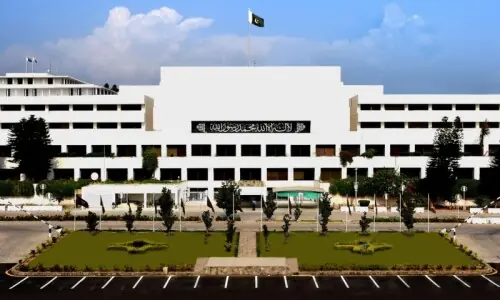
ISLAMABAD: The revival of military courts to try civilians on terrorism charges just requires President Mamnoon Hussain’s ceremonial nod now, as the Senate finally adopted the 28th constitutional amendment with a two-thirds majority on Tuesday.
A total of 78 senators voted in favour of the bill, while three members — all belonging to the Pakhtunkhwa Milli Awami Party (PkMAP) voted against it. Two parties — the Jamiat Ulema-i-Islam-Fazl (JUI-F) and the Balochistan National Party-Mengal (BNP-M) — abstained from the vote.
An amendment, moved by JUI-F’s Maulana Attaur Rahman, seeking the omission of the words “religion and sect” from the bill, was dropped because of his absence.
Senators assembled on two sides of the aisle for voting through division after bells were rung for two minutes and the doors of the lobbies were locked until the completion of voting process.
PkMAP opposes bill, JUI-F and BNP-M abstain; resolution on national security body adopted
Many members voted in support of the bill with heavy hearts and spoke against the revival of military courts, with Pakistan Tehreek-i-Insaf (PTI) Senator Nauman Wazir observing: “We are carrying out an exercise that has already been decided by somebody else”.
Some held parliament responsible for the current situation and called for reforms for the justice system to make sure that no need arose for a similar exercise again after two years.
Pakistan Peoples Party (PPP) Senator Rubina Khalid was of the view that the ruling party had no justification for burdening the next government with military courts, and noted that these courts should have been revived for one year.
PkMAP’s Sardar Azam Moosa Khel pointed out that military courts were not mentioned anywhere in the manifestos of various political parties, while ANP Senator Sitara Ayaz observed that had parliament been strong, senators would not have had to pass this law.
PPP Senator Sehar Kamran described it as “the day of parliament’s defeat”.
But Senate Chairman Mian Raza Rabbani observed that parliaments could never be defeated, but they could compromise.
The chairman, himself an exponent of civilian authority and a known opponent of the idea of military courts, explained that he was supposed to sign the bill after its passage and therefore chose to chair the session instead of signing it in his chambers.
PPP Senator Rehman Malik said that nothing had been done over the past few years to strengthen the judicial system in the country. He called for fast-track trials of terrorism, murder and corruption cases to ensure that parliament does not have to pass a similar law again.
Finance Minister Ishaq Dar, who played a key role in evolving consensus over the bills, said there was no reason to be apologetic. “We are on the right track and are doing what the country needs”.
Opposition Leader Aitzaz Ahsan claimed that the government was not actually in the driving seat, saying that it came to know about the army’s incursion into North Waziristan two days after the operation began.
He also raised the issue of former army chief Gen Raheel Sharif’s preparation to assume the command of a Saudi Arabia-led alliance of Muslim countries and noted that it would be against the spirit of a resolution adopted at a joint session of the parliament regarding military intervention in Yemen.
The house also adopted a resolution moved by Law Minister Zahid Hamid, calling for the revival of a parliamentary committee on national security to discuss matters of urgent nature, periodically reviewing the NAP implementation and overseeing the transition from military to civilian courts. The house was then prorogued sine die.
Published in Dawn, March 29th, 2017