0
0
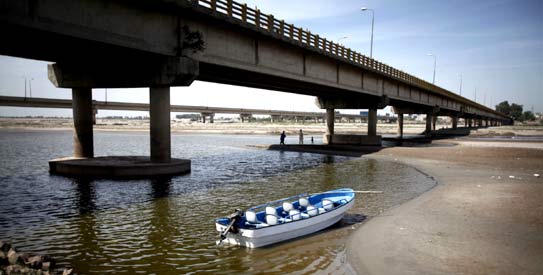
For an elderly Haji Omer Jamali, de-silting of Johi canal delayed for last one decade resulting in water shortage in its command area, is a dire need. Complaints by farmers like Jamali have fallen on deaf ears. Currently, annual closure of barrages is under way for their upkeep and maintenance. It is meant for cleansing distributaries and minors of silt deposits which block water flows. With inadequate flows, silt starts settling in channels. For tail-end portions of channels, de-silting becomes more important. Sometimes, farmers cleanse water channels on their own, disturbing levels of gradients in the process.
Jamali, a grower from Dadu, points out that the 47 mile-long Johi canal has a chronic silting problem. “It didn’t exist at a stretch of six miles at least during flood devastations in 2010. The irrigation officials had given a cut to the canal to divert floodwaters from Khairpur Nathan Shah, Dadu. De-silting of canal is badly needed. It has not been de-silted for last 10 years despite our repeated demands,’ he says.
“It also needs to be remodeled per its actual modules designed way back in 1931 to automatically resolve the problem of water shortage.” Johi canal irrigates a large area and farmers cultivate wheat, rice, mustard and onion with irrigation water. But growers lament that their grievances are not being addressed by officials of the irrigation department.
A paddy grower from upper Sindh Ishaq Mughairi has similar complaints about North Western Canal (NWC) – an off-taking canal on right side of the Sukkur Barrage – which is completely choked on an area spread over 40 kilometres. “Unless this canal is de-silted the tail-enders will continue to suffer. Shortage of water becomes acute during Kharif season as the NWC doesn’t carry water up to its designed capacity,” he says. The plight of Saifullah Magsi, Warah and Kir Thar canal systems in upper Sindh are no different.
The NWC feeds areas in upper Sindh districts of Shikarpur, Larkana, Jacobabad and Qambar-Shahdadkot districts and a part of Balochistan with a designed discharge of 9,600 cusecs. But due to silting it is getting 50 per cent of water discharge from Sukkur Barrage. An estimate of Rs313 million, according to NWC superintending engineer, Shafqat Wadhu, has been given to Sindh government for its de-silting. “Usually main canals are not de-silted but de-silting of NWC is very much needed,” he says.
According to another report Rs70 million is needed for operation and maintenance of Nara Canal system. These minors and distributaries are located in Naukot, Kunri, Digri, Umerkot and Nabisar sub-divisions. Such estimate is submitted by Nara Canal Area Water Board (AWB) of SIDA to the government. No funds have been released by the government while the barrage closure will begin from January 6, confirms AWB member Zahid Bhurgari.
Maintenance of Kotri barrage infrastructure is continuing and its closure will end on January 10. According to Chief Engineer of the barrage Mithal Abbasi a sum of Rs22 million has been released for the (barrage) structure’s maintenance. De-silting of around 45-50 distributaries and minors in seven divisions of Kotri barrage is targeted this year,” says Abbasi.
The barrage’s three main canals Pinyari, Akram Wah, Phulelli provide water to rural parts of Hyderabad, Tando Mohammad Khan, Badin and Thatta while the fourth one Kalri Baghar (KB) feeder takes water to Karachi as well. Entire infrastructure of a barrage is checked from damages point of view, oiled and greased. However, when it comes to canals’ maintenance and de-silting the minor is the important unit for provision of water supply to the command area.
Farmers believe that if authorities are really sincere in de-silting, a notification or schedule has to be issued for information to enable them to know which canal is to be de-silted this year. In its absence, complaints by growers that they don’t get water during Kharif will not end.
De-silting is one of the reasons for water shortage in Sindh apart from inadequate irrigation water supply. Availability of irrigation water has been a problem in Sindh for multiple reasons like inter-provincial distribution of water issues, injudicious distribution of water within Sindh, direct outlets, rotation programme and use of influence.
Less influential farmers suffer badly and they find only recourse to protests to give vent to their anger. Such protests and agitation increase during Kharif season. Growers quote instances in which water doesn’t reach to a channel in an area of 50 miles or so. During summer season rotation plan is enforced by irrigation authorities to ensure, for what they claim, ‘judicious distribution’ of water in all command areas.