Gaza firm to build UAE-funded housing compound

JERUSALEM: A Gaza firm has been contracted to build an Emirati-funded compound for tens of thousands of displaced Palestinians in a part of the territory under Israeli military control, two Israeli officials and two Palestinian businessmen said.
The plan for a Palestinian contracting firm staffed by Gaza workers to build the compound has not been previously reported. It appears to signal an aim to begin reconstruction without waiting for Israel to withdraw from Gaza, a step that is meant to accompany the disarming of Hamas fighters in the next phase of a ceasefire under US President Donald Trump’s plan.
Employing Palestinians in construction could be a way to reduce local hostility to the project, but it remains to be seen whether large numbers of Palestinians would agree to live or work in an Israeli-held area of Gaza.
The United Arab Emirates has yet to formally announce the housing project, dubbed by some diplomats as “Emirates City”. According to a planning map, the compound would be built near Rafah on Gaza’s southern edge, an area depopulated and demolished by Israeli forces during the conflict.
Gaza reconstruction
The four sources identified the firm as the Gaza-based Masoud & Ali Contracting Co (MACC), which has led large-scale projects in Gaza and the Israeli-occupied West Bank for decades.
One of the Palestinian businessmen, who has direct knowledge of the plan, said MACC would partner with two Egyptian firms to build it. He described the project as spanning some 74 acres and capable of housing tens of thousands of people in pre-fabricated trailer-style units stacked multiple storeys high.
A UAE official did not comment directly on the plans but said the country was “firmly committed to supporting all international relief and recovery efforts in Gaza, in close collaboration with partners, to ensure that life-saving assistance reaches those in need swiftly and effectively.”
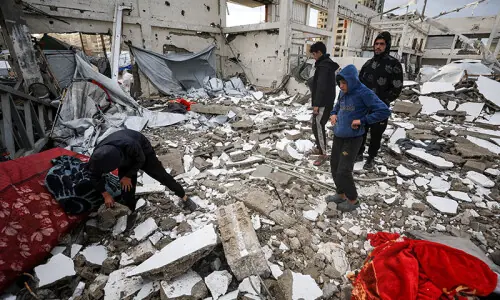
Since Israel and Hamas reached a ceasefire in October, Israel has retained control of 53pc of Gaza, where it has demolished many buildings and built military fortifications. Gaza’s more than 2 million residents are now largely confined to a remaining sliver of land along the coast under Hamas control, mostly in makeshift tents and damaged buildings.
Gaza’s reconstruction, beginning at Rafah, is a core element of Trump’s plan to end the war, but other major steps have yet to be agreed, including the disarmament of Hamas and Israeli withdrawal.
Trump’s plan is being managed by his Board of Peace, a group of international leaders that oversees a Gaza-specific body made up of officials and businessmen and a Palestinian technocratic committee meant to assume governance of Gaza from Hamas.
The UAE last week pledged $1.2 billion for Gaza at a Board of Peace conference. Its plans to build the housing compound were not included in conference presentations on reconstruction.
A US official previously said that the UAE was coordinating with Washington, the Board of Peace and the Palestinian technocratic committee on the housing project.
The UAE has been one of the largest donors to Gaza since the war began in October 2023, providing almost $3 billion in assistance, according to its foreign minister. It has forged close relations with Israel after establishing ties in 2020 under a US-brokered accord.
More acceptable to Gazans
The Palestinian businessman with direct knowledge of the compound’s planning said MACC and the two Egyptian firms had been contracted by a large Egyptian company to carry out the project in Gaza. He declined to identify the Egyptian company, which he said would ultimately be paid by the UAE. No work has yet begun on the ground, in part because Israel has yet to approve the compound’s plans, he said.
A Western diplomat briefed on the project said contractors involved in the project had been scheduled to visit the work site earlier this month, but that it was unclear if the visit had taken place.
According to its website, MACC has built desalination plants, water-pumping stations, solar energy fields, bridges and buildings across Gaza and the West Bank with funding from partners including the World Bank and USAID.
Reham Owda, a Palestinian political analyst, said employing a Palestinian firm, rather than bringing in outside workers, would be “more acceptable to Gazans” because it would create jobs and take local culture into account. “It will gain wide acceptance because it will help solve the housing crisis, accelerate reconstruction, and employ Gaza’s workforce,” Owda said.
Published in Dawn, February 26th, 2026