US lawmakers warn of Trump’s ‘incoherent’ Iran war strategy after classified briefing
WASHINGTON: United States lawmakers from both parties raised concerns on Tuesday about the strategy and potential consequences of the US-Israeli war against Iran following a classified congressional briefing.
Democratic Senator Chris Murphy said the Trump administration’s plans for the war appear “incoherent and incomplete” following the two-hour closed-door briefing.
“So they are going to spend hundreds of billions of your taxpayer dollars, get a whole bunch of Americans killed, and a hardline regime — probably a MORE anti-American hardline regime — will still be in charge,” Murphy said on X following the briefing.
Murphy said he could not disclose classified information but that the plans discussed left him deeply concerned about the administration’s strategy.
He said the briefing suggested that destroying Iran’s nuclear weapons program is not among the listed war goals.
He also said regime change in Tehran is not part of the strategy, raising questions about what the administration ultimately hopes to achieve through the strikes.
According to Murphy, the briefing indicated the primary focus is targeting Iranian missiles, boats and drone factories.
“But the question that stumped them: what happens when you stop bombing and they restart production? They hinted at more bombing. Which is, of course, endless war,” he said.
Murphy also warned that officials did not present a clear plan for reopening the Strait of Hormuz after Iran disrupted the key global oil shipping route.
Democrats warn of troop deployment
Other Democrats expressed similar concerns following the closed-door briefing by senior officials, including Secretary of State Marco Rubio and Defense Secretary Pete Hegseth, about the joint attacks launched by the US and Israel on Iran on Feb 28.
Senator Richard Blumenthal said he left the briefing “dissatisfied and angry”, warning that the conflict could lead to the deployment of US ground troops in Iran.
“We seem to be on a path toward deploying American troops on the ground in Iran to accomplish any of the potential objectives,” Blumenthal told reporters.
Senator Elizabeth Warren questioned the financial burden of the war, saying the government appears willing to spend massive sums on the military campaign.
“The one part that seems clear is that while there is no money for 15 million Americans who lost their healthcare, there’s a billion dollars a day to spend on bombing Iran,” Warren said.
Republicans also raise concerns
Some Republicans have also voiced reservations about the war.
Senator Rand Paul said he doesn’t think there was an “imminent threat” of attack from Iran.
“We’re also told we’re going to free the oppressed people of Iran. I hope and wish for them to have freedom, but if our foreign policy is to free oppressed people, the wars would never end,” Paul said. “I’m going to continue to advocate for the Donald Trump who didn’t advocate for regime change.”
Representative Nancy Mace of South Carolina also warned against sending American troops into another Middle East conflict, saying she does “not want to send South Carolina’s sons and daughters into war with Iran”.
Her remarks came as South Carolina Senator Lindsey Graham said he is asking South Carolina to send its “sons and daughters” to the Middle East.
Tensions in the Middle East escalated after Israel and the US launched a joint attack on Iran on Feb 28 and to date have killed more than 1,200 people, including Ayatollah Ali Khamenei, who was the country’s supreme leader.
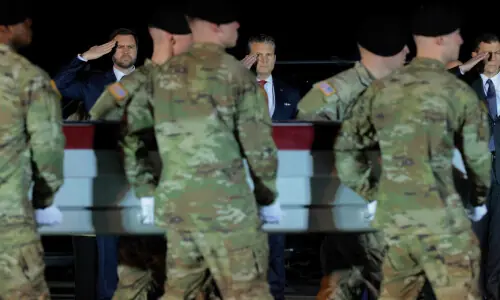
Around 140 US service members have been wounded over the first 10 days of the military campaign, with eight killed and eight severely injured, the Pentagon told Anadolu.