TEHRAN: While Iranian President Masoud Pezeshkian said on Sunday the talks between Iran and the United States, held with the support of regional countries, marked “a step forward”, Iranian Foreign Minister Abbas Araghchi said their military deployment could not scare Tehran.
“Dialogue has always been our strategy for achieving peaceful solutions,” Pezeshkian wrote on X, while stressing that Iran’s approach to the nuclear issue is based on “the rights guaranteed under the Non-Proliferation Treaty”.
The Iranian president added that the nation “responds to respect with respect but does not accept the language of force”.
Also, Iranian Foreign Minister Abbas Araghchi while addressing a forum in Tehran on Sunday asserted, “No one has the right to dictate” Iran’s behaviour regarding its nuclear programme.
Pezeshkian calls talks ‘a step forward’; Araghchi warns against ‘language of force’
“Their military deployment in the region does not scare us,” the foreign minister said.
“Why do we insist so much on enrichment and refuse to give it up, even if a war is imposed on us? Because no one has the right to dictate our behaviour.”
The minister’s comments came after lead US negotiators Steve Witkoff and Jared Kushner visited the recently deployed nuclear-powered USS Abraham Lincoln aircraft carrier in the Arabian Sea on Saturday. Witkoff late said on social media that the strike group was “keeping us safe and upholding President Trump’s message of peace through strength”.
Earlier on Friday, US and Iranian officials held indirect negotiations in Oman. Araghchi acknowledged that while an opportunity arose to “shake hands”, Tehran has little trust in Washington and questions their seriousness, as fresh sanctions on Iran were announced by the US. He said Iran wanted the US to remove sanctions in return for “confidence-building measures” on the nuclear programme.
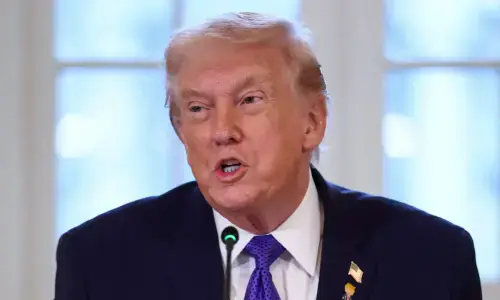
Following the talks, Trump signed an executive order imposing tariffs on countries doing business with Iran and announced new sanctions against shipping entities to curb oil exports.
Araghchi criticised these moves, warning that “the continuation of certain sanctions and military actions raise doubts” about genuine negotiations. He emphasised that Iran’s ballistic missile programme remains “never negotiable” because it is a defensive issue, a stance that conflicts with demands from Israeli Prime Minister Benjamin Netanyahu.
Netanyahu, who is scheduled to meet Trump in Washington on Wednesday, insists that any agreement must limit Iran’s missile capabilities and its support for regional armed groups.
Araghchi stated that Tehran is closely monitoring US signals before deciding on the continuation of talks.
Amid the standoff, Iran said it was consulting with strategic partners, including Russia and China. According to Global Times, Chinese Vice Foreign Minister Miao Deyu and Iranian Deputy Foreign Minister Kazem Gharibabadi met in Beijing to discuss the regional situation.
Gharibabadi emphasised Iran’s commitment to resolving issues diplomatically while opposing external pressures and acknowledging China’s role in maintaining regional peace.
Miao affirmed China’s support for Iran’s sovereignty, opposing unilateral bullying, and expressed readiness to enhance cooperation and uphold international fairness, according to the Chinese foreign ministry.
Published in Dawn, February 9th, 2026