0
0
PESHAWAR: The Khyber Pakhtunkhwa government has increased the annual budget of higher education department from Rs1.9 billion to Rs10 billion to improve the standard of education in the province.
The secretary of higher education department, Kamran Afridi, told a ceremony here the other day that several universities were operating without permanent vice-chancellors when he assumed the office but now the recruitment process was reduced from two years to just two months.
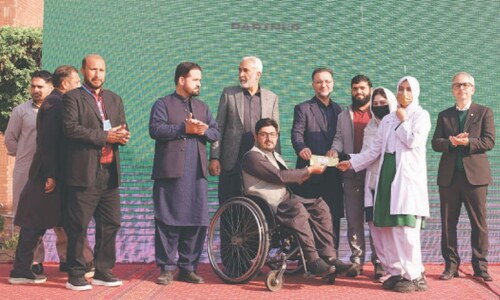
According to a press release, the ceremony was organised by Quality Enhancement Cell (QEC) of Khyber Medical University (KMU) to confer awards on best performing public and private medical, dental, nursing and allied health colleges.
Mr Afridi praised KMU’s quality assurance model, describing it as a benchmark for all universities in Khyber Pakhtunkhwa. He said that KMU had set an exemplary standard in the province and its clear, systematic and transparent quality assurance mechanism had significantly enhanced the overall standard of medical and allied health education.
Ceremony held at KMU to give awards to medical, dental, nursing and allied health colleges
He said that higher education department considered KMU’s model a guiding framework for other universities and would continue to extend full support to strengthen the system. He added that a dedicated QAC had been established at the department to monitor and evaluate performance of all higher education institutions in the province. “It has brought noticeable improvement in academic and administrative standards,” he added.
Mr Afridi said that government would introduce a fully funded, one-year paid internship programme for all new graduates from next year.
The director of QEC, Dr Syeda Asiyah Bukhari, presented annual quality performance report of various institutions in line with Higher Education Commission’s indicators and evaluation standards.
KMU Vice-chancellor Prof Ziaul Haq said that the university aligned its academic, research and institutional quality standards with modern global requirements through a comprehensive quality assurance framework.
He said that KMU provided a robust, transparent and well-structured quality assurance model not only for its constituent institutes but also for all affiliated medical, dental, nursing and allied health institutions.
At the conclusion of the ceremony, quality assurance awards were presented to best performing public and private medical, dental, nursing and allied health institutions. The best teacher awards were also distributed among faculty members of KMU’s constituent institutes while appreciation certificates were awarded to QEC staff.
Published in Dawn, November 29th, 2025