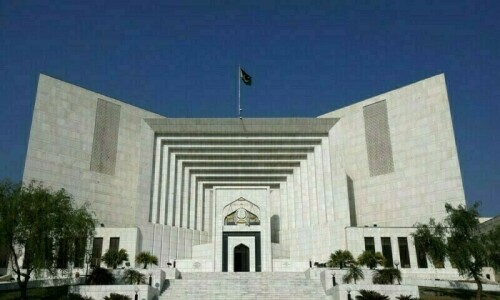
PA speaker, chief secy issued notices on pleas challenging constitutional benches ordinance

KARACHI: The Sindh High Court on Wednesday issued notices to the speaker of the provincial assembly, who is currently acting governor of the province, the chief secretary and law secretary on two identical petitions impugning a recently promulgated ordinance empowering the constitutional benches (CBs) of the high court with exclusive jurisdiction over constitutional matters under Article 199.
A two-judge CB comprising Justice Adnan Iqbal Chaudhry and Justice Muhammad Jaffer Raza also put the advocate general on notice for Nov 27.
The bench took up both the petitions for hearing after overruling various objections raised by the office of the SHC registrar.
Two practicing lawyers — Barrister Ali Tahir and Advocate Mohammad Arshad — have petitioned the SHC and asked it to strike down the Constitutional Benches of High Court of Sindh (Practice and Procedure) Ordinance on the grounds that it has transgressed constitutional limits, exceeded the legislative competence of the provincial assembly and violated the guarantees of judicial independence.
SHC removes office objections; rules petitions filed in public interest to question vires of ordinance promulgated by acting governor
Barrister Tahir has made the province through the Sindh chief secretary and law secretary respondents while Advocate Arshad has cited law department, the Sindh governor and speaker of the provincial assembly as respondents.
Replying to one of the office objections to impugn the ordinance in constitutional jurisdiction, the petitioners argued that vires of an ordinance can be examined under Article 199 of the Constitution. The bench accepted the replies and overruled the objection.
About another objection regarding making the governor a party despite his immunity given in Article 248 of the Constitution, the bench also overruled it. However, it did not issue a notice to the governor.
The bench in its order stated that the petitions were brought in the public interest by lawyers to question the vires of the ordinance recently promulgated by the acting governor.
The counsel for the petitioners submitted inter alia that Section 6 of the Ordinance which declares refusal by a judge to accept nomination to the constitutional bench will “prima facie amount to misconduct” was beyond the legislative competence of the provincial assembly and consequently the governor, so also ultra vires Articles 202-A and 209 of the Constitution of Pakistan, it added.
The bench stated that the lawyers pointed out that Article 128 of the Constitution envisaged that the power of the governor to promulgate an ordinance was not a substitute for an act of the provincial assembly and was to be exercised in matters involving urgency.
Noting that the points raised required consideration, the bench issued notices to the respondents, except the governor, for Nov 27.
The petitioners submitted that the promulgation of the impugned ordinance had caused a significant intervention in administration and adjudication of constitutional matters within the SHC by the executive.
They contended that the acting governor had promulgated the impugned ordinance independently without the advice of the chief minister and his cabinet rendering the promulgation a grave violation of Article 105 of the Constitution.
They argued that the impugned ordinance had effectively ousted the jurisdiction of other benches (regular benches) of the SHC and it was not a matter of procedure but of substantive judicial power which was only the prerogative of Constitution and not of subordinate legislation.
Published in Dawn, November 20th, 2025