Rawat Fort: a forgotten caravanserai crumbling under neglect

Around 17 kilometres from Rawalpindi, the more than 400-year-old caravan serai, commonly known as Rawat Fort, tells the stories of past battles fought between the emperors of Delhi and their enemies.
Nestled between residential and commercial buildings, the fort or caravanserai has been largely neglected by the federal Archaeology and Museum Department, while the Punjab government is reluctant to preserve the site, claiming it falls under the federal capital area.
According to the Gazetteer of the Rawalpindi District 1893–94, Rawat, the first camping ground from Rawalpindi on the Grand Trunk Road towards Jhelum, “owes its interest to the tomb of Sultan Sarang Khan, the renowned Gakhar chief, which is situated there.”
This is not a tomb of any architectural pretension nor of great antiquity, having been built in the middle of the 16th century after the death of Sultan Sarang and no fewer than 16 of his sons in action during the struggles between Emperor Humayun and his enemies.
The Stupa of Manikiala is visible from the fort, about three miles to the southeast.

It may be mentioned that Sultan Sarang helped Emperor Babur, and for this service, in 1525, the emperor gave him the estate of Potohar. However, when Sher Shah Suri drove Emperor Humayun from India, Sultan Sarang created problems for Sher Shah Suri, who then constructed the Rohtas Fort, where he placed a garrison of 12,000 men under his general, Khawas Khan.
According to officials from the Archaeology and Museum Department, Rawat Fort was a caravanserai built along the Grand Trunk Road for the convenience of travellers and government officials.
The fortress is also curiously associated with the name of Masud, son of the famous Mahmud of Ghazna (1039 AD), who was said to have been arrested by his rebellious soldiers and eventually murdered in the fort of Giri near Taxila.
It is also associated with the famous Gakhar chief Sarang Khan, who fell with his sixteen sons fighting against Islam Shah Suri, son of Sher Shah Suri and is buried within the precincts of the monument.
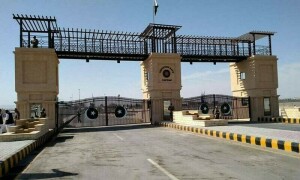
The fortress contains three gateways on the east, north and south, and a three-domed mosque in the middle of the western wing with an octagonal, single-domed mausoleum on the northwestern corner, partly obstructing the frontage of the mosque and numerous scattered graves inside.

There are regular rows of identical living cells along the four sides of the quadrangular inner face of the defence walls overlooking the inner courtyard. Inside the fort are a quadrangle tomb, one collapsed complex, a mosque and a few graves.
The caravanserai follows the pattern of the Persian rebat, which was common between the 8th and 12th centuries, with two tall gates for the entrance and exit of heavily laden camels and other animals. Towers at the corners and at intervals along the curtain walls conveyed a powerful and forbidding impression.
The fortress complex included living quarters and courtyards for women and men, while a spring well in the main courtyard provided water for animals and visitors.

There is also evidence of the presence of a hamam. However, the main gate of the fortress has vanished, and the department has installed iron gates. The defence wall is intact, but the stairs leading to the top are closed.
The site today has been heavily encroached upon by villagers, some of whom have dismantled older structures and reused the medieval bricks for their cemented homes.

The mosque, which is still used as the area’s Jamia Masjid, originally had three main rooms connected by arches. However, small modern changes have altered the structure, and the old tile flooring has disappeared.
“The courtyard of the mosque has expanded due to the increasing population of the area. During Friday and Eid prayers, most residents of the area and adjoining villages offer their prayers here,” said Abdul Rasheed, a shopkeeper adjacent to Rawat Fort.
He said he had heard the history of the Qila, as locals call it. “British authorities also used the building, but it was abandoned after the partition of the subcontinent,” he said.

However, a senior official of the Archaeology and Museum Department said the federal government had allocated funds to preserve the site, as it had already been declared a national heritage to protect it from encroachments.
Published in Dawn, November 17th, 2025