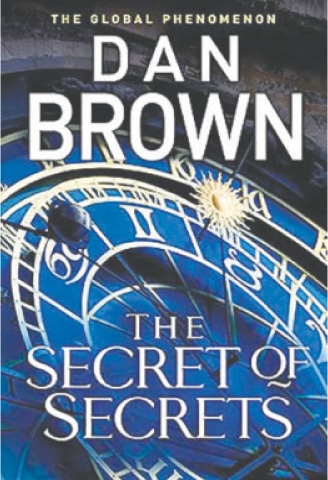
The Secret of Secrets
By Dan Brown
Penguin Random House
ISBN: 978-1787634558
704pp.
It is always exciting when a major bestselling author comes up with a new book, and the case of Dan Brown’s The Secret of Secrets is no exception.
Having rocketed to fame with The Da Vinci Code over two decades ago, Brown’s subsequent books, though formulaic, enable one to experience the further adventures of his brilliant and quick-thinking protagonist, Robert Langdon.
An internationally renowned symbologist and professor at Harvard, Langdon meets with his close friend Katherine Solomon in Prague, where the latter is keynote speaker at a conference on noetics (the study of the intellect and pure thought). Although a rigorously trained scientist, Katherine had made notable strides in exploring the field of mental consciousness, with special respect to the significance of out-of-body experiences.
Katherine believes that thought and imagination do not have their origins within our brains; rather, the 87 billion neurons of the brain receive influences from all around us, which are then processed by the mind into ideas, feelings, dreams etc.
Symbols, mystery and thrills — Dan Brown’s latest novel has two academics and lovers encountering all kinds of trouble as they run for their lives and try to save a book of research
I should note at this point that Brown describes Prague in so much detail and with so much familiarity that his novel will do more for the tourism industry there than a hundred books on Czech tourism might! Hotels, museums, parks, bridges and the general landscape are all delineated in vivid detail. In one memorable scene early in the book, Langdon even leaps into the River Vltava for an impromptu swim. This move arises because Katherine has produced a manuscript on her research findings, which results in her life as well as Robert Landon’s being endangered.
Powerful entities, for reasons that are unclear for the first two-thirds of the book, seek to destroy all extant copies of the manuscript. Her editor at the New York branch of Penguin Random House (PRH), Jonas Faukman (an anagram of Dan Brown’s own editor, Jason Kaufman), is horrified to find that the servers of the PRH firm have been hacked into and every copy of the book has been deleted!
Katherine had been invited to the Czech capital at the request of a respected scientist, Dr Birgita Gessner. Much to Langdon’s chagrin, Katherine disappears after setting out to meet Gessner for a breakfast meeting. It turns out that Gessner has been murdered for complex reasons, chief of which relates to a mysterious underground facility located beneath Prague’s Folimanka Park. The chivalrous and heroic Langdon loses no time in trying to figure out what has happened to Katherine, with whom he has gradually fallen in love.
Unlike Gessner, Katherine is fortunately found to be alive, but that doesn’t prevent the hero and heroine from being hotly pursued and hounded, first by the Czech Office of Foreign Relations and Information (USZI) and then the CIA itself!
To make things more interesting, Brown introduces a golem-like figure (traditionally, in Judaic lore, a golem was an artificial man, constructed from clay) who wafts in and out of the novel. Given its somewhat destructive actions, one is tricked into believing that the golem is the villain of the piece; however, the reality of the matter is far more complex.
The US ambassador’s residence in Prague — known as Petschek Villa — is a palatial Beaux Arts chateau whose French architectural grandeur inspired its local nickname, Le Petit Versailles. Built for Otto Petschek, a wealthy Jewish industrialist whose family was driven out of Prague by Nazi occupation, Petschek Villa was overrun and inhabited by the armies of both the Nazis and the Russians. A touchstone of history, the villa now stands as an iconic landmark to the region’s dark history of occupation, oppression and genocide. After Hitler declared his intention to turn Prague into a “museum of an extinct race”, Petschek Villa was selected as a “trophy case” for Nazi triumph. — Excerpt from the novel
Why the CIA would be interested in destroying copies of an academic manuscript is the mystery at the crux of the novel, and I will refrain from giving away key elements of the plot at this point. Suffice to say that Katherine’s ongoing research dovetails with certain advanced technology that the CIA intends to use for the purposes of national security. Public dissemination of that knowledge is simply not something that the Agency considers to be in its best interests.
Langdon eventually locates Katherine and figures out the sinister agenda of those who have created a highly sophisticated lab beneath Folimanka Park. Obviously, the US Embassy also gets involved in the affair, since both Langdon and Katherine are US citizens on foreign soil. However, the embassy comes across as rather inept when juxtaposed alongside the intrepid and enterprising Langdon. Fortunately, the real villain of the piece gets his just desserts in a very satisfactory manner.
The pace of Dan Brown’s writing never flags and his book is plotted in a way that is pitch-perfect when it comes to structure. In spite of being a hefty tome of over 600 pages, the book is a surprisingly brisk read. There are some glaring plot holes, however. It is utterly implausible to assume that, decades ago, Katherine’s dissertation supervisor, on finding out that a patent application for her brilliant theories was denied, would not simply have told her to publish her thesis and obtain a copyright for her work. This would have acted as insurance for her speculations at a very early stage in her career.
Even more implausible is the fact that, as Langdon and Katherine race around the underground facility, not a single camera appears to be tracking them! Given that the Folimanka Park location is a nexus of highly classified US military intelligence, this glaring omission is ludicrous at best and thematically inexcusable at worst.
Equally surprising is the degree to which the CIA director himself is largely clueless about what has been happening in Prague for decades. Finally, the fact that virtually all other governments and secret service agencies are unaware of what the US has been engaged in on Prague soil is something that even the most gullible readers would find hard to swallow — especially since the golem-figure runs around protecting a young Russian woman who has been subjected to unethical experiments without her consent.
Phillips Exeter Academy is mentioned on more than one occasion (which is understandable, since Brown is a loyal alumnus and benefactor of that elite school), but not a single secret service agency other than the CIA makes an appearance in the novel. Brief references are made though to Jeff Bezos, Bill Gates, Elon Musk and even Adolf Hitler. Dan Brown’s priorities are nothing if not confusing at times!
However, fans of Dan Brown’s novels seek adventurous thrills more than accuracy, and there are plenty of the former in The Secret of Secrets. Langdon is a very likeable protagonist and reading his latest adventures gives one a sense of pleasantly encountering a good friend whom one has not met for a while.
The author should also be given credit for enabling his audience to visualise the world as it might potentially be in the future. A novel relies on the power of its creator’s imagination, and Dan Brown has proved time and time again that he has an especially fine mind when it comes to writing books that offer us sheer entertainment.
The reviewer is associate professor of social sciences and liberal arts at the Institute of Business Administration. She has authored two collections of short stories, Timeless College Tales and Perennial College Tales, and a play,
The Political Chess King
Published in Dawn, Books & Authors, November 2nd, 2025