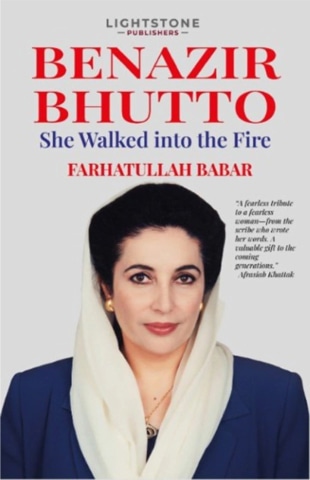
Benazir Bhutto — She Walked into the Fire
By Farhatullah Babar
Lightstone Publishers
ISBN: 978-9697-163496
331pp.
In Pakistan, political memory is crowded with ghosts, but few politicians are invoked as frequently — or as selectively — as Benazir Bhutto. She is remembered through slogans, anniversaries and elegies, yet is often stripped of the complexity that made her formidable and fragile at the same time.
Farhatullah Babar’s Benazir Bhutto — She Walked into the Fire attempts to restore that complexity. It is neither a conventional biography nor a detached academic study. Instead, it offers something rarer when it comes to Pakistani political writing: a reflective insider’s account by a man who did not merely observe power, but helped give it a public voice.
Babar’s proximity to Bhutto is extremely important. As her speechwriter and spokesperson, he occupied the narrow space between private doubt and public resolve. His 330-page book — divided into 51 short chapters — recreates the tension that was rampant in her life.
The book’s structure favours momentum over monumentality. It suggests that Bhutto’s life was lived less as a single arc and more as a succession of abrupt turns, be they dismissal, exile, return, negotiation or betrayal. The book presents itself as a fearless tribute, and in many ways, it is exactly that. Yet, its fearlessness lies less in its praise rather than in its willingness to describe how power actually works in Pakistan: informally, asymmetrically and often humiliatingly for those who hold constitutional office.
Babar does not claim detachment and his admiration for Bhutto is evident. However, he is seasoned enough to recognise that reverence alone cannot explain why her career unfolded as it did — or why it ended the way it did. The most revealing passages appear midway through the book, particularly between Chapters 10 and 15, where Babar abandons the safety of retrospective narrative and reconstructs moments of political foreknowledge.
Farhatullah Babar’s reflective, insider account of Benazir Bhutto’s life and politics corrects the twin caricatures that dominate her legacy and describes how power actually works in Pakistan
One episode, set in November 1996, captures the peculiar inversion of authority that has long defined Pakistan’s civilian politics. Bhutto, then prime minister, learns of her impending dismissal not through formal channels but from a journalist. The constitutional drama that would soon unseat her government had already slipped beyond the institutions meant to contain it. Information travelled sideways before it travelled upwards, as it often does in Pakistan.
This episode is not presented theatrically and Babar lets the moment speak for itself. Its significance lies not in shock value but in what it reveals about governance in a system where elected leaders are often the last to know when decisions about their fate have already been made. Dismissal in this instance is not an event; it is a leak.
Another chapter ventures into territory that many political writers would either sanitise or ridicule. Babar reveals Bhutto’s habit to consult mystics and spiritual intermediaries often, revealing a leader who, despite her Western education and modernist rhetoric, placed faith in non-rational forms of guidance. The temptation to dismiss this as an eccentricity is avoided. Instead, Babar frames it as a response to chronic uncertainty.
When institutions fail repeatedly, when conspiracies are not merely imagined but palpably experienced, the search for reassurance can assume unconventional forms. In this account, Bhutto’s engagement with the occult is not seen as a contradiction of her politics, but as an extension of her vulnerability.
These moments humanise Bhutto without trivialising her. They portray a leader who bore the weight of expectations. She navigated a political environment that did not provide predictability or protection. By doing so, the book corrects the twin caricatures that dominate her legacy: the sainted martyr on the one hand, the entitled aristocrat on the other, and Babar opines that neither image is sufficient.
The book’s most politically consequential sections, however, focus on Bhutto’s prolonged exile after the 1999 military takeover by Gen Pervez Musharraf. Chapters 12 to 15 describe how, in the aftermath of September 11, Pakistan’s internal power struggles became entangled with global security priorities. Babar recounts how messages were conveyed to Bhutto in late 2001 through American channels: cooperation with Pervez Musharraf was a prerequisite for an early return; refusal would result in prolonged exclusion.
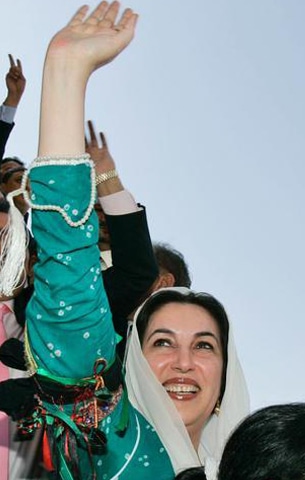
These chapters are unsettling precisely because of their restraint. There are no melodramatic accusations, no grand declarations of foreign conspiracy. Instead, the reader is presented with cold, calculated logic. Bhutto’s political future was not being negotiated in parliament, but through informal understandings shaped by counterterrorism imperatives. Democracy, in this context, appears not as a principle but as a managed risk.
What emerges is a portrait of a leader constrained by both domestic and international forces. Bhutto’s choices were genuine, but they were also bound. To cooperate was to ensure legitimacy; to resist was to prolong irrelevance. Babar does not argue that foreign actors engineered Pakistan’s civil-military imbalance, but he demonstrates how comfortably they operated within it. The result was a narrowing of civilian space at precisely the moment when the return of democracy was most urgent.
The book’s style reinforces its arguments. Short chapters, crisp scenes and a refusal to linger too long on a single episode keep the narrative moving swiftly. This is not accidental. Babar seems intent on preventing Bhutto from being restricted to being a static symbol. Instead, she is shown to be perpetually in motion — negotiating, recalibrating, returning. Even her final homecoming in 2007 is not framed as an act of courage, but as a calculated gamble undertaken amid extraordinary pressure.
Critics may argue that the book tilts too much in favour of its subject. That is a fair concern. This is not a forensic audit of Bhutto’s governments, nor does it dwell extensively on allegations that continue to shadow her tenure… that is not the book’s purpose.
Under the leadership of Ameena Saiyid, Lightstone Publishers has made an important contribution to Pakistan’s intellectual discourse, by publishing serious, readable and timely books. The ambition and intent behind many of its recent publications are commendable. That said, the press — and readers — would benefit from greater attention to editorial rigour and production quality.
In Benazir Bhutto — She Walked into the Fire, a few avoidable errors detract from an otherwise valuable work. For instance, on page 51, it is stated that Khalid Naeem Hashmi and his friends were sentenced to public floggings under the regime of Gen Ziaul Haq. This is incorrect. It was Khawar Naeem Hashmi, not ‘Khalid’ Naeem Hashmi, who was publicly flogged during the Zia era. Such inaccuracies are not minor slips; they involve real individuals and well-documented episodes of political repression, and therefore required careful verification.
Finally, there are other factual slips that should have been caught. On page 191, the last line states that Benazir Bhutto’s first government was dismissed “just 30 months into office.” This is clearly an error; the correct figure is 20 months. Errors of this kind momentarily undermine the reader’s confidence in the text, especially in a book that otherwise seeks to establish historical credibility.
There are also formatting and proofreading issues that could easily have been corrected at the copy-editing stage. For example, on page 72, words run together without proper spacing, a problem that reappears on page 90. These may seem like small issues, but repeated typographical errors interrupt the reading experience and give an impression of haste. The handling of photographs is another area that needs reconsideration. The images included are of poor quality, resembling newspaper reproductions rather than book-grade printing. A publisher must make a clear choice: either omit photographs altogether or invest in better paper and printing, at least for the photo sections, so that they enhance rather than diminish the book’s overall presentation.
None of these issues diminish the importance of the book or the seriousness of its intent. But, together, they point to the need for better editing, fact-checking and production standards. Given Lightstone’s growing role in shaping contemporary Pakistan’s non-fiction ecosystem, such improvements would significantly enhance the impact and longevity of its publications.
The reviewer is a columnist and educator. He can be reached at mnazir1964@yahoo.co.uk
Published in Dawn, Books & Authors, March 8th, 2026