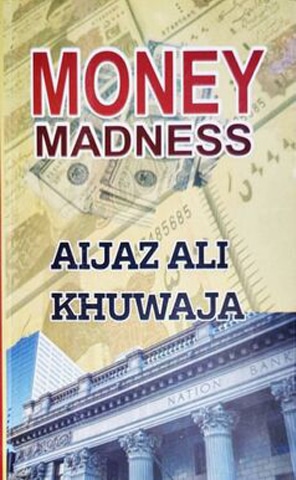
Money Madness
By Aijaz Ali Khuwaja
Kanwal Publications
ISBN: 978-969-2252-85-0
256pp.
Aijaz Ali Khuwaja has written a number of non-fiction books and Money Madness marks his debut in fiction. It is always a pleasure to see a Pakistani author enter the field of creative writing, as stories by Pakistani writers definitely deserve to be told — and read.
Money Madness unfolds across two main storylines over two time periods. Parts one and three focus on a contemporary money fraud, while part two, which is the longest, centres on a love story set during Gen Zia’s era. The common factors in the two narratives are four friends — the main characters — and money, ethnicity and provincialism, drive the narrative of the novel.
We are not told much about the four friends other than the fact that they hail from small towns or villages in Sindh, their various occupations as well as that three are Muslim and one is a Hindu. Three of them are married and the unmarried one is the protagonist of the love story. Unfortunately, their characters are not fleshed out and they remain one-dimensional. Their family members are even less developed, they are mere shadows in the background, who, at best, are mentioned when tea is sometimes served.
The novel opens with one of the four friends, Akbar, in serious trouble. A large sum of money has been deposited into his bank account without his knowledge. He is neither well-off nor well-educated, so he calls upon his friends for help. It is heartening to see the other three friends rally round him at once. They conclude that he has been targeted by a money-laundering outfit and set out to help him. Parts one and three delineate the complications faced by the friends in their attempts to extricate Akbar from financial entrapment.
A debut novel has a strong idea spanning two plot lines and two time periods but desperately needed a strong editor as well
Sadly, the reader does not identify with the four young men in any meaningful manner. They are just names on paper. They do not evoke sympathy, nor do their predicaments arouse concern. In fact, all the characters are lacklustre and quite unmemorable. It is not even particularly interesting when the author resurrects Akbar’s dead parents and alludes to them several times as if they are alive.
Part two tells the love story of two college students in Hyderabad. The male, Mubashar, is one of the novel’s four protagonists and an ethnic Sindhi and the girl is Mohajir. It will not be a spoiler to mention that the romance does not prosper, as the author reveals this early in the book. The problem, however, are the author’s sweeping generalisations.
For example, Khuwaja contends that Mohajirs left their homes and possessions in India and migrated to Pakistan in 1947 in pursuit of money. He states that they were warmly welcomed by Sindhis and even given homes and land, but their greed for money was not assuaged. He also laments that, during Partition, ethnic Sindhi Hindus were encouraged to leave because religion was given priority over ethnicity at that time. All the later ills faced by the province, in his view, are traceable to this mistake.
Apart from the cross-cultural romance, communal strife and violence and the deadly rivalry between political parties during the Zia regime dominate part two of the novel. Khuwaja paints a picture of uncertainty and danger vividly. Universities are closed for months; hundreds of people die in street violence. Yet, these conditions are not considered reason enough for Mubashar’s beloved and her family to flee the country. The girl is depicted as a culprit in this tale of love: it is only because she and her Mohajir family migrate westwards, allegedly in search of even more wealth that poor Mubashar’s heart is broken. Money madness in action!
Khuwaja uses the book to air his views on a variety of subjects. He gives long lectures on Partition, the slums of Karachi, including Jati near the coast of Sindh, and even Pakhtun tea sellers. These harangues break the flow of the story. They are also repetitive and not necessarily accurate; for example, Karachi is called the most populous city in the world.
The Indus River plays a significant role in the novel as well. The loss of its past glory is mourned, and provincial politics are blamed. In the same vein, the author believes that the birthplace of Mohammad Ali Jinnah has been changed from Jherruk to Karachi because of a conspiracy targeting rural Sindh. Incidentally, he calls the house known as Jinnah’s family home in Karachi ‘Liaquat Mansion’ rather than ‘Wazir Mansion.’
The novel is not tightly constructed. Too many unnecessary details divert the reader’s attention from the actual narrative. When Mubashar is called back to the village by his father, all the logistics of his journey from Hyderabad, including travel times, are detailed. Since the trip passes uneventfully and the travel information does not advance the story in any way, it is quite unnecessary.
Money Madness is not an easy read. The editing is subpar, with errors in syntax, tense and word order creating constant roadblocks in the smooth perusal of the novel. Paragraphing is often erratic, with pages consisting of single-line paragraphs. The vocabulary is also not the best. People go to college to “study MBBS”, a “cousin aunt” cooks and the beauty of the “evening season” is extolled.
The idea of a novel spanning two plot lines and two time periods is a strong one. A thrilling yarn about financial shenanigans and youthful romance never fails to interest readers. And Khuwaja is to be complimented on his choice of subject matter — it would be interesting to see what tales he weaves in his next novel. However, he needs to ensure better literary editing, which would eliminate repetitions, digressions and grammatical mistakes, so that the story’s integrity remains intact.
The reviewer is a freelance writer, author of the novel The Tea Trolley and the translator of Toofan Se Pehlay: Safar-i-Europe Ki Diary
Published in Dawn, Books & Authors, March 8th, 2026