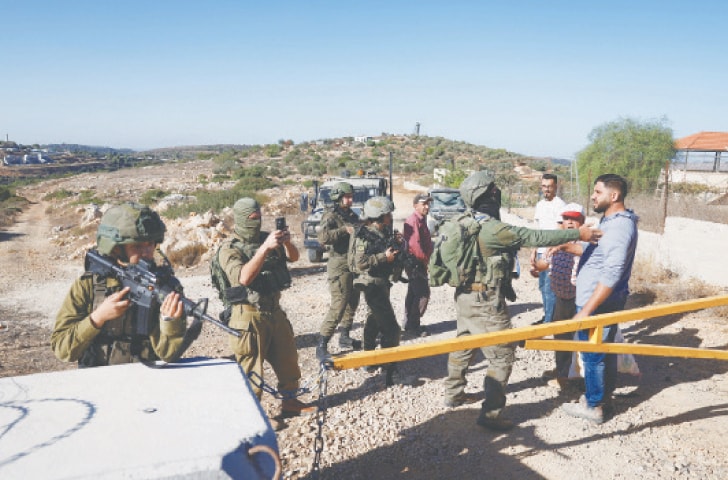
TURMUS AYYA: The scene shocked many and highlighted the violence of this year’s olive harvest in the Israeli-occupied West Bank: a young masked man clubs an older Palestinian woman picking olives, who then collapses on the ground.
The incident during an attack by Israeli settlers, filmed by an American journalist, took place in the town of Turmus Ayya near Ramallah, a hotspot of violence this year.
“Everybody was fleeing because the settlers attacked suddenly, maybe 100 of them,” witness Yasser Alkam said, adding that one Swedish activist also had his arm and leg broken by settlers.
Alkam, a Turmus Ayya city official, said that the woman, 55-year-old Um Saleh Abu Aliya, was struck as she was waiting for her son to drive her away from a mob of settlers.
“Fighting back would only bring more violence, sometimes with the army’s backing,” lamented Nael al-Qouq, a Turmus Ayya farmer who was prevented from reaching his olive trees that same day.
Expanded settlements
Not far from the scene, an Israeli flag flapped in the wind at a settlement outpost, illegal even under Israeli law.
The army eventually arrived in Turmus Ayya and dispersed the crowd with tear gas, a journalist witnessed. But not before the youths who descended on the village burned at least two cars.
The head of the West Bank’s Israeli police, Moshe Pinchi, told his district commanders to find the man who attacked Abu Aliya, according to a leaked WhatsApp message reported by Israeli media.
The Israeli army said that it “works in coordination with the Israel Police to enforce the law concerning Israelis involved in such incidents”. But Turmus Ayya is far from an isolated case, and journalists have witnessed at least six different instances of Palestinians being denied access to their land, attacked by settlers, or being victims of vandalism during the 2025 olive harvest.
Clashes in rural areas reached new heights this year, prompted by ever-expanding Israeli settlements and a growing number of settlers — not all of whom engage in violence against Palestinians.
More than 500,000 Israelis live in settlements in the West Bank, which Israel has occupied since 1967. All settlements in the West Bank are illegal under international law.
Near Turmus Ayya, in the village of Al-Mughayyir, one villager was prevented from harvesting altogether.
“I own ten dunams (one hectare) of olives. All I have left are the olive trees in the garden of the house ... They uprooted it all,” Abdul Latif Abu Aliya, 55, said. Abu Aliya’s land borders a road on the other side of which three trailers make up a recently-installed settlement outpost.
After a settler was injured during an altercation near Abu Aliya’s house, an army order called for the trees his father and grandfather planted to be uprooted. Bulldozers then pushed mounds of soil and roots halfway up the field and 100 metres from the family house, making a barrier that Abu Aliya and his family do not cross for fear of being attacked by settlers.
Faced with unprecedented violence during this year’s olive season, the Palestinian Authority’s agriculture minister called for the international community to protect farmers and pickers.
“It’s the worst season in the last 60 years,” Agriculture Minister Rizq Salimia told journalists, adding that this year’s crop was already bad due to poor climate.
Ajith Sunghay, head of the UN’s Human Rights Office in the Palestinian territories, condemned “severe attacks” during this year’s harvest and deplored “dangerous levels of impunity” for perpetrators.
The annual harvest, once a peaceful gathering for the occupied West Bank’s families, has in recent years turned into a series of increasingly violent confrontations involving Israeli settlers, troops, Palestinian harvesters and foreign activists.
Identity marker
The season began in October and will last until mid-November, as Palestinians across the West Bank harvest olives from trees they see as deeply connected to their national identity.
The West Bank boasts over eight million olive trees for three million Palestinians, according to the agriculture ministry’s 2021 census.
Every autumn, Palestinians farmers, but also city folk whose families own a few trees, head out into the fields to pick olives, mostly by hand.
The UN’s humanitarian agency, OCHA, said that 27 West Bank villages were affected by harvest-related attacks in the week of Oct 7 to 13 alone. “The incidents included attacks on harvesters, theft of crops and harvesting equipment, and vandalism of olive trees, resulting in casualties, property damage, or both,” OCHA said.
Published in Dawn, October 26th, 2025