0
0
• Defence minister says even Afghan capital is ‘not a no-go area’
• Denies any ‘US urging’ behind Islamabad’s decision to carry out airstrikes
• Hopes ceasefire will allow resumption of Pak-Afghan trade
• China vows to continue constructive role for improvement of ties
• Russia calls for more counter-terror cooperation between Pakistan and Afghanistan
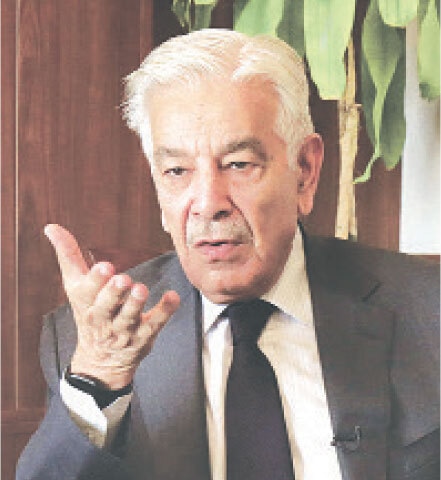
KARACHI: The ceasefire between Pakistan and Afghanistan hinges on the Afghan Taliban’s ability to rein in militants attacking Pakistan, Defence Minister Khawaja Asif said on Monday.
In remarks to Al Jazeera Arabic, the defence minister said that the primary objective of the ceasefire agreement was to eliminate the menace of terrorism.
However, he also told Reuters that the ceasefire rests on whether the ruling Afghan Taliban can rein in the terrorists from attacking across the shared border between the two countries, underscoring the fragility of the accord.
“Anything coming from Afghanistan will be [a] violation of this agreement,” he said, adding: “Everything hinges on this one clause.”
The two neighbouring countries agreed to a ceasefire in Doha over the weekend after days of border clashes that killed dozens, the worst such violence since the Taliban seized power in Kabul in 2021.
However, the Pak-Afghan border remains closed for trade and transit for the seventh consecutive day, leaving hundreds of loaded trucks and trailers carrying transit goods, fresh fruits, vegetables, and other commodities stranded on both sides.
Speaking to Al Jazeera Arabic, the minister seemed hopeful that the accord would allow the resumption of Pak-Afghan trade and transit activities, enabling the western neighbour to use Pakistan’s ports again.
In the written agreement signed by Pakistan, Afghanistan, Turkiye and Qatar, it was clearly spelled out that there would not be any incursions, the minister noted.
“We have a ceasefire agreement as long as there is no violation of the agreement which is already in force,” he said, although the Taliban regime did not comment on the claim.
The outlawed Tehreek-i-Taliban Pakistan (TTP) operates out of Afghanistan to attack Pakistan “in connivance” with the ruling Taliban, the minister said.
‘Kabul not a no-go area’
Islamabad has repeatedly called on Kabul to bar terrorist groups from using its territory to attack Pakistan. However, Kabul denies the allegations and claims Afghan soil is not used for attacks on neighbouring countries.
“We were being attacked. Our territory was being attacked. So we just did tit for tat. We were paying them in the same coin,” Mr Asif said.
“They are in Kabul. They are everywhere. Wherever they are we will attack them. Kabul is not, you know, a no-go area.”
The next round of talks would be held in Istanbul on October 25 to evolve a mechanism on how to enforce the agreement, he said.
Speaking to Al Jazeera Arabic, Mr Asif said that the Afghan defence minister had acknowledged terrorism as the main cause of tension in bilateral relations that will now be addressed.
“Pakistan has suffered immense human and financial losses over the past years.” However, he expressed hope that peace would now return and relations between Pakistan and Afghanistan would normalise.
The defence minister said the Afghan refugees holding valid visas and documents will be allowed to stay in Pakistan.
“However, a large number of undocumented refugees will continue to be repatriated,” he added.
Mr Asif said it is premature to claim full satisfaction over the resolution of all concerns. “We will have to see in the coming weeks and months how effectively the agreement is implemented.”
‘Absolutely not’
In a separate interview to Arab News, he ruled out the notion that Pakistan had conducted the airstrikes in Kabul on the urging of the United States, saying: “It is total nonsense and nothing else.”
He questioned why Pakistan would do so, saying the country had had enough of its involvement in Afghanistan for the past few decades.
“We want to stay away and live like decent neighbours. We don’t want to have any involvement in Afghan affairs,” Asif said, adding that Pakistan had “no business” in Afghanistan’s relationship with India or any other country.
“Absolutely not. Whatever they want to do in their own territory and doesn’t spill over to our territory, doesn’t become our business.”
International reactions
On Monday, China also welcomed the immediate ceasefire between Pakistan and Afghanistan, commending “the peace effort of countries who contributed to the ceasefire. China will continue playing a constructive role for the improvement and development of Pakistan-Afghanistan relations”.
Russia also joined the chorus, with Foreign Ministry spokeswoman Maria Zakharova saying Moscow welcomed “the agreement on a mutual ceasefire along the Afghan-Pakistani border”.
She argued that Islamabad and Kabul’s intention to engage in dialogue and resolve their disagreements through diplomatic means “forms the basis for maintaining peace between the two countries, which are friendly to us, and serves as an important factor in ensuring regional security.”
“We call on Kabul and Islamabad to expand their cooperation, including in countering terrorism,” she said.
Earlier, Saudi Arabia also welcomed the ceasefire, affirming its support for efforts aimed at promoting peace and stability between the two countries.
A statement posted on the Saudi foreign ministry’s X account said it welcomed “the establishment of mechanisms to consolidate lasting peace and stability between the two countries, during the round of negotiations held in Doha.”
“This kingdom hopes that this positive step will lead to an end to tensions on the border between the two countries,” the statement said.
A day earlier, Turkiye’s, Oman’s and Qatar’s foreign ministries had also issued statements welcoming the ceasefire.
It is interesting to note that while the Qatari Foreign Ministry’s initial statement referenced “tensions on the border” as a key issue addressed during the talks in Doha, it revised the language after objections from the Taliban, replacing the phrase with “tensions between the two brotherly countries.”
However, the Saudi statement stuck to the same language.
Published in Dawn, October 21st, 2025