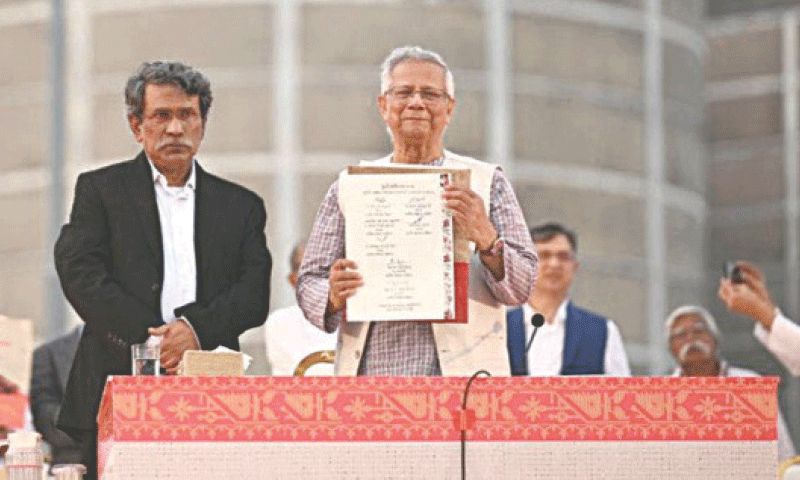

MOST of the political parties have signed the much-discussed and long-awaited July National Charter — a landmark document towards reshaping Bangladesh’s democracy and its institutions. A dream born out of last year’s student-led mass uprising. Thus, it is perhaps ironic that those who refuse to sign the charter include the National Citizen Party, the natural heir to the July uprising.
Formed in mid-February, the National Consensus Commission was tasked with reviewing and adopting proposals from six major reform bodies covering the constitution, judiciary, electoral system, Anti-Corruption Commission, and public administration.
It convened two rounds of dialogue with political parties and alliances to draft a reform charter, followed by a third round focused on its implementation. The parties reached a consensus on at least 84 issues, culminating in the July charter — half of which pertain directly to constitutional reform.
At its heart, the charter proposes sweeping changes: constitutional amendments, rebalancing executive authority between the president and the prime minister, reinstatement of the caretaker government, guarantee of electoral neutrality, judicial independence, and decentralisation, among others.
Without a clear implementation timeline, the July National Charter risks becoming yet another addition to archives of forgotten commissions
These are ambitious goals, signalling a bold attempt to reshape the foundations of governance. But therein lies the danger.
Without a clear implementation timeline, the charter risks becoming yet another addition to the archive of forgotten reports and unfulfilled promises. Bangladesh has seen this pattern before — commissions formed, plans drafted — only to be shelved, invoked in speeches, and ultimately ignored. In fact, history offers sobering reminders of missed opportunities.
On November 21, 1990, at the final stage of the anti-HM Ershad movement, three major alliances — the Awami League-led eight-party alliance, the BNP-led seven-party group, and a five-party leftist coalition — declared the Tin Joter Ruprekha (which roughly translates to “the tripartite roadmap”) from separate rallies.
That declaration called for the removal of the Ershad regime and the establishment of a democratic order rooted in the spirit of the Liberation War. It pledged to uphold fundamental rights, judicial independence, and the rule of law. It even proposed reforms to restore voter confidence and transform state-run media into autonomous platforms for fair political campaigning.
Yet, after Ershad’s fall and the restoration of democracy, most of these promises faded away. It was a year later in 1991, when Justice Shahabuddin Ahmed’s interim government set up 29 task forces under the leadership of planning adviser Rehman Sobhan. Over 250 of the brightest minds in Bangladesh worked together to provide detailed recommendations for policy reforms that could guide the newly elected government.
The task force reports were widely praised for their depth and practicality. Yet the effort was largely ignored by the next government. Fast forward to 2007, when the caretaker government led by Fakhruddin Ahmed sought to break that cycle. It established the Regulatory Reforms Commission (RRC) to modernise the country’s outdated governance, administrative, and economic frameworks. Chaired by Akbar Ali Khan, the commission submitted 153 recommendations.
But by October 2009, Khan had resigned, citing the Awami League government’s non-cooperation and withdrawal of staff. Only about a third of the proposals were ever implemented. At the time, the ruling party acted on just two.
The RRC’s 131-page report, published in 2009, still stands as a testament to unrealised reform — a carefully drafted roadmap that went largely unused. This time, following a mass uprising, hard-won agreements emerged against the backdrop of Bangladesh’s long and troubled history of failed political dialogue.
What makes the July charter different from earlier documents is that it emerged after extensive consultations with political parties across the spectrum. Through these discussions, the parties agreed on some of the most contentious reform issues that have plagued Bangladesh for decades.
Bangladesh now stands at a critical crossroads. Will the July charter become a living document, backed by deadlines and deliverables? Or will it be shelved only to gather dust like so many of its predecessors?
Published in Dawn, October 20th, 2025