Quest for a vision for national economic progress


In turbulent times, as facing the world today, historical record shows that ideas with a future become the most powerful tool to create a new economic and social order.
Currently, in Pakistan also one can notice an emerging segment of development economists, think tanks and political leaders, including those holding government positions, espousing some ideas to open up the path for national economic progress.
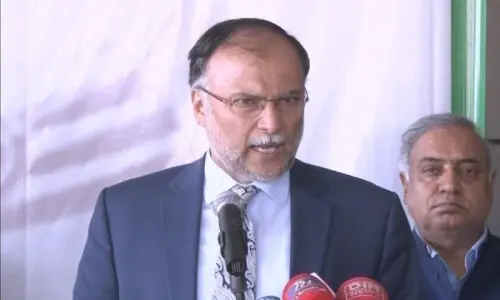
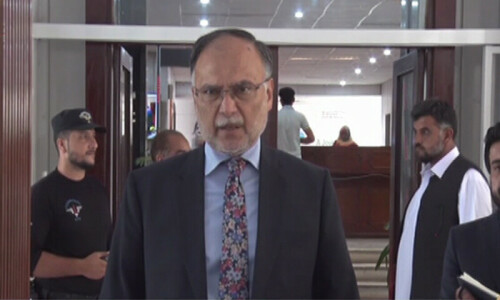
Noteworthy is a recent statement of the Federal Minister for Planning, Development and Special Initiatives Ahsan Iqbal: “Real power does not stem from wealth or weapons but from vision and disciplined execution.”
Speaking at the 25th Convention of Management Association of Pakistan, he observed, “Great nations are not built by financial capital but by management capital. Efficiency should replace excuses, data must replace opinions and teamwork must replace turf wars.”
Similar views are also expressed by some analysts. “Sustainable growth must be built on social justice, not merely fiscal arithmetic,” says analyst Asad Hayat, “Pakistan’s current situation calls for policies that place human welfare at the centre of economic recovery — policies that protect the poor, empower workers and build resilience against future shocks.”
Amid criticism for lack of substantial progress, the development minister insists that the planning commission is much more relevant in the present day
On Oct 10, the National Assembly is reported to have echoed with a demand that the erstwhile Federally Administered Tribal Areas, now merged with Khyber Pakhtunkhwa, must be brought at par with country’s other developed regions as the area’s backwardness provides room for terrorism.
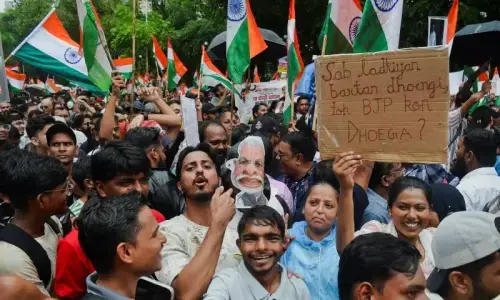
On the same day, it was reported that workers of Dasu hydropower project took to the streets for the second consecutive day and blocked the Karakorum Highway, demanding the release of their wages in line with labour laws.
A protestor, Mohammad Javed explained that the government recently issued a notification fixing the monthly wage for 26 working days at Rs40,000, however the workers have yet to receive this benefit.
Things cannot move in the right direction without a democratic set-up that gives citizens an effective voice in the country’s governance.
In an engaging session with management and business students, the planning minister lamented that Pakistan’s problem was not lack of talent or resources, but rather capital management; the ability to plan, execute and deliver holds the key to national progress.
However there are diverse views on how to pull the economy from the current situation. “Only through scientific knowledge can a country move forward,” said Dr Sikander Moghul, at the launch of his two Sindhi-language books at the Arts Council of Pakistan, Karachi on Oct 21.
The takeaway from the event, a press report says, was that scientific inquiry and research is essential for progress, innovation and for understanding of the world.
A basic question, certain critics ask, is as to whether the Planning Commission still remains relevant in the situation that Pakistan faces quoting, for example, the performance of the country’s manufacturing sector besides other issues.
‘Efficiency should replace excuses, data must replace opinions and teamwork must replace turf wars’
Large-Scale Manufacturing contributed about 13.5 per cent to GDP in FY14. The figures reads almost the same for FY25 at 13.2pc, marking a contraction compared to FY24, says an article titled ‘Planning Commission or Graveyard of Fantasies’ published by The Express Tribune, jointly authored by Imtiaz Gul and Arshad A. Abbasi. In 2014 the Planning Commission, they recalled, had vowed to transform Pakistan into a “high value manufacturing hub”; a promise that is yet to become a reality.
Responding to critics’ comments, which he described as “rhetorically powerful but factually unconvincing”, Ahsan Iqbal wrote in a recent opinion piece for The Express Tribune, “Vision 2025 was not a fantasy. It was a serious, evidence-based national framework crafted through hundreds of consultations with provinces, industry, academia and civil society.”
The minister conceded that “when critics ask whether the Planning Commission is still relevant, the answer is an unequitable yes — now more than ever”.
In the same article, titled ‘Vision or Fantasy: a reality check’, he further explained, “In an age of disruption and uncertainty, Pakistan needs an institution that safeguards the long view, integrates fragmented efforts and ensures that short-term fire-fighting does not eclipse long-term direction… Pakistan’s challenges are real — but so is its potential.”
China accounts for more than 30pc of the global manufacturing which is more than America, Germany, Japan and South Korea combined, says The Economist, as it argues that Trump is failing to stop Beijing’s rise as a manufacturing superpower. Autonomous local bodies have also played a vital role in significantly reducing the country’s poverty level.
A positive move is that 13 amendments have been proposed in the Small and Medium Enterprises Development Authority (SMEDA) Ordinance 2002 to streamline inter-ministerial coordination and ensure swift approvals of SME development incentives from other divisions, according to SMEDA CEO Socrat Aman Rana.
Published in Dawn, The Business and Finance Weekly, October 20th, 2025