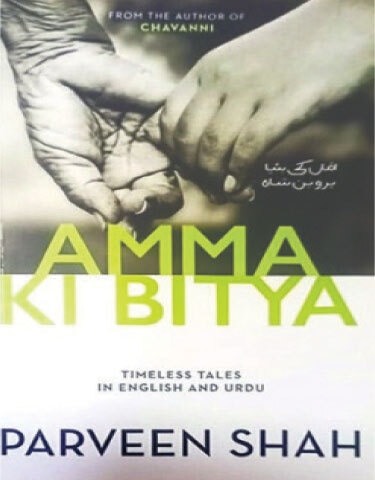
Amma Ki Bitya: Timeless Tales in English and Urdu
By Parveen Shah
Panna Book Centre
ISBN: 1000000097427
126pp.
There’s a brilliantly evocative African proverb that I often find myself ruminating upon following the loss of a cumulative lifetime of stories, wisdom and experiences that occurs when a person passes — “When an elder dies, a library burns to the ground.”
Most of us invariably contend with thoughts of loss, life and legacy in the aftermath of tragedy. A death in the family, news of a plane crash or tremors from an earthquake suddenly put life into perspective — albeit briefly, before we are once again consumed by our petty problems.
People always need dramatic examples to shake them out of the apathy that can come to stifle daily life. In many ways, stories, and the storyteller, attempt to provide an antidote for impassivity, while also becoming a means through which the storyteller can help preserve fragments of their very own internal ‘library’ before it turns to ashes.
Many writers have wrestled with this notion. Stephen King’s novella The Life of Chuck is a poignant exploration of the extraordinary nature of what may be dismissed as ‘ordinary’ lives and how this truth becomes all the more apparent when one is confronted by the spectre of death.
A collection of short stories, anecdotes and vignettes in English and Urdu imparts a quiet wisdom accrued over decades
In a similar vein, Daniel Wallace’s Big Fish: A Novel of Mythic Proportions looks at how the stories that are passed down from one generation to the next, no matter how ‘mundane’ or fantastical, are what define a person’s, and by extension a family’s, legacy.
But Parveen Shah’s second book, Amma Ki Bitya: Timeless Tales in Urdu and English, isn’t just an exploration of these themes; it is a distillation and physical manifestation of them. Much like her earlier work, Chavanni [Quarter], Shah’s sophomore effort arrives like a handwritten letter from an older generation — personal, revealing and instructive.
Shah, a seasoned educationist, draws on her own experiences and those of her students, friends and family in this collection of short stories, anecdotes and vignettes (some in English and some in Urdu) that impart a quiet wisdom accrued over decades.
At first glance, the book may seem modest, with most stories around a page long. But this very brevity gives each piece a fable-like sharpness, making every story feel like a small window into a larger world of lessons, emotions and human contradictions.
One of the most striking qualities of Amma Ki Bitya [Grandmother’s Daughter] is the narrative voice — which skilfully oscillates between different narrative points of view, acting like a custodian of family memory. Shah observes people with the curiosity and discipline of an educator, but recounts their lives with the tenderness of a trusted family confidant. The result is a tone that is neither moralising nor detached, but instead deeply empathetic.
For instance, stories such as ‘Respect’ and ‘Catharsis’ provide a glimpse into how the bond between a teacher and a student can help heal unseen wounds and reveal not only a teacher’s insight into her student’s character but also how respect and trust, once earned, can guide behaviour more powerfully than fear or punishment. The tender exploration of these sorts of moments is what gives Amma Ki Bitya its quiet authority.
But where Shah’s writing style truly shines is in the Urdu stories in Amma Ki Bitya. While the stories in English are crafted with precision and crispness in mind, the tales in Urdu unfurl like a richly adorned carpet. Shah paints vivid portraits that draw upon experiences from her childhood, friendships, family, marriage and career, in a manner that has warmth, humour and personableness that comes across so naturally in her Urdu prose. These narratives have an unhurried flow to them and read like stories one might breeze through on a languid sunny morning, or tales that might be narrated by a griot or dastangoh.
The stories ‘Azeem Insan’ [Great Man] and the titular ‘Amma Ki Bitya’ are not just deeply personal reflections for Shah — they are beautifully curated, intimate looks at the lasting bonds from relationships that linger throughout the years. Other stories, however, blur the line between fiction and non-fiction. They may be based on something Shah saw or was told, or they may have been imagined into being by her.
Either way, they resonate because Shah harbours the ability to craft fully realised characters and worlds within the confines of just a page or two. This is a rare gift, since the short story is a notoriously exacting form, hence prompting the oft-repeated adage, “A writer can be taught everything except how to write a short story.”
What helps is that Shah’s prose is deliberately straightforward. She avoids reliance on literary flourishes, instead writing as she might speak to her students or children. Yet, beneath the simplicity lies a keen observational eye. Shah knows how to select a telling detail — a whispered name at the deathbed, a telling embrace, a tea-set gleaming in a shop window — and let it carry the emotional weight of the story. This restraint enhances the impact of each anecdote, inviting readers to supply their own interpretations.
Because each passage is not too long, the effect is cumulative. One finishes a story, pauses to reflect and then moves on to another, gradually building a mosaic of a life’s teaching. In many ways, this structure mirrors how family values and stories are transmitted — not through formal lessons, but through small, memorable incidents, retold and internalised over the years.
Ultimately, this book is a window into Shah’s very own internal ‘library’ and, as is the case with all affecting works of writing, you’ll find much in her ‘library’ that resonates with yours.
The reviewer is a member of staff
Published in Dawn, Books & Authors, October 12th, 2025