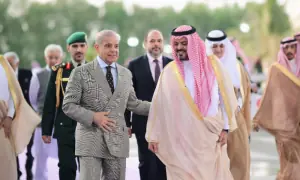


PAKISTAN’S foreign policy has never witnessed as much proactiveness in its foreign affairs as in recent months. Islamabad has reset its relationship with Dhaka, effectively displayed a counter-force response against India, re-engaged Washington, deepened strategic ties with Beijing, signed the Strategic Mutual Defence Agreement with Riyadh, and played an active role in the Gaza peace process. As part of its grand strategy, Pakistan is presenting itself as ‘net security stabiliser’ for South Asia and ‘net security provider’ for the Arab Gulf region.
Pakistan’s grand strategy is based on two broader approaches to achieve several aims. First, Islamabad wants to present itself as a strategically relevant state in the evolving world order. For many years, it witnessed estrangement in its ties with the US due to varying interests in Afghanistan. This estrangement intensified after the US exited Afghanistan. Resultantly, Islamabad was concerned that its strategic relevance had diminished in the Western world. Although Islamabad’s economic and strategic needs were fulfilled by non-Western capitals, it believes that attachment to the West can serve its political, strategic and economic interests well.
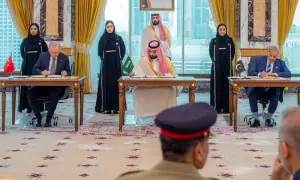
The concept of strategic relevance is deeply embedded in Islamabad’s calculus. Pakistan believes that strategic relevance in both Western and non-Western capitals will help it gain access to economic and defence deals. A strategically relevant Pakistan can fight Kashmir’s case well in the international arena. Islamabad has seen its strategic relevance limited to South Asia — and that too could diminish due to rapidly altering regional realities. Therefore, it has tried to extend its strategic relevance to the Arab Gulf. Islamabad’s decision to sign a defence pact with Riyadh will strongly link Pakistan’s strategic stakes to the Arab Gulf region.
Second, Islamabad wants to reshape the South Asian security architecture. While Islamabad has traditionally been concerned about New Delhi’s dominant role in South Asia, the White House seems to be frustrated with India’s insistence on strategic autonomy. New Delhi doesn’t want to infuriate Beijing or to cut trade ties with Moscow.
Islamabad wants to attain strategic relevance.
New Delhi also didn’t fulfil Washington’s expectations in trade. It continues to test Washington’s patience by not budging from its position on the 50 per cent increase in tariffs by the US. Islamabad has viewed these developments as a strategic opportunity.
To avail it, Islamabad has been doing exactly the opposite of what New Delhi is bent upon doing. While New Delhi denies President Donald Trump had a role in the ceasefire between India and Pakistan following the May stand-off, Islamabad proposed his name for the Nobel Peace prize. New Delhi is reluctant to sign the India-US trade deal. In contrast, Islamabad finalised a trade deal with the US, collaborated on crypto and extended counterterrorism cooperation by extraditing an IS terrorist to the US.
However, Islamabad is not solely relying on Washington; rather it has brought Beijing into the South Asian equation. After failing to revive Saarc, Islamabad is trying to establish sub-regional fora with the help of Beijing. Islamabad’s successful diplomacy has led to the creation of two important trilateral forums comprising Afghanistan, China and Pakistan, and Bangladesh, China and Pakistan. On these lines, Islamabad also wants to encourage smaller South Asian states to join either existing trilateral forums or create new but similar ones.
By deepening America’s economic stakes and bringing China into the South Asian equation, Pakistan wants to achieve two aims. The first is a regional US presence to ensure Washington’s proactive role in managing the Pakistan-India crisis and also focusing on a ‘South Asia peace plan’ to resolve the Kashmir issue. Second, it sees the Chinese presence in South Asia as countering New Delhi’s influence in the region.
Above all, the deepening engagements of Washington and Beijing in South Asia’s strategic, economic and political affairs will help Islamabad balance the two competing powers. Primarily, Islamabad wants to hedge its bets until a clear winner emerges from the competition between these major powers.
Islamabad is confident that this grand strategy will elevate Pakistan to the status of a middle power, with a stronger profile regionally and globally. However, in the presence of internal security challenges, a fragile economy, the lack of good governance, and complex geopolitical realities, it seems Islamabad is punching above its weight. Therefore, the sustainability of this grand strategy remains uncertain.
The writer is an analyst of South Asian affairs. The views expressed are his own.
Published in Dawn, October 11th, 2025