The 18th century French philosopher Jean-Jacques Rousseau argued that religion is necessary for a stable state. His writings greatly inspired the makings of the French Revolution which, ironically, was largely anti-religion. But Rousseau mostly spoke about a ‘civil religion’, and not a traditional, revealed faith. Civil religion functions like a belief system by ‘sacralising’ ideas that are secular.
Rousseau was writing during a period when pre-modern Christianity was receding. It had begun to be viewed by most European thinkers as exploitative, myopic and a hindrance to the advancement of ‘new knowledge’ derived from empiricism and rationalism.
This critique was not only coming from staunch secularists alone, but also from Christian reformists. Yet, even the most secular thinkers agreed that faith was important to keep societies from spiralling into spiritual anxiety and chaos. Rousseau’s idea of civil religion, therefore, became increasingly influential across the 19th and 20th centuries. Concepts like the nation and the state began being given a sacred status and rituals.
These rituals borrowed symbolic elements from traditional religions but reframed and reinterpreted them. For example, sacralisation in this regard often constitutes national holidays, flag-raising ceremonies, pledges of allegiance, remembrance days and memorial services for historical events or figures etc. These are ritualised in a way to evoke emotions as rituals of traditional faiths do.
Secular ideas, when imbued with sacred meaning, turn politics into a ‘moral mission’ and reshape democracy’s character in the process
Civic religion eventually gave birth to the ‘sacralisation of politics.’ Politics is inherently amoral. It is largely invested in the interest of the self or the nation, and is often unconstrained by moral judgement when pursuing these interests. But the gradual sacralisation of the body politic sacralised the amorality of politics as well.
According to the researcher Bilge Yabanc, many political parties have transformed politics into a religious-like mission by infusing secular entities — such as the nation, the state and the leader — with sacred meaning. Some of the first major consequences of this process were rather drastic. They produced political forces that wanted to be the only ones in the picture.
Early examples in this regard include the Russian Communist Party (Bolsheviks), the National Fascist Party in Italy, the Nazi Party in Germany, the Movimiento Nacional in Spain and, later, Mao Zedong’s Communist Party of China.
According to the British historian Paul Jackson, these created new symbols and rituals to evoke belief in a higher cause (related to the state). This was to be navigated by a ‘visionary’ leader shaped by a ‘cult of personality.’ In 1952, the German-American political scientist Waldemar Gurian wrote that the totalitarian movements which rose after World War I “were fundamentally religious movements, based on a new conception of faith.” Political scientists began to refer to this conception as “political religion” (not to be confused with religious politics).
Jackson wrote that a utopian vision is at the core of a political religion. It is treated as a messianic mission, binding leaders and followers together in a shared project. It develops new rituals that make a charismatic individual the personification of the mission. He/she also personifies a wider mythology that allows societies to engage in activities that express their collective belief in the sacred cause espoused by the new ‘faith’. But sacralisation of politics doesn’t always produce totalitarian outcomes. It is very much present in democracies as well.

In developed as well as developing democracies, too, the nation-state continues to be treated as a sacred entity, and serving it is viewed as a sacred purpose. Ever since the 2000s, populist leaders have been the main outcomes of the sacralisation of politics. According to Yabanc, they present themselves as saviours, and their pronouncements are given a quasi-religious significance, demanding uncritical devotion from followers.
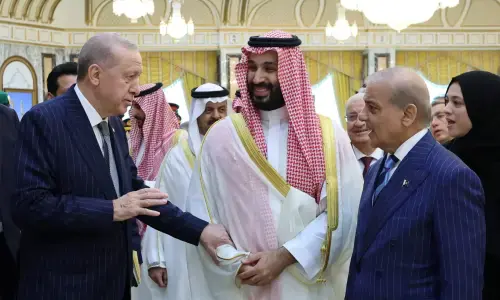
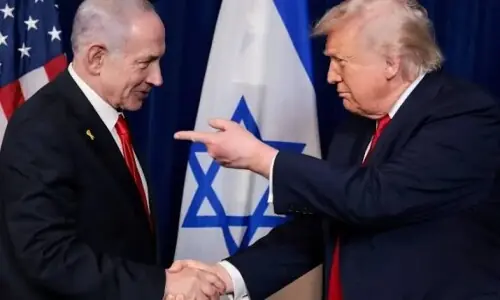
This is quite apparent in Narendra Modi’s India, Recep Tayyip Erdogan’s Turkey, Donald Trump’s America and Benjamin Netanyahu’s Israel, as it was in Jair Bolsonaro’s Brazil and Imran Khan’s Pakistan. Their political agendas were framed as being of utmost moral importance. To Yabanc, politics has increasingly become an expression of a ‘spiritual’ mission.
Twentieth century totalitarian ideas — Stalinism, Nazism, Fascism and Maoism — were extreme outcomes of the sacralisation of politics. Less monolithic versions of the same were already present in almost every country. Initially, sacralisation sought to replace traditional beliefs with more modern and pluralistic identity markers. It tried to formulate beliefs and rituals to fill the gaps left behind by the receding traditional beliefs. Interestingly, during this process, the idea of democracy too was sacralised.
After the Second World War, when ‘political religions’ such as German Nazism and Italian Fascism collapsed, democracy was presented by the West as a more sober and rational idea. But the fact is, it was already in the process of being sacralised. As far back as 1934, the American philosopher John Dewey was trying to find “a moral and spiritual motivation for democracy.”
During the Cold War (1945-91), the tendency to treat democracy with great reverence intensified. It was elevated to having superior moral authority, especially in opposition to Soviet communism. As long as there was a ‘totalitarian’ Soviet Union, the sacralised idea of democracy continued to gain traction as an ideal system that guaranteed the construction of free and ethically and morally sound societies.
This sacralised perception of democracy reached its peak after the collapse of the Soviet Union in 1991. But, according to the British-American sociologist Michael Mann, in the absence of a communist ‘other’, democracy turned on itself, especially when its sacralised sides became entry points for populists to storm the corridors of mainstream power.
They began shaping a “moral majoritarianism” that undermines institutions, creates polarisation, justifies authoritarian behaviour, and cultivates a following that is encouraged to undermine critical thinking for a greater cause — causes such as the establishment of a white Anglo-Saxon Christian state in the US, or a ‘kingdom of God’ in Brazil, a ‘Riyasat-i-Madina’ in Pakistan and an entirely white Europe etc.
In the early 2000s, many political scholars began to speak about a “post-secular world” and the “return of religion.” But the fact is, secularism began to erode when secularists themselves began to sacralise secular entities. As the American political scientist Anna Grzymala-Busse correctly posits, it was the sacralisation of politics that “buttressed popular religiosity and attitudes and empowered religious organisations in influencing policy across a wide range of domains.”
The so-called return of religion was the outcome of the sacralisation of multiple secular ideas. This ploy eventually ate up what it was trying to make more widely accepted: secularism.
Published in Dawn, EOS, September 28th, 2025