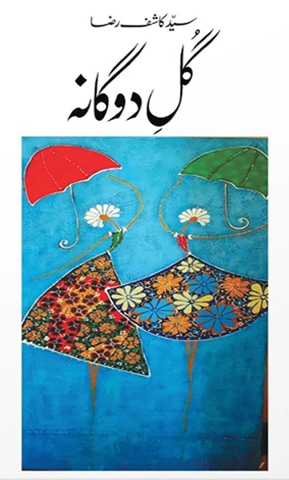
Gul-i-Dogana
By Syed Kashif Raza
Maktaba e Danyal
ISBN: 978-969-419-124-6
208pp.
In William Shakespeare’s play Romeo and Juliet, before drinking poison to kill himself, Romeo kisses Juliet one last time. His final words: “Thus with a kiss I die.” In a sweetly paradoxical way, with death being the corollary of the art of love, the playwright immortalises the two characters.
You will find a good number of references to lips and kisses in poet, novelist and journalist Syed Kashif Raza’s new collection of Urdu poems Gul-i-Dogana [Conjoined Flowers]. But they are not employed merely to invoke a sensual feeling… there’s more to it than meets the (reader’s) eye.
Raza has previously published two poetry collections — Muhabbat Ka Mahl-i-Wuqu [The Location of Love] and Mamnu Mausamon Ki Kitab [The Book of Banned Seasons] — and one critically acclaimed and award-winning novel, Chaar Dervish Aur Aik Kachhwa [Four Dervishes and a Tortoise]. He is also a translator of high merit. The latest book gives away the fact that poetry is his first love.
The simple reason for this assertion is that, while composing poems, he seems to be at his imaginative best, using and arranging words with the kind of flair and abandon that only a poet can. And it’s the reader who benefits most from this exercise. Raza’s ghazals flow with the pulsating rhythm that one associates with well worked-out jazz beats and his nazms convey his ideas like a waterfall coming down a verdant hill, carrying with it the freshness of unsullied nature.
Gul-i-Dogana has 72 ghazals and 25 nazms. Both are technically refined and contextually rich. In the case of the former, as has been mentioned in the opening paragraph, the reader will find a decent number of references to romantic moves (lip-locking, praising the lushness of the beloved’s lips, etc) which can’t be taken for their literal meaning alone. The poet goes beyond the physical aspect of familiarity to find a world (repeat: find) where the inexplicability of pleasure becomes immeasurable in a metaphysical sense.
Shuroo-i-ishq se pehlay wo lab pasand kiyay
Aur aik bosa-i-wahshi se muhr-band kiyay
Jhuka main aur meray saath jhuk gaey aflaak
Bara’ey bosa jab us ne woh lab buland kiyay
[Loved those lips even before falling in love
And sealed the deal with a savage kiss
As I bent, the skies bent over with me
When she raised for a kiss those lips]
By turning a sensory experience into a cosmic idea, the poet is emphasising the limitless possibilities that human intimacy entails. The theme continues in quite a few ghazals.
Chura bhi laitay hain nazrein kabhi kabhi khubaan
Ye loag yun bhi ishara waghaira kartay hain
[The fair ones sometimes evade eye contact
That’s how they drop a hint or two]
This roundabout way of appreciating beauty becomes creatively uncomplicated in ghazals where Raza seems to be well within himself, that is, trying to reflect on his life trajectory. While doing so, he comes across as an individual who doesn’t approve of looking back and regret; and yet, there’s something in the poet that makes him want to halt in his stride, take a breather and mull over… for a bit.
Dikhai deti hai jo shakl woh bani hi na ho
Ajab nahin ke kahani kahi gayi hi na ho
Jo kho chuka hai wohi ab ho mera sarmaya
Jo mil gaya hai mujhay woh meri kami hi na ho
[The face that I see is maybe unmade
There’s a likelihood that the story is yet to be told
What I’ve lost is perhaps what I’ve gained
What I’ve gained is probably what I lack]
Engaged in the creative process, Raza never loses sight of the fundamental requirement of the art of writing poetry. Here is a versifier in whose poems it is difficult to ascertain whether the technique (metres and phraseology) that he uses to express a feeling grabs the reader’s undivided attention first or the poetic and tender metaphors that he comes up with, which immerse the reader in his evocative lines. This becomes more difficult to analyse while reading his nazms on diverse topics.
Aahaton mein milo
Apni poshak ki mehrbaan chilmanon mein khilo
Saans ki karwaton se ruko
Aankh ki jumbishon se barrho
Baat kartay huay apnay daanton se tooto
Labon ke kinaron se sarko
Hawaaon mein behti hui a’ao
Aur meri saanson mein phailo
Hawaaon ko poshak se khailnay do
Inhain apnay baghon ki jaanib bulao
Kabhi pairhan se sarakti hui aik lehzay ko simto
Magar phir dupattay ke rangeen kinaro se bikhro
Henaaon se mehko
Sabaaon se bey-aabru ho
Raahdarion se guzartay huay
Painchon ko utha ker meri aankh ke aaeney par chalo
(Aain-i-Mulaqaat)
[Meet me in footsteps
Meet me through the merciful casements of your attire
Halt, as the breath takes a turn
Move, as the eyes twitch
Break, while talking with the click of your teeth
Budge from the edges of lips
Come [to me] riding the air
And spread your wings with my breathing
Let the winds play with your dress
Call them towards your gardens
Occasionally, gather yourself for a moment after tugging at your clothes
Then disperse from the colorful edges of the dupatta
Be fragrant with henna
Get sullied by the morning breeze
Moving through the corridors
Lift the bottom of your trousers and walk on the mirror of my eyes]
[The Constitution Of A Meeting]
This display of metaphoric wealth comes to the fore even when he touches upon as dark a topic as death or personal experiences of loss and dismay. It goes to show that his creativity is backed by the massive (and necessary) amount of reading (something that his contemporaries can emulate) that he’s done over the years as an avid student of literature.
It is more than evident in the poem ‘Maut Ke Baad Aik Nazm’ [A Poem Penned Post-Death]:
Kuza bhar darya se bahar nikla tha
Ya qatra tha
Kya maloom
Miqdarein to paimanon se naapi jati hain
Paimanon mein chalta tha main
Darya se bahar bhi jaisay ik darya sa behta tha main
Chulloo chulloo bat’ta
Pal pal kat’ta bhi tha
Khushion se gham zara zyada lagta bhi tha
Phir bhi us darya ke rang niralay thay
Maut ke is darya mein harkat hai hi nahin
Fursat se ik pal bhi fursat hai hi nahin
Ae beyhiss-o-harkat darya
Bey-dar, bey-taaqat darya
Itnay jugg tau beet chukay hain, kitnay aur bitaney hain
Kya is darya se aagay kuchh aur bhi darya aanay hain
[I had stepped out of the river in a gugglet
Or like a droplet
Who knows
Quantities are measured in goblets
I used to walk in goblets
I used to walk like a river outside of a river
I would be divided by the handfuls
Cut in pieces, bit by bit
Sorrow appeared more than my share of happiness
And yet, the colours that the river emitted looked unique
(But) this river of death has no movement
There’s no freedom from freedom
Oh, you stationary river
Oh, you river sans entrance
So much time has lapsed, what more?
Are there any more rivers beyond this one?]
This poetry collection is highly recommended.
The reviewer is a member of staff
Published in Dawn, Books & Authors, September 14th, 2025