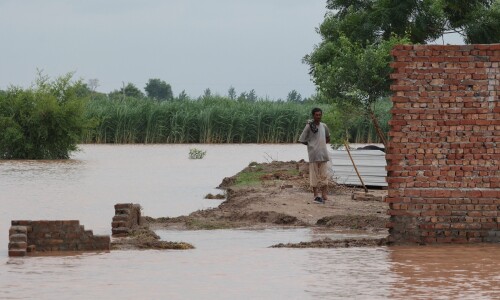
Crop devastation


THE devastation unleashed by the floods across Punjab — with Sindh facing a similar situation — is nothing short of catastrophic. The deluge has wiped out crops on thousands of acres across Punjab, the country’s food basket, sparking calls for an agricultural emergency.
While an official assessment of the exact agricultural losses caused by floods and excessive monsoon rains is awaited, a business body has claimed that the flooding has led to staggering losses to crops and rural livelihoods. A preliminary assessment by the Pakistan Business Forum shows that 60pc of the rice crop, 35pc of cotton and 30pc of sugarcane in central and southern Punjab have been damaged, besides widespread losses to rural livelihoods. In a letter to the prime minister, the forum has asked that an agricultural emergency be declared. Stating clearly that “such destruction in Punjab due to flooding has never been witnessed before, with Sindh soon facing a similar devastation if immediate preventive measures are not taken”, the letter cautions the government that the key agricultural targets set for the current fiscal year may be unattainable now.
The forum’s call has not come a moment too soon as the unfolding economic upheaval and humanitarian crisis have exposed the fragility of our farm sector. With food inflation already rising, and large amounts of wheat stored in warehouses or at home by farmers for personal use damaged or swept away by the floodwaters, the devastation risks jeopardising the food security of tens of millions of people in both the rural and urban areas.
More crucially, the recent monthly finance ministry report has predicted that flood-related damage may worsen fiscal pressures as food and industrial crop losses are likely to necessitate imports.
Not just that. The farm sector, which forms nearly a quarter of the economy and employs almost 40pc of the labour force, was in troubled waters even before the rains lashed down and floods inundated vast swathes of farmland. The sector had grown only marginally by 0.56pc — the lowest in almost a decade — in the last fiscal year against the five-year average of 3.38pc, depressing overall GDP growth and affecting both the industrial and services sectors. With agriculture growth falling short of the target, the story will likely repeat itself this year.
While declaring an agricultural emergency is necessary to support rural communities, the government must also use the unfolding crisis to push overdue structural reforms in this neglected sector. As a PBF member stressed, the present crisis should serve as a wake-up call to overhaul agricultural strategies. Without decisive action to mitigate the immediate fallout and avert longer-term decline, the country risks deepening its economic vulnerabilities.
Published in Dawn, September 8th, 2025