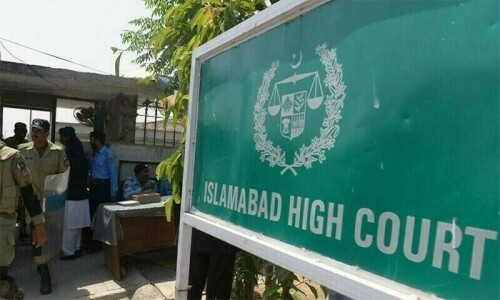
ISLAMABAD: While five judges of the Islamabad High Court (IHC) have finalised their objections to what they described as the “hasty” approval of new court rules without “meaningful” consultation, the IHC administration has claimed that all judges had been duly involved in the rule-making process months before the full court meeting was convened.
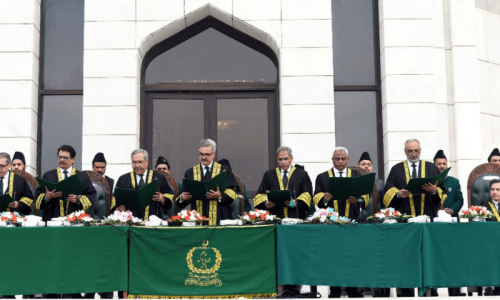
The High Court Establishment (Appointment and Conditions of Service) Rules-2025 were passed at the recent full court meeting of the IHC by a narrow margin, with six of the 11 judges voting in favour.
Justice Mohsin Akhtar Kayani, Justice Tariq Mehmood Jahangiri, Justice Babar Sattar, Justice Sardar Ejaz Ishaq Khan, and Justice Saman Rafat Imtiaz — the five senior judges who opposed the move and demanded certain amendments — would file their dissenting notes.
The newly promulgated rules substantially enhanced the authority of the chief justice, empowering him to nominate any judge to the powerful administration committee, while simultaneously eliminating the inclusion of the senior puisne judge as a de facto member of that body.
Dissenting notes ready to be filed after new rules divide judges
‘Misuse of powers’
A day before the full court meeting, Justice Babar Sattar and Justice Sardar Ejaz Ishaq Khan wrote a letter among their colleagues, expressing grave concerns that administrative powers were allegedly being misused to “sideline dissenting judges”. Later, they also objected to the way the rules were presented at the meeting, complaining that “insufficient time” had been provided for a proper review.
Also, according to Justice Ejaz, the new Practice and Procedure Rules (PPR) were officially gazetted without meaningful debate or approval by the full court. He claimed the voluminous document — spanning more than 600 pages — was circulated only a day and a half before the meeting, thereby reducing consultation to a “mere formality and making substantive input impossible”.
A senior IHC official, however, disputed this claim, insisting that every judge had been fully on board during the rule-making exercise. He cited an office order, dated June 12, 2019, and issued by then chief justice Athar Minallah, which constituted a committee to draft the rules in line with those of the Lahore High Court. The committee included additional registrars Ijaz Ahmed and Salamatullah.
Input of all judges sought
According to the official, the draft rules were duly circulated among all the judges, months before the meeting was convened, and their input was solicited. Apart from Justice Sattar, he said, no judge provided any suggestions.
However, the recommendations submitted by Justice Sattar were rejected by the then chief justice on the grounds that they appeared tantamount to empowering judges with suo motu authority.
One of the dissenting judges, nonetheless, claimed that the version of the rules presented at the full court meeting was “different from the one previously circulated”.
Administration committee
Defending the changes, the official maintained that only minor alterations had been made. For instance, Rule 237 now provides that the administration committee, headed by the chief justice, shall ordinarily comprise three judges, though the chief justice may nominate additional members if deemed necessary. Likewise, Rule 239 now stipulates that each member of the administration committee shall serve as an administration judge, with their powers and responsibilities to be defined by the chief justice from time to time.
Previously, the senior puisne judge automatically served as an administration judge, granting him significant authority over court affairs. Under the revised framework, however, the chief justice has complete discretion to assign administrative functions, a change that effectively curtails Justice Kayani’s role.
Justice Sattar and Justice Ejaz reportedly objected to the way case assignments were being structured, alleging that the process was “manipulated to favour” judges transferred to the IHC along with the chief justice, while sidelining permanent judges who had opposed his transfer.
Special bench
They specifically referred to the formation of a special bench to address the backlog of tax cases. on which both dissenting judges were placed and assigned more than 200 tax references to be heard daily from 9am until the court’s rising.
Their pending cases were reassigned to other judges. The IHC official, on the other hand, rejected the objections, citing the LHC practice where specialised benches are also assigned to senior judges.
Referring to the ‘Roster of Sitting’ at the LHC’s principal seat, he pointed out that Justice Abid Aziz Sheikh and Justice Javid Iqbal Wains sit on a bench for tax and commercial cases and hear such matters full-time from Monday through Friday.
Published in Dawn, September 8th, 2025