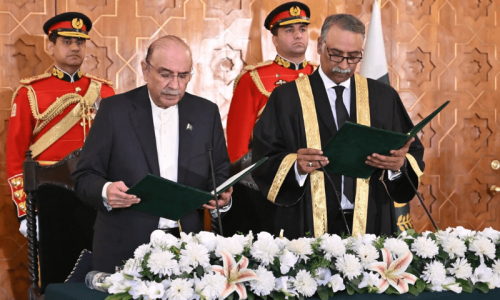
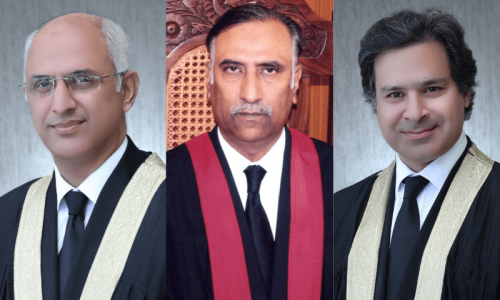
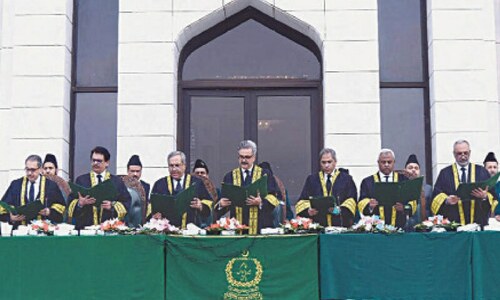
IT has now come to this: five judges versus the president, the federation, the Judicial Commission, the registrars of the Supreme Court and the high courts of Sindh, Punjab, Balochistan and Islamabad, and three of their fellow judges.
The five, who are “serving confirmed judges” of the Islamabad High Court, have formally challenged the manner in which three justices were recently transplanted to the IHC from other high courts, how the IHC’s seniority list was subsequently changed, and how far more senior, confirmed IHC judges were summarily replaced on important committees by the freshly transferred judges.
The petitioners have called on the apex court to exercise its original jurisdiction under Article 184(3) to hear their pleas, as they believe what happened at the IHC is tantamount to a “dismantling of the salient features of the Constitution”; specifically, “the independence of judiciary, separation of powers and federalism”. They seem to have made a strong case.
It may be recalled that the trouble at the IHC began last year when several judges formally raised the issue of routine meddling by security agencies in court affairs. The contents of their complaint, addressed to the then chief justice, Qazi Faez Isa, were corroborated by similar complaints made subsequently by other high courts as well. Unfortunately, the former chief justice never had the bandwidth to address these complaints, and the matter was not addressed.
Now, and especially after the 26th Amendment, a perception has been building up that all judges who are perceived as a ‘threat’ by the current regime are being systematically sidelined and ‘neutralised’ by being denied their due promotions and/ or deprived of any important administrative responsibilities they may have held.
The way things have played out in the SC and the IHC in recent months certainly seems to have lent considerable credibility to that perception.
It has been most disappointing to observe that the petitions against the 26th Amendment have not been taken up with the seriousness and urgency they ought to have attracted from the SC. The judiciary’s image as an independent and impartial arbiter has continued to deteriorate as a result.
This petition, if it is taken up, will at least compel various actors to place on the record legal justifications for various actions and decisions which have been publicly perceived as having deprived the judiciary in general, and the IHC in particular, of their institutional independence, autonomy and ability to function without fear or favour.
It must also be reiterated that it is only proper that petitions pertaining to the independence of the judiciary as an institution are heard by a full court so that there is no complaint regarding conflicts of interest. The institutional leadership cannot ignore the growing criticism forever.
Published in Dawn, February 22nd, 2025