0
0

• CJ turns down plea by some judges to postpone meeting as they haven’t had a chance to review the voluminous document
• Move to have family courts hear polygamy cases gets full court nod
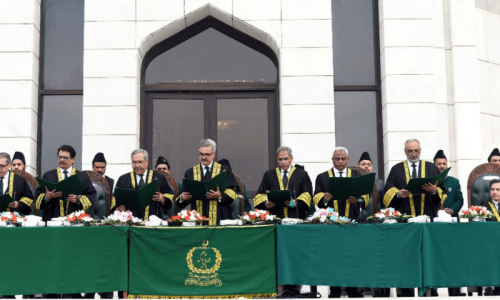
ISLAMABAD: Despite strong resistance from senior judges, a full court meeting of the Islamabad High Court (IHC) on Wednesday adopted the High Court Establishment (Appointment and Conditions of Service) Rules, 2025.
The rules were passed by a slim majority, while a proposal from two judges, seeking changes to the meeting’s agenda, was rejected.
According to the agenda, the full court had been convened to deliberate on three key issues: amendments to the law related to polygamy, structural flaws in the IHC building, and the adoption of the service rules.
The meeting was attended by all 11 judges, including Chief Justice Sardar Mohammad Sarfraz Dogar, Justice Mohsin Akhtar Kayani, Justice Tariq Mehmood Jahangiri, Justice Babar Sattar, Justice Arbab Mohammad Tahir, Justice Sardar Ejaz Ishaq Khan, Justice Khadim Hussain Soomro, Justice Saman Rafat Imtiaz, Justice Mohammad Azam Khan, Justice Mohammad Asif, and Justice Raja Inaam Ameen Minhas.
Polygamy law, building flaws
Sources said the full court unanimously approved the amendment to the polygamy law, under which such cases will now be tried by family courts instead of executive magistrates.
It also decided to refer the IHC building case to the federal government for a thorough investigation into persistent issues. An inquiry conducted by the public works department earlier pointed out several defects in the elevators.
The inquiry report noted that the elevators lacked certain features promised in the prototype and the specifications, but it failed to identify those responsible for the faulty installation and maintenance.
Apart from the elevators, the IHC building continues to suffer from multiple problems, including an ineffective cooling system and inadequate parking facilities for litigants and lawyers.
The judges observed that instead of referring the matter directly to the National Accountability Bureau or the Federal Investigation Agency, the federal government should be asked to carry out a comprehensive probe and take corrective measures.
CJ’s powers
Unlike these two agenda items, the proposed IHC Rules, 2025 triggered a sharp division among the judges. While the chief justice strongly supported them, senior judges, including Justice Kayani, Justice Jahangiri, Justice Sattar, Justice Sardar Ejaz, and Justice Imtiaz, opposed their adoption and urged amendments.
A day before the meeting, Justice Sattar and Justice Sardar Ejaz Ishaq Khan had written letters to their colleagues, voicing serious concerns that administrative powers were being misused to sideline dissenting judges.
Both judges strongly objected to a new circular requiring judges to obtain a No-Objection Certificate (NOC) from the chief justice for foreign travel.
They alleged that case assignments were being manipulated to benefit judges transferred to the IHC alongside the chief justice, while permanent judges who had opposed his transfer were being sidelined.
The letters also challenged the chief justice’s use of the “master of the roster” power to transfer part-heard cases.
Justice Khan also took exception to the new Practice and Procedure Rules (PPR), reminding his colleagues that PPR had already been gazetted without approval or even proper discussion by the full bench.
He noted the voluminous document, spanning more than 600 pages, had been provided only a day and a half before the meeting, reducing consultation to a mere formality and making meaningful input impossible.
Justice Khan demanded that five additional agenda items, including these objections, be formally taken up for “proper deliberations” in the full court meeting, signalling his refusal to let the controversy be ignored.
Voting and objections
According to sources, Chief Justice Dogar rejected any alteration in the agenda and proceeded to call a vote.
Six judges, including the chief justice, approved the rules, while five opposed them and resolved to record their objections in writing.
During the proceedings, the dissenting judges questioned whether those voting in favour had even read the new rules. The response, sources claimed, was negative.
Some judges, noting the massive length of the document, requested the chief justice to postpone the meeting, but their plea was turned down. Ultimately, the High Court Establishment (Appointment and Conditions of Service) Rules, 2025 were adopted by a razor-thin majority, leaving the full court deeply divided.
Published in Dawn, September 4th, 2025