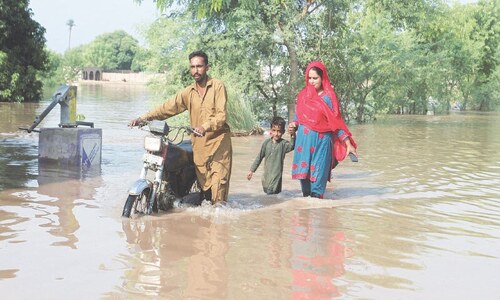
Beyond the thousands directly affected by the devastating floods, countless struggling Pakistanis, still waiting for promised relief from improved macroeconomic indicators, now fear the wider impact of the crisis on their already difficult lives.
If flooding persists and recovery and reconstruction efforts remain slow, the fallout on food security, livelihoods, and household resilience could intensify, placing even greater strain on already vulnerable families across the country.
Pakistan is still reeling from the catastrophic 2022 floods, which inflicted tens of billions of dollars in damage, widespread displacement, and massive economic losses. The disaster was a major contributor to the country’s deepening economic crisis — marked by record-high inflation, surging poverty and inequality, and a negative growth trajectory.
This year’s rains and floods also appear extraordinary in both scale and impact. While it may be too early to compare the recent floods to the 2022 disaster that submerged a third of Sindh, early assessments suggest the need to put the situation in perspective and address growing public misperceptions, often amplified by social and electronic media coverage.
Despite some minor delays, trains, flights and traffic on major routes continue to operate largely as normal, and no significant supply shortages have been reported so far.
Flood-affected areas continue to experience aid gaps as the state scrambles to offer relief
A formal assessment of the 2025 floods’ impact will likely be compiled and released after the monsoon season concludes, as officials say all tiers of government are currently focused on minimising infrastructure damage, saving lives and delivering immediate relief.
When asked about the broader impact, National Disaster Management Authority (NDMA) Chairman Lt Gen. Inam Haider Malik declined to comment, citing the ongoing volatility of the situation. He stated that a comprehensive report on economic impact will be issued once all relevant data has been collected and consolidated.
The NDMA, however, has shared a detailed situation report documenting the losses, damages and relief efforts since the start of the monsoon season across Pakistan. Drawing on real-time updates, the report includes the latest developments over the past 24 hours, along with visual summaries of cumulative data on casualties, injuries, infrastructure damage, private property losses, food distribution, and the status of government-run relief camps.
According to the NDMA’s daily situation report, dated September 30, which includes cumulative data, a total of 884 people have lost their lives due to floods:Khyber Pakhtunkhwa (KP) reported the highest toll with 489 deaths, followed by Punjab (223), Sindh (58), Balochistan (26), Gilgit-Baltistan (41), Azad Jammu & Kashmir (AJ&K) (38), and Islamabad (9).
In terms of property loss, 2,154 houses were completely destroyed: KP (917), GB (733), AJ&K (324), Balochistan (101), Sindh (34), Punjab (4), and Islamabad (1); while 7,138 houses were partially damaged nationwide. Livestock losses totalled 6,180, with KP alone accounting for 5,460 of those.
Earlier, the United Nations Office for the Coordination of Humanitarian Affairs (UN-OCHA) reported that floods in KP had damaged over 3,200 acres of farmland, with Buner (1,157 acres), Swat (853), Shangla (559), and Swabi (330) being the most heavily hit.
Over 80 per cent of affected communities reported crop losses, particularly severe in Battagram and Mansehra, raising alarms over food security and livelihoods. Livestock losses reached 6,206, with Buner alone accounting for 4,818 of the total, followed by Swat, Shangla, and Battagram.
These setbacks have intensified rural hardship and displacement. While 77pc of flood-hit areas remain accessible, market disruptions persist, with Buner facing the lowest access (35pc), and 55pc of affected areas continue experiencing irregular supply of essential goods, especially in Swabi, Shangla, and Swat.
According to the UN report, significant aid gaps persist despite relief efforts. Food assistance reached only 42pc of households, concentrated in Buner, Swabi, and Shangla, while districts like Battagram, Lower Dir, and Torghar received little to none. Health services covered just 39pc of the affected population.
The report underscores the urgent need for sustained, coordinated support to address widespread food insecurity and livelihood disruptions.
Pakistan’s economy cannot remain unaffected by a disaster of this scale. The good news is that, despite the immense challenge of supporting displaced communities, compensating private losses, and restoring critical infrastructure, experts do not anticipate a major spike in inflation, though food may face short-term pressure due to crop damage.
The bad news for ordinary citizens is that any improvement in living standards may be delayed, as the floods are likely to further slow growth — already below the level needed to prevent families from slipping deeper into hardship.
Syed Salman Shah, Director General, Provincial Disaster Management Authority (PDMA) Sindh, noted that improved preparedness and more effective management this year have helped reduce the risk to life, property and infrastructure. He believes the worst is over for this monsoon season.
Mr Shah attributed the relatively limited impact of this year’s rains and floods to their lower intensity compared to the 2022 catastrophe, which affected at least 33 million people, caused over $40 billion in damages, left around 2,000 people dead, destroyed 2m homes, and wiped out 900,000 livestock.
“This year, floodwaters primarily struck areas where encroachments and construction had taken place on riverbeds and natural waterways,” Mr Shah observed.
“It’s unwise to tempt fate or nature,” remarked one expert privately. “When commercial interests provoke natural disasters by building in vulnerable zones, it’s the responsibility of civic authorities to prevent such violations. Turning a blind eye allows unscrupulous actors to endanger lives and futures for short-term private gain.”
Published in Dawn, The Business and Finance Weekly, September 8th, 2025