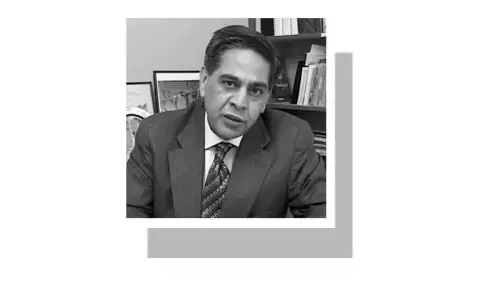
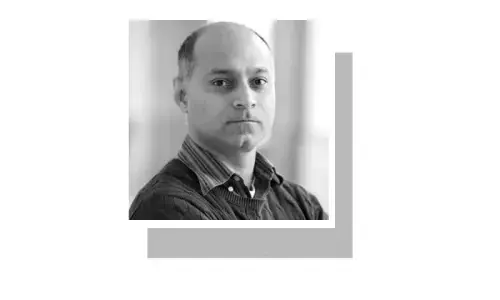
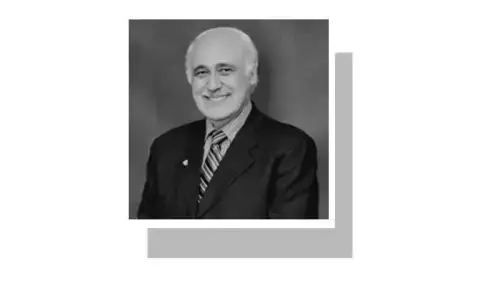
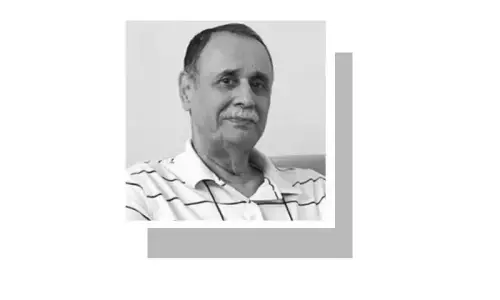
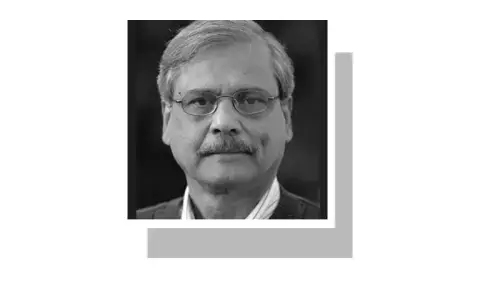
THE years ahead are shorter than those already lived. Time therefore to honour two Pakistanis lost to history: Ch. M. Zafrulla Khan (1893-1985) and Eqbal Ahmad (1933-1999). Both shared a deep affinity with the Palestinians and fought, albeit armless, for their cause. Like the Arabist T.E. Lawrence, they too wrote their “will across the sky in stars”.
Chaudhry Zafrulla served as our first foreign minister, and then as president of both the UN General Assembly and the International Court of Justice.
In November 1947, Ch. Zafrulla addressed the UN General Assembly in New York on the plan to divide Palestine. He spoke scathingly of the inequity of a proposed arrangement under which Jews who constituted 33 per cent of the population received 60pc of the area of Palestine. Of the irrigated, cultivable areas, 84pc would go to the new Jewish state and only 16pc to the Arabs.
Despite Ch. Zafrulla’s persuasive rhetoric, the state of Israel came into being on May 14, 1948. The US recognised it the same day.
The ideals espoused by two Pakistanis have been relegated to oblivion.
In Eqbal Ahmad’s case, conflict birthed his pacifism. Wounded during the Kashmir conflict in 1948, he later participated in the revolution in Algeria that led to that nation’s independence from France in 1962. The US involvement in Vietnam agitated him and because he had the support of like-minded thinkers, the US administration longed to get rid of this ‘troublesome’ intellectual.
In 1971, the FBI arrested him on the implausible charge that he, as part of the Harrisburg Seven, planned to abduct Dr Henry Kissinger (then national security adviser to Richard Nixon). After a ridiculously long trial, he and his fellow accused were acquitted. In his later years, like a moth attracted to a flame, Eqbal returned to the US where he became a respected if isolated academic.
His riposte in 1968 to Samuel Huntington (of The Clash of Civilisations fame) deserves to be recalled. Ahmad identified the perceptible gap between Third World countries’ impatience for change and America’s obsession with order, their longing for national sovereignty and America’s preference for pliable allies, and their desire to see their soil free of occupation and America’s need for military bases abroad.
Both Ch. Zafrulla and Eqbal Ahmad have become prisoners of their own reputations. The ideals they espoused and their voices of reason have since been relegated to oblivion. Mercifully, they have not lived to see Prime Minister Netanyahu flout the authority of the International Criminal Court after it issued his arrest warrants for war crimes and crimes against humanity. So far, Netanyahu has escaped arrest and punishment. The Nazis at Nuremberg couldn’t. Nor have they lived to see President Donald Trump (like some flaxen-haired Samson) pull down the numerous pillars of order that define civilisation, on himself and on us.
The parallel between the Israeli/Palestinian conflict and the ongoing Indo-Pak impasse sprang to mind, after reading the Israeli expert M. Horowitz’s book Hope and Despair, subtitled Israel’s Future in the New Middle East (2024). Horowitz argues that Israel faces two choices — continuing confrontation which would lead to partial isolation, or engagement with the enemy. Former PM Yitzhak Rabin pursued the latter. As he put it, “You don’t make peace with friends; you can only make peace with your enemies”. Rabin paid for this belief with his life.
Almost 30 years ago, in 1996, Eqbal Ahmad spoke of the armed minorities in Egypt, Jordan, Saudi Arabia — “armed minorities ruling majorities” — and predicted that “they are going to collaborate with the United States and wherever necessary with Israel at any cost”. (The Abraham Accords of 2020 are the first step.)
The recent SCO conclave in Tianjin is the modern equivalent of the Yalta Conference of 1945. At Yalta, the Big Three nations — the US, Great Britain and the Soviet Union — carved the world into dominions of influence. Then, China and India did not matter. At Tianjin last week, China hosted 24 countries representing 43 per cent of the world’s population. The US and Israel could only watch with dismay as China, Russia and India came together to draw the contours of a new global order. (Significantly, the official languages used at Tianjin were Chinese and Russian, not English and French.)
An invisible presence at Tianjin was the late Chairman Mao Zedong. In his famous Red Book of Quotations (1966), he anticipated Trumpism: “The people of all the continents should unite, all peace-loving countries should unite, and all countries subjected to US aggression, control, intervention or bullying [emphasis mine] should unite”. In 1945, the Big Three thought they had triangulated the world. In 2025, a multipolar world has decided that the US, the EU and Nato should not matter. Their True North is being replaced by a Global South.
The writer is an author.
Published in Dawn, September 4th, 2025