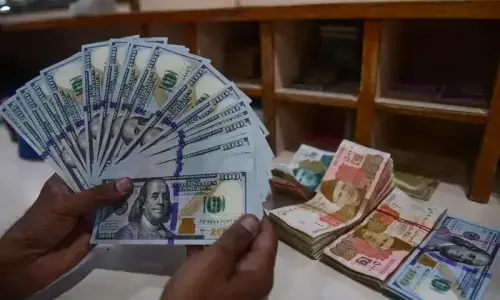
CRYPTOCURRENCIES, best understood as digital assets, remain a niche segment within the global financial system despite much recent hype. For digital assets to gain serious traction, they must prove their value through solid use cases that enhance the existing ecosystem. There are signs that this may finally be happening as reality begins to catch up with the hype. What does this suggest for the future of Pakistan’s financial markets?
In Pakistan, the first official stance came in 2018 when the State Bank of Pakistan warned the public that digital assets “are neither recognised as legal tender nor authorised by SBP for issuance, sale, purchase, exchange, or investment”. Fast forward to March 2025, when the government established the Pakistan Crypto Council, chaired by the finance minister, signalling a significant shift in attitude.
By July 2025, the Virtual Assets Ordinance was enacted, creating the Pakistan Virtual Assets Regulatory Authority to frame legal, licensing and regulatory policies for the sector. It now seems likely that Pakistan is moving towards adopting digital assets, making it important to understand their implications.
The underlying technology for cryptocurrencies is Blockchain: a shared, secure, transparent, immutable, and decentralised digital ledger of transactions. Blockchain offers many potential applications beyond cryptocurrencies.
The biggest challenge remains the high price volatility.
Cryptocurrencies date back only to 2009 with the launch of Bitcoin. Today, thousands of cryptocurrencies exist, ranging from legitimate projects to scams. Bitcoin remains the largest, with a current market capitalisation of around $2.5 trillion, five times that of the second-largest, Ethereum. Unlike fiat currencies issued by sovereign governments, cryptocurrencies have no central issuing authority. This decentralisation means they operate without banks or other financial intermediaries.
Public attention has largely focused on Bitcoin and a few others, mainly due to their extreme price volatility and the fortunes made or lost by speculators. However, for cryptocurrencies to become a meaningful part of the financial system, they must offer use cases beyond trading and speculation. We can assess this by comparing them to the traditional roles of currency: as a medium of exchange, a unit of account, and a store of value. Let’s examine two use cases.
Firstly, cryptocurrencies can serve as a faster, cheaper payment system. Current bank-based payment systems, especially for cross-border transactions, are slow and costly due to multiple intermediaries. Cryptocurrencies enable instant, direct payments between parties without banks. However, for this to work, cryptocurrencies require broader, potentially universal, acceptance. US companies like Ripple, which backs the cryptocurrency XRP, are positioning themselves as efficient alternatives for cross-border payments, even seeking collaboration with banks. Ripple’s July 2025 application for a US banking licence highlights this evolving relationship.
Secondly, cryptocurrencies are sometimes viewed as a ‘digital gold’, offering a store of value separate from government-issued fiat currencies.
This narrative has gained ground amid concerns over fiat currency debasement due to excessive monetary expansion, especially following the 2007-08 global financial crisis and the 2020 Covid-19 pandemic. Cryptocurrencies which have capped supplies (Bitcoin’s cap is 21 million coins), are seen as better preserves of value. However, this is not true for all cryptocurrencies.
The biggest challenge remains their high price volatility. Stability of value is essential for any asset to fully function as money. Stablecoins, sp-ecial cryptocurrencies pegged 1:1 to high-quality assets, offer a solution. The US passage in July 2025 of the GENIUS Act regulates stable-coins, requiring full asset backing. Stablecoin issuance is booming, with commercial banks like JPMorgan, the largest US bank, launching their own versions.
Central banks are also exploring digital assets via Central Bank Digital Currencies, government-issued digital fiat money. The SBP confirmed in July 2025 that it is working on a CBDC.
Notably, the US opposes a government digital currency, citing concerns about citizens’ privacy.
So, is this Pakistan’s crypto moment? The pace of developments in 2025 is unprecedented for a government initiative. The timing is intriguing, coming shortly after a US administration pursued a digital asset agenda. Pakistan has an opportunity to study global trends carefully, prioritise citizen welfare, and establish strong, thoughtful regulation.
Reports indicate substantial cryptocurrency trading and investment by Pakistani citizens. The government and regulators need to catch up.
The writer is a member of the Economic Advisory Group.
Published in Dawn, September 3rd, 2025