0
0


LAHORE: Wednesday was an enigmatic day for Lahorites: some of them, true to their spirit, went to River Ravi to see it springing back to life after decades of sleep and others, especially those living on its banks, considering it a dead stream now, in panic and disbelief about how it is going to behave in the coming hours or days – and at what cost?
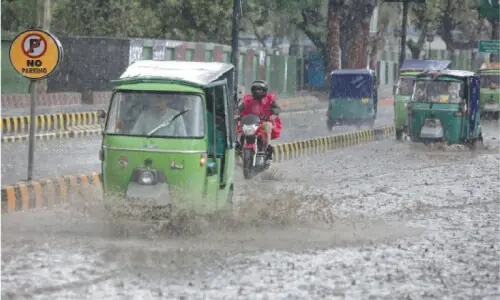
However, as news started spreading that large swaths of upper districts – like Narowal and Shakarghar – have submerged in floodwater released by India and the surge is going to hit suburbs of Lahore by night, fear set in, both for people and the provincial government.
Massive urbanisation around Lahore during the last four decades – since the last major flood hit the area in 1988 – has only multiplied potential affectees, who have built homes not only in ways of historical breach points but the riverbed itself. Thousands of homes, factories, petrol pumps and other huge investments are now threatened as Ravi threatens to break its banks.
The government, already stretched by simultaneously dealing with two other flooding rivers – Chenab and Sutlej – for the last few days, has yet another problem at hand: Ravi bullying to overflow and hold Lahore – the second largest city of the country – hostage.
The Context: With exceptionally heavy rains in its catchments, all its tributaries already overflowing and India releasing additional water from reservoirs, River Ravi has swollen beyond limits. The situation is ominous because Himachal Pardesh, from where Ravi originates, had 62 percent more rains so far and weather forecast torrential rains in the next 48 hours. It all flows into Thein dam on the Indian side. The Indians, warning Pakistan of impending flood, opened dam gates on Tuesday night, releasing well over 200,000 cusecs of water downstream into Pakistan. Some reports suggest that over 250,000 cusecs have actually been released.
Since India illegally held Indus Basin Water Treaty in abeyance in April and refused to share data, there is hardly any way to check the varsity of the water data. It delivered ‘lose’ warning massages to Pakistan about water releases through diplomatic channels, rather than Indus Commissioner’s office, and bred confusion about its plans and water handling.
It creates confusion. To begin with, no one on this side of the Redcliff divide knows whether this is only a surge that Pakistan must deal with or more will follow. What would be the quantum of the next one?
Though River Ravi was in a low-level flood at 72,000 cusecs during the day, it is expected to swell beyond 200,000 or 250,00 cusecs during the night and test defenses of the city. This is enough to give Lahorites sleepless nights.
Historically, River Ravi has been prone to flooding during the monsoon. It experienced three major flood waves in 1947 (225,000 cusecs), 1973 (237,380 cusecs) and 1988 (326,000 cusecs) and some smaller ones – less than 200,000 cusecs in the 1990s. Though all of them extracted high human and infrastructural cost, but they were dealt with.
Situation Handling:According to the Provincial Disaster Management Authority (PDMA), infrastructure on the river can handle up to 300,000 cusecs of water. Even with extraordinary measures, the river will surely wreak havoc beyond the 30,000 cusecs.
However, this assertion of the PDMA has its critics. Citing 1988 floods, comparable to the current situation, an official of the Punjab Agriculture Department says that a 326,000-cusec wave in 1988 was handled with breaches on the right bank and water flowed through vast empty lands around Shadara, Muridkey and joined the river again near Sheikhupura. This facility is not available now. All those areas are now populated with housing schemes, factories, development infrastructure and so on. “If the current surge remained within 200,000 cusecs, it would be managed, albeit at some human and infrastructure cost. But if it surges to 300,000 cusecs and beyond, suburban Lahore would be in for massive trouble,” he warned.
“All those vast fields, which became floodplains to save the city, now have two elevated motorways,” points out an official of the Irrigation Department. Both these motorways – Lahore-Sialkot and Lahore-Islamabad – would block water flow and inundate areas. They would also block the flood’s path back to the river. This is a dangerous situation, especially if India decides to empty its dams and releases additional water as it did on Wednesday,” he warns.
Published in Dawn, August 28th, 2025