0
0

SYED Shah Sirajuddin Husaini, commonly known as Siraaj Aurangabadi, an ascetic who scorned worldly gains and fame, was a popular poet of Urdu in 18th century. As put by Jameel Jalibi in his Tareekhe-i-Adab-i-Urdu, Siraaj Aurangabadi was the finest poet in the period between Vali Dakani and Mir Taqi Mir/ Mirza Sauda. Jalibi is of the view that no other poet of the era can surpass Siraaj when it comes to prolificacy, vigour and style.
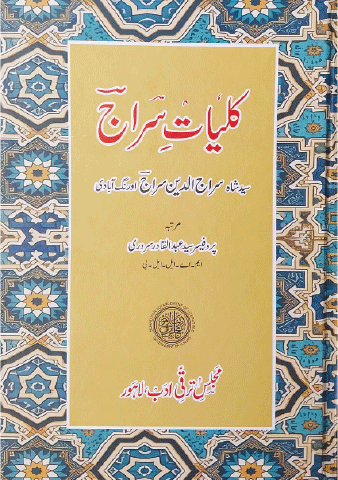
Prof Abdul Qadir Sarvari edited and annotated Kulliyaat-i-Siraaj (or complete poetic works) and published it in 1940. Lahore’s Majlis-i-Taraqqi-i-Adab (MTA), has just published a new edition of Sarvari’s version of Kulliyaat-i-Siraaj. This edition is published with text composed on Urdu’s calligraphic software and care has been taken to ensure an error-free text.
In his introduction to the new edition, Abbas Tabish, director, MTA, has rightly mentioned that Siraaj was a poet who profoundly influenced the genres of ghazal and masnavi in Urdu and his influence on latter-day giants, such as Ghalib and Mir Taqi Mir, too, can be discerned. One can hear Siraaj’s echoes in some of Mir’s couplets. Similarly, Ghalib’s ghazal reflects some impact of Siraaj’s thought and style. Abdul Qadir Sarvari in his foreword, duly reproduced in this new edition, has listed the phrases and compounds that are believed to be Ghalib’s innovation but were in fact first used by Siraaj Aurangabadi and Ghalib simply borrowed them from Siraaj, says Tabish.
Siraaj Aurangabadi’s biographical details are obscured. Firstly, because in those days such details were generally not considered as important as to be recorded precisely and, secondly, Siraaj himself did not give much importance to his poetry. In fact, he did not attach importance to his existence either. An ascetic who had forsaken poetry and much of worldly affairs at an age of around 27, Siraaj penned some events of his life in his introduction to Muntakhab Divanha (1169 Hijri), a selection from great Persian poetry that Siraaj had compiled before renouncing the world and beginning a life in isolation. Based on that semi-autobiographical piece, some researchers have tried to signpost Siraaj’s life, but their accounts differ, especially when they try to establish the dates of important events in the poet’s life.
For instance, Siraaj’s date of birth has been a contentious issue and scholars have reckoned different years. Shamsullah Qadri, Muhammad Yahya Tanha, Naseeruddin Hashmi, Ram Babu Saksena, Dr Rafiq Husain and Farman Fatehpuri have mentioned 1127 Hijri, (1715 AD) as Siraaj’s year of birth. Mohiuddin Qadri Zor wrote it was 1125, though he did not mention any source. Abdul Qadir Sarvari and Jameel Jalibi believed Siraaj was born in 1128 Hijri. What complicates things is the fact that Siraaj’s year of birth is not mentioned in any tazkira (account of poets and poetry) or any historical source. So most of the scholars have relied on a few couplets by Siraaj wherein he has mentioned the year of compilation of his divan. But Syed Shafqat Rizvi wrote that the text of those few couplets varies in different manuscripts and cannot be relied upon. So one should instead rely on a statement by Ziauddin Parvana, a disciple of Siraaj. According to Shafqat Rizvi, Parvana wrote in his Anvaar-us-Siraaj (1203 Hijri): “My khwaja (master) was born on Monday, 13th of Safar, 1124 Hijri, in Auranagabad. To mark Siraaj’s birth, his father wrote a chronogram that read Zahoor-i-Ahad.” The numerical values of letters used in Zahoor-i-Ahad, if added up, would come to 1124 (Hijri). And Safar 13, 1124 corresponds to 11th of March, 1712, which can be considered Siraaj Aurangabadi’s correct date of birth.
Siraaj is said to have remained in a state of trance-like ecstasy for about seven years. In that state of mystic self-transcendence, Siraaj began composing poetry in Persian, but never bothered to commit his verses to writing. Having come out of that state of ecstasy finally, he became a spiritual disciple of Shah Abdur Rahman Chishtie. Siraaj was about 20 at that time. A few years later, he quit writing ghazals and devoted most of his time to worship. His Urdu verses were compiled by Abdur Rasool Khan, another disciple of Abdur Rahman Chishtie.
Siraaj’s kulliyaat has ghazals, masnavis, panegyric odes, quatrains and other poetic forms that were in vogue at that time. Siraaj’s other works include Masnavi Bostan-i-Khayal (1160 Hijri), some other masnavis, Persian ghazals and letters.
Though Jameel Jalibi has mentioned 1763 as Siraaj Aurangabadi’s year of death, Siraaj died on Friday, the 4th of Shawwal, 1177 Hijri, which corresponds to April 6, 1764.
Published in Dawn, August 25th, 2025