India is working with a French company to develop and manufacture fighter jet engines in the country, New Delhi’s defence minister said.
Defence Minister Rajnath Singh in May approved the prototype of a fifth generation Advanced Medium Combat Aircraft (AMCA), calling it a “significant push towards enhancing India’s indigenous defence capabilities”.
Singh, in a speech at a conference in New Delhi on Friday, gave more details about developing fighter jet aircraft engines in the country.
“We are moving forward to manufacture aircraft engines in India itself,” Singh said, in comments broadcast by Indian media.
“We are collaborating with a French company to start engine production in India.”
Singh did not name the company, but Indian media widely reported the company to be Safran, which has been working in India for decades in the aviation and defence sectors.
There was no immediate confirmation.
India, one of the world’s largest arms importers, has made the modernisation of its forces a top priority, and made repeated pushes to boost local arms production.
The world’s most populous nation has deepened defence cooperation with Western countries in recent years, including the Quad alliance with the United States, Japan and Australia.
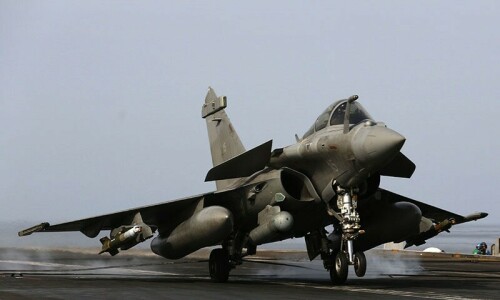
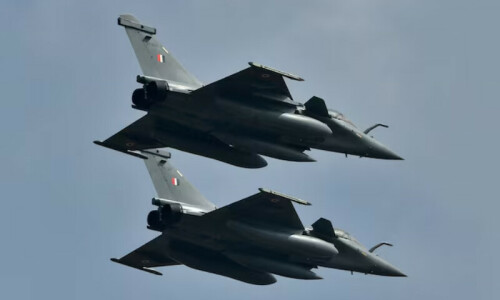
India signed in April a multi-billion-dollar deal to purchase 26 Rafale fighter jets from France’s Dassault Aviation.
It would join 36 Rafale fighters already acquired, and replace the Russian MiG-29K jets.
Singh has also promised at least $100 billion in fresh domestic military hardware contracts by 2033 to spur local arms production.
This decade India has opened an expansive new helicopter factory, launched its first domestically made aircraft carrier, warships and submarines, and conducted a successful long-range hypersonic missile test.
India was engaged with Pakistan in a four-day conflict this year, their worst standoff since 1999.
The military confrontation between India and Pakistan came in May as the former, without evidence, linked the Pahalgam attack to Islamabad, which strongly denied the allegations. On the night of May 6-7, New Delhi launched a series of air strikes on Pakistan, killing at least 40 civilians. Both sides then exchanged missiles, which stretched over the week, before a US-brokered ceasefire had both sides agree to stop the hostilities.