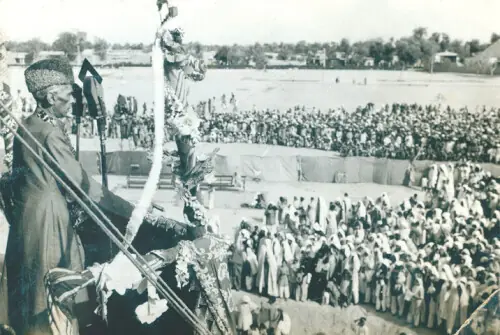
AS Pakistan marks its 78th Independence Day, the nation stands with renewed pride, reaffirming the vision of its founding father. Pakistan’s resolute response in the recent conflict with India has fuelled a surge of nationalistic fervour, created unity, integration and changed the world’s perception by exposing India’s hostility and antagonism. The plight of over 200 million Muslims in India, living under an atmosphere of fear and discrimination, serves as a reminder of the necessity of Pakistan’s creation. Had the subcontinent not been divided, we would have been denied the dignity of living as a free people — with our own land, sovereignty, and the promise of peace and equality.
The ideological, constitutional, political, and democratic movement led by Quaid-i-Azam Muhammad Ali Jinnah with courage, commitment and wisdom created a new state for the marginalised Muslim nation. His foresight and democratic resolve, reflected in his famous 14 points, revolutionised Muslim politics in the subcontinent. Unlike the Nehru Report, Jinnah’s 14-points (1929) charter was a comprehensive future constitutional framework which provided for federal form of governance and uniform measure of autonomy for the provinces.
It protected the legal rights of Muslims and demanded reforms in the Northwest Frontier Province and Balochistan. Further, the separation of Sindh from Bombay was emphasised in the points. The Quaid also emphasised protection of Muslim culture for strengthening social connections among scattered members of the community. Sharing common values, norms and customs contributed to the development of geographic and cultural harmony as unifying factors for Muslim nationalism. Jinnah’s 14 points formed a complete code for protection of distinctive Muslim culture and civilisation and formed the basis for Muslims’ legal battles for achieving independence.
In 1930 Allama Dr Muhammad Iqbal conceived the idea of a separate homeland for Muslims and his clear conception was based on geographical and ideological factors, which became indispensable for launching the movement for a separate country from the platform of the All-India Muslim League (AIML).
Nevertheless, the British unveiled their plans and later passed the Government of India Act 1935, which contemplated a constitution with central government and provincial assemblies which were granted autonomy. More Indians were to be given the right to vote. Muslims were disappointed with this act because it provided insufficient autonomy to them in provincial assemblies. The Indian National Congress (INC) also rejected the act on the grounds that it will further divide people of India. However, despite their serious concerns over the British’s constitutional move, both INC and AIML agreed to participate in the 1937 elections based on this act. In these elections Congress achieved success and emerged as the dominant party winning 706 seats out of 1,585. Thus, the Congress successfully formed the ministries in various provinces, including Muslim-majority provinces. It introduced Wardha Scheme which downgraded Muslims. Anti-Muslim initiatives of Congress exposed its real face and Muslims became aware of Congress politics aimed at securing the rights of Hindus.
The Muslim League was able to present the best strategy for securing first nationhood, then statehood. The Lahore Resolution was the practical solution of problems faced by India’s Muslims.
Considering the AIML’s unsatisfactory performance in the 1937 elections, the Quaid reorganised the party and created unity among its discordant factions to create a mass movement. The Lahore Resolution of 1940 marked a significant milestone in the Muslims’ pursuit of a separate homeland. Thus, Muslim League cooperated with the British due to assurance it received from them for their support for the creation of Pakistan.
It was after the Lahore Resolution that the name ‘Pakistan’ became widespread despite being coined by Chaudhary Rahmat Ali in 1933. The resolution proposed the creation of independent states for Muslims in regions where they were in the majority. The Congress strongly opposed the Lahore Resolution, because it considered this would divide India.
The Muslim League was able to present the best strategy for securing first nationhood, then statehood. The resolution was the practical solution of problems faced by the Muslim community. However, the Quaid remained cautiously optimistic as well as determined about the road ahead.
During his presidential address at the Muslim League’s session at Lahore he asserted that India’s 90m Muslims were not a minority but a nation. He based his concept of Muslim nationhood on the contemporary political discourse of nation-state and its elements such as territorial sovereignty, nationalism, and citizenship.
The resolution specified the geographical boundaries of the Muslim state it wanted to establish in north-western and north-eastern India where Muslims were in the majority. The resolution provided legal foundation of the Muslim nation-state by emphasising territorial sovereignty.
Lahore Resolution was not just an ideological triumph; it was a glimpse into the vision for Muslims which was no more blurred by power-sharing compromises. The resolution brought the Muslim community on the cusp of a new era of emancipation and made its ideological goals clear, leaving no room for alternative destinations. There was a swarm of challenges in the way of realising these goals.
Two years later the Cripps Proposal (1942) was conceived as a British plan offering India full dominion status and the right to frame its own constitution after World War II. It allowed princely states to have the same status as provinces and gave provinces the choice to opt out of the Indian Union. The proposal failed because Congress rejected it, as they demanded an immediate transfer of power rather than waiting until after the war. The Muslim League also opposed the idea, as it did not explicitly promise a separate Muslim state (Pakistan). The British insisted on retaining control over defence and communication, which Indian leaders found unacceptable.
In order to divert attention of the masses towards the Muslim demand, Congress started Quit India Movement (1942), which was a mass civil disobedience movement demanding an immediate end to British rule in India. The common Indian was motivated to support the movement boycotting British goods and businesses, withdrawing money from government banks, refusing to cooperate with British officials and leaving cities for villages. The Quit India Movement began because the British failed to offer an immediate and satisfactory solution for India’s independence. The Cripps Proposal had been rejected, and frustration grew among Indian leaders. The movement was also fuelled by the hardships of World War II and the increasing desire for self-rule.
Protesting and participating in civil disobedience activities during the Gandhi-Jinnah Talks (1944), Gandhi remained unsuccessful in convincing Jinnah to abandon his demand for the partition of India and the creation of Pakistan. The talks reinforced the Two-Nation Theory and shaped future negotiations, ultimately leading to the partition of India.
In 1945, the Simla Conference was called by Lord Wavell after World War II to discuss India’s future governance. He offered complete power to the Indian government, with the viceroy as only a ceremonial head. However, the conference failed because the Congress and the Muslim League had conflicting demands — Congress opposed separate Muslim representation, while the Muslim League insisted on its demand for Pakistan. The failure of the conference highlighted the deep divisions between the two parties.
However, in the General Elections of 1945-46, the Congress won over 80 per cent of non-Muslim seats, while the Muslim League secured all 30 Muslim seats in the Central Legislature. In the provincial elections (1946), the Congress dominated non-Muslim seats, and the Muslim League won around 95pc of Muslim seats, proving itself as the sole representative of Indian Muslims. Thus the Cabinet Mission (1946) was sent by the British government to resolve the political deadlock between Congress and the Muslim League. It proposed an Indian union, a constitution-making body, provincial autonomy, and an interim government supported by major political parties.
The Muslim League initially accepted the plan because it allowed grouping of Muslim-majority provinces and gave them the option to opt out after the first general elections, aligning with their demand for Pakistan. The Muslim League withdrew from the plan when the Congress rejected key provisions and agreed to join the constituent assembly with amendments, which threatened the League’s demand for a separate Muslim state.
Thus, Direct Action Day (Aug 16, 1946) was a nationwide protest called by the Muslim League to press for the demand for Pakistan after the failure of the Cabinet Mission. It led to violent riots, particularly in Calcutta, causing thousands of deaths. In December 1946, the London Conference was convened to discuss the critical situation that had emerged since the Direct Action Day. Nevertheless, acceptance of the British government’s decision regarding grouping of provinces paved the way to partition.
Lord Louis Mountbatten was appointed as the last viceroy of India with a task to oversee the British withdrawal from the subcontinent and to build relationships with prominent leaders. His attempts to convince Mr Jinnah to agree to united India were unsuccessful. The British Parliament passed the Indian Independence Act on July 18, 1947 and formally legislative authority was granted to respective constituent assemblies of the newly formed states. The Muslim League finally won its political battle against all odds. Muslims entered their promised land and secured their national home.
The Quaid had genuinely desired for friendly relations between India and Pakistan. But partition was painful, and the territory Pakistan received was moth-eaten due to unfair distribution of areas and vivisection of two historic Muslim dominions of Bengal and Punjab. For demarcating the borders between India and Pakistan a commission was formed under Cyril Radcliffe — a man who had never visited India. Consequently, the decisions of the commission caused significant problems, including mass migration, disputes, and communal violence.
The bloodbath that ensued between Muslims and Hindus originated in the British partition policies, which were directly responsible for deadly breakdown in intra-community relations. Displacement and tensions caused the death of around one million people from both sides. The boundary division was unjustified and unfair because it favoured India and caused territorial losses to Pakistan. It was deprived of many Muslim-majority areas; consequently territorial disputes between India and Pakistan arose. Soon after independence both countries engaged in their first armed conflict in 1947 marking the beginning of long-standing tension between both nations over Kashmir.
The legacy of partition has remained the major factor in the Indo-Pakistan relationship to the extent that even after several decades, both countries are unable to improve ties. The post-partition wars over Kashmir intensified the sense of Pakistan’s vulnerability, and this gave impetus to development of Pakistan’s nuclear weapons as a reactive move to the Indian nuclear programme.
Keeping in view Narendra Modi’s anti-Pakistan rhetoric during his election campaign for his third consecutive term, it was not expected from India to improve its relations with its neighbour, which nosedived in 2019 with India’s revocation of Articles 370 and 35A of its constitution, annulling held Kashmir’s limited autonomy.
Thus, Modi’s hubristic hold over power using Hindutva as a tool continued to undermine Pakistan by spreading social media lies and false propaganda against the country. Nevertheless, India has failed spectacularly in its mission.
Pakistan’s deepening strategic partnership with China and the recent upswing in relations with the United States have opened a rare diplomatic window. Pakistan needs to pursue diplomatic efforts to remove insuperable obstacles, turn the long-cherished dream of Kashmir’s accession to Pakistan into a historic reality and accomplish the unfinished task of partition.
The writer is Professor of History and Pakistan Studies & Chairman, Board of Intermediate & Secondary Education Hyderabad.