ISLAMABAD: PPP leader Sherry Rehman has said Indian Prime Minister Narendra Modi’s hegemonic ambitions have turned India into a rogue state, creating a risk-laden environment for Pakistan and the entire South Asian region.
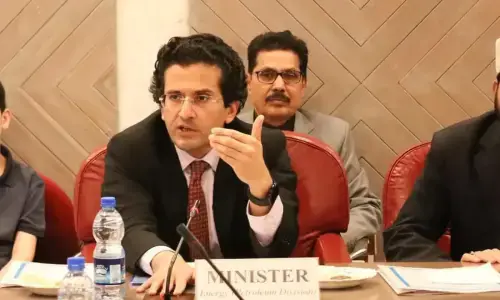
“Modi’s India has emerged as a rogue state. This is a strategic new abnormal attempted to be imposed on South Asia by a hegemonic power next door,” she said while speaking at the Institute of Regional Studies on “Pakistan’s Strategic Global Outreach”.
“It is not business as usual — it is a deliberate attempt to normalise dangerous escalations. Pakistan is not dabbling in an imaginary narrative. Our diplomacy is rooted in ground realities and verifiable facts. Narrative alone cannot be the basis of statecraft,” Senator Rehman emphasised.
“Modi has brought the Gujarat model to all of India, which is a classic case of Moditwa, a beleaguered India. This doctrine openly prioritises confrontation over dialogue. It openly embraces conflict. It wants to identify an enemy within the country and an enemy without. The enemies within are the Muslims and other minorities, and the enemy without is Islamabad. They have used narrative building as a tool for hostile unilateralism in a hyper-charged, nuclearised environment,” added.
Says Islamabad’s diplomacy rooted in ground realities, verifiable facts
Sherry Rehman, who is also PPP vice president, said Modi has four ambitions to fulfil: “First, Modi’s India continues to seek to manipulate terrorism as a domestic and international dog whistle, fomenting and supporting instability inside Pakistan, which is totally unacceptable. Second, it negates all calls for bilateral or mediated diplomacy as a tool for engagement, which mature countries do, while targeting Pakistan with aggressive calls for isolation across multilateral forums. That is not happening either, which you can see from the US to China, or the region.
“Third, it builds a motive for military action as a coercive tool — from cross-border strikes to air-based attacks. It is not a doctrine based on power, it is a doctrine based on fear. Fourth, it embraces unilateralism as the only path on key disputes, including Kashmir. It weaponises a settled Indus Water Treaty by attempting to create irreversible facts on the ground. Israel does the same.”
The PPP leader said the May limited war redefined deterrence dynamics, yet India and the Modi government remain intent on attempting to cement this “new abnormal” as the region’s status quo.
Highlighting Pakistan’s diplomatic mobilisation, she credited the coordinated leadership of the prime minister, army chief, Foreign Office and PPP chairman. “Our delegations went from capital to capital during a diplomatic deficit, speaking truths on the ground that others were not hearing. It was a pivotal moment to position Pakistan as a serious, emerging, moderate medium power.”
Senator Rehmen accused India of creating a gap between reality and fiction even within its own country. “The Modi government has fallen into a commitment trap, driven by BJP-RSS culture and domestic political compulsion.”
She said India’s institutional framework is in decline, with the government increasingly relying on crisis creation — both internal and regional — to maintain control.
“From entertainment to mainstream media, India has blurred the line between truth and propaganda. The war showed the world what this abnormality looks like — from the weaponisation of water to fictionalised claims of military successes. India even claimed to have shot down Pakistani aircraft three months after the conflict, but provided no proof,” she added.
The PPP leader warned against India’s repeated attempts to weaponise water. “This is a completely mala fide intention — turning a treaty into a dispute and breaching long-standing red lines. Once cross-border rivers become weapons, consequences will be dangerous.
“Pakistan will never accept unilateralism, nor the weaponisation of water, sovereignty, or narrative. We have always sought dialogue, but we cannot repeatedly request engagement from a state that speaks the language of toxicity. The time has come to expose India’s rogue behaviour on all fronts,” she urged.
Published in Dawn, August 13th, 2025