0
0

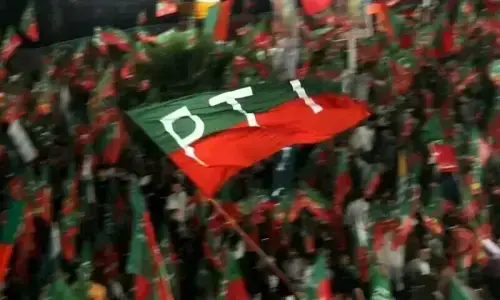
FAMED German philosopher Friedrich Nietzsche in his book, Beyond Good and Evil: Prelude to a Philosophy of the Future, wrote: “In individuals, insanity is rare; but in groups, parties, nations, and epochs, it is the rule.” In today’s Pakistan, the truth of these words is absolute to the point of being painful, with politics of cult and insanity of masses going hand in hand.
Neil Postman, in his book, Amusing Ourselves to Death: Public Discourse in the Age of Show Business, discussed how television prioritises appearance over substance. In a visual world, he argues, being good-looking and confident matters more than being wise or knowledgeable.
In The Origins of Totalitarianism, Hannah Arendt explained that totalitarian propaganda does not aim at telling the truth, but instead replaces reality with a powerful fiction. In the Pakistani context, we have all seen the cult narrative taking U-turns after U-turns, with the resultant political shifts becoming an emotional journey for millions, who kept believing that nothing mattered except the sup-remacy of their leader above and beyond anything and everything; way above and beyond.
Belgian psychologist Mattias Desmet says that when people go through four things — loneliness, lack of meaning, anxiety and frustration — they become mentally vulnerable. In this state, whole groups can fall under the spell of a false, but powerful story. They give up thinking for themselves in exchange for a sense of belonging and direction.
In Pakistan, there was frustration, youth unemployment, inflation and a climate of fear and confusion. The people were searching for hope. The ‘leader’ stepped into this emotional vacuum with a simple story: he is the ‘good guy’, and everyone against him is part of an ‘evil plan’. His slogans were not policy goals, but emotional calls that made people feel proud, moral and united.
In such cases, people stop caring whether something is true or not. What matters is whether it fits the emotional story they now believe.
This explains why many party supporters ignore scandals, court cases and gover-
nance failures. They are not just following a politician; they are defending their emotional reality. The ‘leader’ has become a symbol of personal dignity and national pride, and any criticism of him feels like a personal attack.
Such mass formation is dangerous. People lose interest in facts, and loyalty is valued more than truth or justice. When this happens, corruption hides behind slogans, and democracy turns into a popularity contest.
At this point, it is clear that the party has become a group centred around a cult figure. Loyalty to the ‘leader’ has replaced policy, governance and debate. Even criticism from within is treated as betrayal rather than reflection.
This emotional dependence on one man has blinded supporters to corruption, mismanagement and democratic decay. Politics has turned into myth-making, where facts no longer matter and failure is rebranded as conspiracy.
If the supporters do not break free of this tantalising cult, this cycle of emotional politics, and return to the core elements of critical thinking, institutional trust as well as accountability, the price will not just be political; it will be national.
Muhammad Ramish Chaudhry
Islamabad
Published in Dawn, August 5th, 2025