It’s all around us. On TV news bulletins, in newspaper headlines and even going viral on social media: couples suffer heavy consequences in marrying for love.
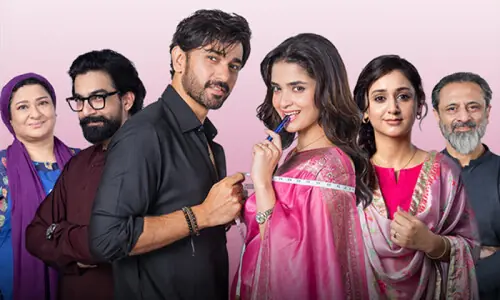
In Pamaal, the new serial out on Green TV from next week, we see Malika, played by Saba Qamar Zaman, defying the odds and choosing love over tradition, leaving behind the comfort, safety and security of her father’s house for the unfamiliar. What she finds at her husband’s house, however, isn’t a bed of roses and the typical fairytale happy ending she had bargained for, and for which she gambled away her future security, prospects and happiness.
Malika’s husband, Raza, played by Usman Mukhtar, is everything she ever wanted in a husband: stable, thoughtful and devoted. But their life together as husband and wife starts off on unsure footing, and constraints slowly begin to creep up and tighten their hold around Malika, crushing her free spirit.
Sounds familiar so far, doesn’t it?
The plot rings true for so many women who make the journey from their father’s house to the husband’s and in-laws’ house on uncertain terms. Moreover, Pamaal is about a woman, Malika, who learns how to survive and reclaim her strength, independence and true identity. It is a moving tale of love, loss, resilience and second chances in life — the end of one journey leading to the beginning of another.
Pamaal premieres this month on Green TV’s prime time slot and will be simultaneously released digitally on Green Entertainment’s YouTube channel and other social platforms.
Saba Qamar and Usman Mukhtar come together in a pairing that seems defined by depth, nuance and emotional intensity — both actors are known for their bold role choices and powerful screen presence. In Pamaal, they portray a relationship filled with love, restraint but also unspoken tension.
Their chemistry is poised to drive the story forward, making them the emotional anchor for the drama written by Zanjabeel Asim Shah (Bismil, Noor Jahan, Habil aur Qabil, Shiddat) and directed by Khizar Idrees (Mastaani, Lapataa, Badshah Begum, Manto, Verna, Zindagi Tamasha). A stellar supporting cast includes Haris Waheed, Salma Asim, Adnan Jaffar, Faiza Gillani, Naima Khan, Shahnawaz Zaidi and Fatiq.
It is claimed that this unusual love story and journey of self-discovery is based on a true story. However, Icon was unable to confirm the exact story behind the inspiration from writer Zanjabeel Asim Shah, since she was travelling.
The new Green TV drama Pamaal, which goes on air from next week and stars Saba Qamar and Usman Mukhtar, revolves around a young woman who marries for love, only to find her dreams of happy-ever-after fall apart. Can a nuanced, reflective serial capture viewer eyeballs like more standard masala fare?
From the teasers and the production clips I was able to view, Pamaal’s visual direction brings believable intimacy and authenticity to the screen, in a story of emotional depth and quiet rebellion by director Khizer Idrees.
Pamaal is a drama at its most intense when it comes to topics such as love, marriage and finding self-worth. Was it just as intense to direct it, I ask its director. “Directing Pamaal has definitely been intense, but in the most rewarding sense,” says Khizer. “This is not just another story about the emotions and traumas of married life, but it is also based on a true story. Hence, the aim was to translate that as authentically and meaningfully as possible on screen. There was a certain ethical and emotional precision we needed to achieve.

“Authenticity was essential, not just in terms of the events depicted, but in the psychological truth of how people internalise pain, navigate control, and search for meaning within relationships.
Khizer continues: “My process was about walking a fine line, about remaining loyal to the emotional truth of the script while allowing room for cinematic interpretation. The story had its own integrity, but there were moments where we leaned into creative licence to help the audience stay emotionally connected.
“Reality can sometimes be too complex to depict in a strictly literal way. So, occasionally, filmmakers shape certain elements to heighten the impact. I tried the same, but it was never about embellishment. It was about making the experience more immersive.
“We all have our own stories and experiences, which make us unique from the rest,” he adds. “To tell a story of someone that is also relatable to everyone is a huge task in itself. Directing something like this requires a deep level of trust with your cast and crew. I feel blessed that everyone contributed wholeheartedly and performed their parts amazingly well.”
So, as Pamaal progresses, what should viewers expect or watch out for direction-wise? Khizer explains: “Briefly, Pamaal is about how past wounds echo into the present, and shape the contours of a marriage. The challenge was to peel off the story’s intensity one layer at a time. The progression of the emotions should be dictated by the progression of the whole story, rather than the individual scenes.”

The process, the director explains, involved working closely with the actors who, due to the non-linear pattern of shooting, had to pick up their character’s arc from different places. As the director, he says, “I had to be mindful as well that I, along with the actors, follow the trajectory as planned.
“Secondly, it is very easy to keep the characters either black or white. We, on the other hand, carefully and consciously kept the characters grey, so that we could add a texture of reality. And as someone who has to keep a bird’s-eye view on everything, I had to mentally review every nuance, every detail, every dialogue, so that nothing feels sensationalised.”
Can we expect some unexpected twists in the story as Pamaal runs its course, I ask Khizer. “Absolutely,” he responds. “Circling back to my first point, this story is based on true events and, like everyone’s life, this story too meanders through the unexpected
curveballs of real life. The characters have to take the red pill to survive the menacing wrath of the events that dawn every day like a new day.
“As the director, I sincerely hope that me and my team’s effort would do justice to the script and also echo the similar silent stories drifting around us,” he adds.
Saba Qamar has a strong track record of choosing meaningful roles as an actress. What drove her to accept the offer to play Malika?
“What made me say ‘yes’ right away is that Malika’s story is real — it’s based on a true story and that instantly made it meaningful for me,” she tells Icon. “She’s someone who truly exists in our society, and I felt connected to that.
“She’s a simple, innocent girl from the mountains who sees the world through a pure lens. When she falls in love, she believes in it completely, but slowly discovers that the man she loves is a narcissist. Her world shifts and so does she.”
For Saba Qamar, the message is clear: whether you’re a girl or a guy, emotional dependency can make you feel powerless.
“I wanted to be part of something that encourages people to find strength within themselves. There’s more to her journey, but I want people to experience it firsthand. That’s why I took this role — it spoke to something real.
“I’ve played powerful and intense roles before,” says Saba, “but Malika is different. She’s a simple girl who hasn’t seen the world’s harsh side. She lives by her values, listens to her husband, and sacrifices her own dreams without questioning. Her husband is narcissistic, but she doesn’t even realise that and just keeps following his lead. Then life throws challenges at her that are way beyond what she’s prepared for… but she still faces them. That quiet strength, that inner journey it’s what makes Malika so special to me.”
And what does she think of Zanjabeel Asim’s script exploring the concept of women’s self-worth? Does she think Khizar Idrees’ direction has done justice to it?
“I think Zanjabeel has brilliantly shown the side of society we often ignore, of how women are raised to suppress their feelings, what our mothers teach us about sacrifice, and how deeply that shapes us. She’s [Zanjabeel] exposed the darkest corners of our culture, and every woman can relate to this story in some way. It’s real, this is what’s happening around us every single day.
“As for Khizar Idrees, he’s done complete justice to it. He understands emotion, depth, and the silence between words. I’m genuinely proud he directed this project, as I truly believe people are going to feel this one down to the very core of their beings.”
Finally, I ask her, how does she think female viewers will relate to Pamaal?
“I believe Pamaal will go a long way in giving women the courage to reflect, to question, and to find their voice again. It’s not just a story… it’s a mirror. So many women lose themselves in love or marriage, and this character shows that it’s never too late to stand up and say ‘I matter too.’ If even one woman sees herself in Malika and decides to stop shrinking, then I think we’ve already made an impact.”
I approach Usman Mukhtar, who plays Raza, Malika’s husband, with the query if his character is someone whose personality borders on toxic masculinity or is he just a victim of confusion or misunderstanding?

“Raza is a very complex character, and a grey character to play,” he tells me. “He is not a hero in the conventional sense and there are a lot of things about him that I cannot reveal here right now. You will have to witness his character unfolding in the coming episodes.”
How did he find the script and the direction? “Pamaal is a pretty decent script from Zanjabeel Asim and the quality [of direction] is also pretty good, as everybody must have already seen from the teasers. I’m also pretty excited to see how viewers react to this drama.”
Recently, Green TV has been on a winning streak, with back-to-back dramas that have been bringing in the much-sought-after TRPs or ratings. Kabuli Pulao, Duniyapur, Iqtidar and Faraar immediately spring to mind.
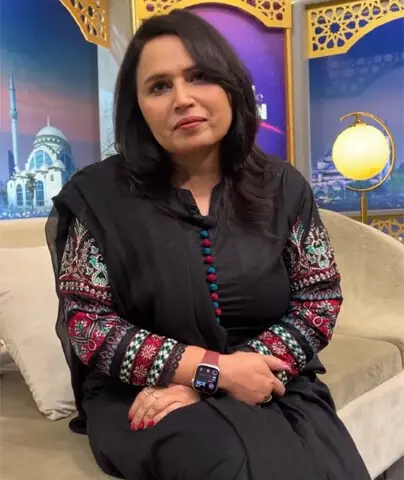
I ask Tehreem Chaudhry, executive director at Green Entertainment and producer at Multiverse Entertainment, about leading the race in drama production and what conscious choices and decisions have been made to steer the channel in this direction.
“From the start, the decision was to treat content as more than just ratings chasing. We choose stories that have something to say. That shift in mindset — backing quality over familiarity — is what sets us apart, what I want to take forward and something that I don’t ever want to let go.”
In answer to what TV viewers can expect in the near future, she says, “All I can say for now is more risk-taking. More variety. Stories that go beyond the usual family feuds or romance angles. Maybe even cross-genre experimentation — I believe it’s something that’s totally missing from our screens right now.
“There’s a big focus on elevating production standards as well, not just visually but in how scenes are written, scored and edited. We want viewers to feel like they are watching something crafted with care, not rushed to fill air-time.”
What are her views on the Pakistani drama circuit and the direction it’s headed in? “You can feel there has been a shift and standards are going up. Writers, actors and directors — they all want to explore different genres and do something different. There’s more focus on craft than just ticking commercial boxes.
“I won’t shy away from giving a bit of credit to Green TV, as the viewers’ response after its launch said it loud and clear: audiences want substance! That pressure to create quality again and again is actually a good thing. It’s pushing the whole industry forward, to evolve, and it’s about time!”
In actual fact, despite the critical success of dramas such as Kabuli Pulao, there were rumours that Green TV had decided to pivot towards more typical and sensational drama fare that was said to get better ratings.
As Green Entertainment’s flagship prime-time drama for August, Pamaal has a lot riding on it. Can a project that blends emotional depth with narrative maturity, and which champions the complexity of modern relationships, resilience in the face of heartbreak, and the journey from silence to self-worth, also draw in the viewers over more standard masala-fare?
I guess we will find out this month.
Published in Dawn, ICON, August 3rd, 2025