Trump says India to pay 25pc tariff from Aug 1 with additional penalty for Russian energy purchases


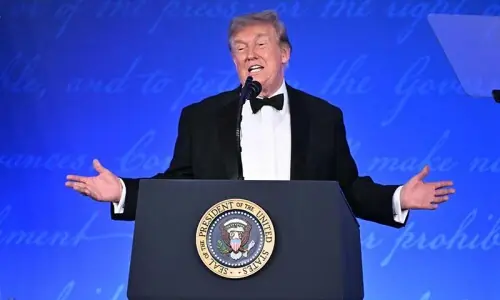
United States President Donald Trump on Wednesday imposed a 25 per cent tariff on goods imported from India starting August 1, along with an unspecified penalty for buying Russian weapons and oil, potentially straining relations with the world’s most populous democracy.
The US decision singles out India more severely than other major trading partners, and threatens to unravel months of talks between the two countries, undermining a key strategic partner of Washington and a counterbalance to China.
In posts on his social platform Truth Social, he said the US had a “massive trade deficit” with India.
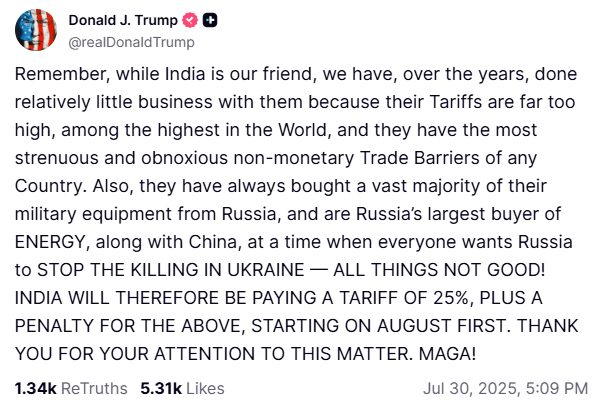
In another post, he said: “Remember, while India is our friend, we have, over the years, done relatively little business with them because their tariffs are far too high, among the highest in the world and they have the most strenuous and obnoxious non-monetary trade barriers of any country.
“Also, they have always bought a vast majority of their military equipment from Russia, and are Russia’s largest buyer of energy, along with China, at a time when everyone wants Russia to stop the killing in Ukraine — all things not good! India will therefore be paying a tariff of 25pc, plus a penalty for the above, starting on August 1st.”
White House economic adviser Kevin Hassett said Trump has been frustrated with how trade talks with India are progressing and believes his 25pc tariff announcement will help the situation.
Trump and US Trade Representative Jamieson Greer will have more information “shortly” on the additional penalty, Hassett told reporters at the White House.
In response, the Indian government said in a statement that it was studying the implications of Trump’s announcements and remained dedicated to securing a fair trade deal with the US.
“India and the US have been engaged in negotiations on concluding a fair, balanced and mutually beneficial bilateral trade agreement over the last few months. We remain committed to that objective,” it said.
India said it attached the utmost importance to protecting and promoting the welfare of its farmers, entrepreneurs and small businesses.
“The government will take all steps necessary to secure our national interest, as has been the case with other trade agreements,” it said.
The White House has previously warned India about its high average applied tariffs — nearly 39pc on agricultural products — with rates climbing to 45pc on vegetable oils and around 50pc on apples and corn.
Russia continued to be the top oil supplier to India during the first six months of 2025, making up 35pc of overall supplies.
The US currently has a $45.7 billion trade deficit with India.
The news pushed the Indian rupee down 0.4pc to around 87.8 against the US dollar in the non-deliverable forwards market, from its close at 87.42 during market hours. Gift Nifty futures were trading at 24,692 points, down 0.6pc.
Earlier, he said a trade deal with India had yet to be finalised and warned of possible higher tariffs ahead of an August 1 deadline to seal an agreement.
His comments followed a Reuters report that India was preparing to accept higher tariffs of 20-25pc on its exports to the US in the absence of a trade deal, as it holds off on offering fresh concessions ahead of Friday’s deadline.
“India has been a good friend, but India has charged basically more tariffs, almost more than any other country,” Trump told reporters aboard Air Force One on Tuesday, adding that it would come to an end.
Asked about the Reuters report, Trump said a trade deal had not been finalised and India could face steeper tariffs.
India plans to resume broader trade talks with the US in mid-August when a US delegation is due to visit, hoping to seal a comprehensive bilateral trade agreement by October, Indian officials said.
“Talks are progressing well,” an official said, adding Trump could issue a tariff order in a “worst-case scenario”. The official declined to be identified without authorisation to speak to the media.
“But, we assume it would be (a) temporary measure, considering the five rounds of trade talks that have taken place. A deal will soon be worked out,” the official said.
Trump also reiterated his claim that he helped broker a ceasefire to the conflict between India and Pakistan earlier this year, saying both sides accepted his request.
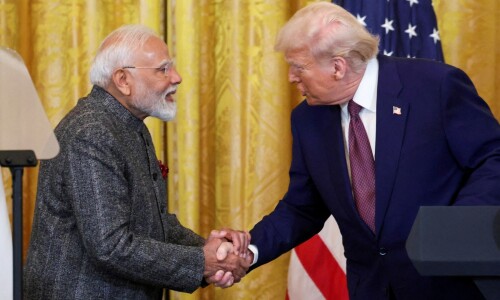
“That was great,” he said describing his friendship with India’s Prime Minister Narendra Modi. India disputes Trump’s claims that he brokered the ceasefire.
Analysts say Trump’s remarks on the India-Pakistan conflict have cast a shadow on trade negotiations.
On Monday, Trump said most partners that do not negotiate separate trade deals would soon face tariffs of 15-20pc on their exports to the US, well above the broad 10pc tariff he imposed in April. His administration will notify some 200 countries soon of their new “world tariff” rate.
US Trade Representative Jamieson Greer told CNBC that the India talks require more time, noting Trump wants good deals, not fast ones.
India has shown “strong interest in opening portions of its market” though its trade policy had long focused on protecting domestic interests, Greer said.
Piyush Goyal, India’s trade minister, told Reuters last week India was making “fantastic” progress in US trade talks.
Indian officials said New Delhi had offered tariff cuts on a wide range of goods and was working to ease non-tariff barriers.
However, agriculture and dairy remain no-go areas, with India unwilling to allow US imports of genetically modified soybean or corn, or to open its dairy sector.
Total bilateral goods trade reached about $129bn in 2024, with India posting a surplus of nearly $46bn.
Officials said India was calibrating its strategy amid broader US tariff threats targeting Brics nations (Brazil, Russia, India, China, South Africa and others), including India, over issues such as de-dollarisation and Russian oil purchases.
“We remain hopeful of securing a deal that gives Indian exporters preferential access compared to our peers,” a second Indian government official said, speaking on condition of anonymity.
Contentious issues
“Higher tariffs for India compared to countries it competes with, for exports to the US, are going to be challenging,” said Ranen Banerjee, a partner of economic advisory services at PwC India.
India’s commerce ministry, which is leading the trade talks, did not immediately respond to a request for comment.
US and Indian negotiators had held multiple rounds of discussions to resolve contentious issues, particularly over market access into India for US agricultural and dairy products.
Despite progress in some areas, Indian officials resisted opening the domestic market to imports of wheat, corn, rice and genetically modified soybeans, citing risks to the livelihood of millions of Indian farmers.
The US had flagged concerns over India’s increasing and burdensome import-quality requirements, among its many barriers to trade, in a report released in March.
The new tariffs are expected to impact India’s goods exports to the US, estimated at around $87bn in 2024, including labour-intensive products such as garments, pharmaceuticals, gems and jewellery, and petrochemicals.
India now joins a growing list of countries facing higher tariffs under Trump’s “Liberation Day” trade policy, aimed at reshaping US trade relations by demanding greater reciprocity.
The setback comes despite earlier commitments by Prime Minister Narendra Modi and Trump to conclude the first phase of a trade deal by autumn 2025 and expand bilateral trade to $500bn by 2030, from $191bn in 2024.
Indian officials have previously indicated that they view the US as a key strategic partner, particularly in counterbalancing China. But they have emphasised the need to preserve policy space on agriculture, data governance and state subsidies.
Hopes for a deal
It was not immediately clear whether the announcement was a negotiating tactic. While Trump railed against Japan in a June 30 Truth Social post and said there would likely be no deal with the North Asian nation, a deal was agreed on July 22.
An Indian government official told Reuters that New Delhi continued to remain engaged with the United States to seal an agreement.
Economists, too, remained hopeful.
“While the negotiations seem to have broken down, we don’t think the trade-deal haggling between the two nations is over yet,” said Madhavi Arora, an economist at Emkay Global.