• Ruling PTI gets six, opposition alliance secures five seats as per agreed formula
• KP lawmakers allege ‘vote-swapping’ by party leadership to keep members in line
• PML-N nominee bags Punjab seat in by-election
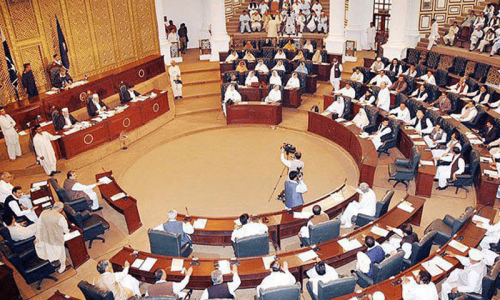
PESHAWAR: After more than 17 months, the Senate finally became whole on Monday as Khyber Pakhtunkhwa Assembly, following the oath-taking of lawmakers on reserved seats, elected 11 members to the upper house of parliament under a seat-sharing formula inked between the PTI government and the opposition alliance.
As per the arrangement which had been initially opposed by several PTI lawmakers, six seats went to the ruling party and five to the opposition parties, including two each to the PPP and the JUI-F and one to the PML-N.
The election witnessed a 17-month delay due to litigation over reserved seats, which was finally settled with the decision of the Constitutional Bench last month, followed by the ‘controversial’ oath-taking of members on Sunday. The final result was in line with the seat adjustment deal, agreed between the PTI government and the opposition parties.
For the election, six PTI nominees, five opposition picks, and one PTI dissident were in the running. Initially, five disgruntled PTI candidates were vying for the Senate seats, but Irfan Saleem, Mohammad Waqas Orakzai, Syed Irshad Hussain, and Aisha Bano withdrew after the party leadership convinced them that their candidacy would harm the party.
According to Form-58 released individually to the winning candidates by the returning officer, the ruling PTI won six seats: four general seats and one seat each for women and technocrats. Similarly, the opposition got five senate seats: three general and one each reserved for women and technocrats. PTI winners on the general seats included Murad Saeed with 26 votes, Mirza Afridi with 21 votes, Faisal Javed with 22 votes, and Noorul Haq Qadri with 21 votes. Azam Swati and Robina Naz won the reserved seats with 89 votes each.
PPP’s Talha Mehmood, Niaz Ahmed of the PML-N, and JUI-F nominee Attaul Haq received 18 votes each on general seats, while the technocrat and woman seat respectively went to PPP’s Robina Khalid and Dilawar Khan of the JUI-F. Ms Khalid got 52 votes and Mr Khan got 54 votes.
Vote-swapping allegations
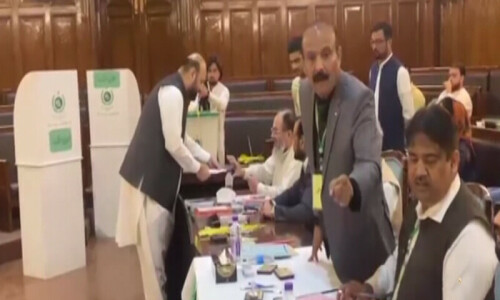
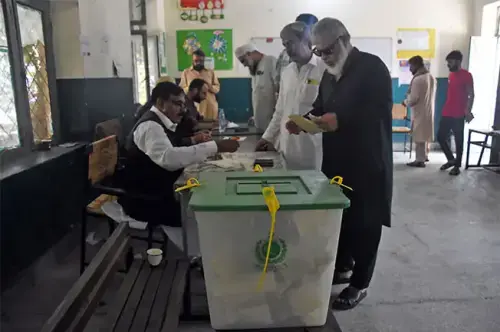
The polling was scheduled to start at 11am; however, it started at 11:26am and ended at 5pm. All 145 members of the KP Assembly polled their votes in an exercise inside the assembly, which was restricted to media persons. Out of 145 polled votes for the general seats, two were declared invalid. Similarly, four and two votes were also declared invalid for seats of women and technocrats, respectively.
Several ruling and opposition members, on the condition of anonymity, told Dawn that their leadership allegedly relied on ‘vote-swapping’ to keep their members in check. This involves the party heads, or their nominees, marking the ballots for them in return for a blank ballot, to ensure that their members do not vote against party lines.
The MPAs, before they went in to cast their vote in the polling booth, received a ballot paper already marked, while leaving behind their own unmarked ballot paper, to be marked and polled by the next person. The practice was in blatant violation of the election rules and transparency, but not the first time such a procedure has been adopted. Both the treasury and opposition lawmakers followed the same process.
This is not the first time such a procedure has been adopted in the Senate election. During the tenure of Perviaz Khattak as the CM, the ruling PTI engaged in this practice, but not the opposition. Before that, the ANP would use covert tactics to keep its lawmakers in check. However, the way this practice had been deployed in Monday polls was unprecedented.
Punjab by-poll
In Punjab, PML-N leader Hafiz Abdul Kareem secured the vacant Senate seat in a by-election held to fill the seat left vacant after the death of Sajid Mir.
Out of 368 total votes, 345 were cast. Hafiz Abdul Kareem emerged victorious with 243 votes, while opposition candidate Mehr Abdul Sattar received 99 votes. Three votes were rejected.
Rana Muhammad Arshad, PML-N’s chief whip, highlighted the unity among government allied parties, stating that members fully adhered to their leadership’s directives.
Rana Arshad said that their 16 MPAs were abroad, so they could not use their right to franchise; otherwise, the ruling coalition’s vote tally would have been even better.
Amjad Mahmood in Lahore also contributed to this report
Published in Dawn, July 22nd, 2025