

IN his seminal book, The Great Transformation (1944), Karl Polanyi makes a case for how modern societies are characterised by the creation and use of three fictitious commodities — money, human labour, and land or nature.
His reason for labelling them fictitious was because they are exchanged in markets, like any other commodity, even though their existence and creation is unlike all others, which are usually produced to be consumed.
Money is a creation of governments to facilitate exchange and has no actual use value beyond it. Outside of the most extreme examples, humans do not give birth to children to create more labourers. And no human creates nature, yet fields, forests, mountains, mines and even the seas are commodified through legal wizardry and bought and sold freely.
While much can be said about the complete degradation of human life to merely its worth as labour, and the corrosive role of money in shaping all aspects of life stripped of moral and ethical dimensions, it is the third fictitious commodity that weighs heavy on Pakistani lives today.
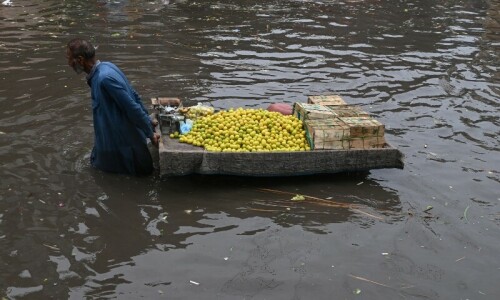
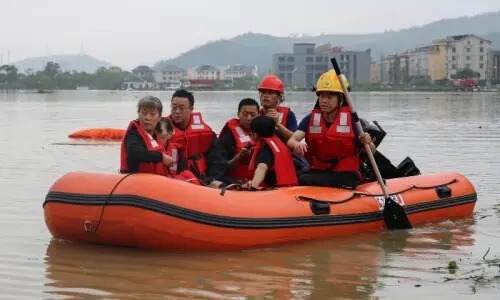
By latest estimates, over 100 people have died in monsoon rainfall incidents across the country these past few weeks. The tail-end of last week was marked by extreme flooding and devastation across the Potohar plateau, with towns and villages in Chakwal and Rawalpindi heavily impacted by several days of continuous rain.
As others point out, there are two aspects to this ecological carnage. One is the general impact of climate change across the world. Extreme weather events are now far more common. The amount of rainfall previously witnessed across one season now routinely takes place in a few days. While cloud bursts and rainfall-induced flooding was particularly devastating in 2022 in Sindh and Balochistan, each successive year has also seen significant loss of life and property in all four provinces.
Pakistani state authorities are quick to highlight the climate change aspect of monsoon catastrophes. This focus serves to underscore the country’s vulnerability to climate change, which is far higher than its historical contribution to greenhouse gas emissions, and helps make its case for greater climate financing for mitigation and adaptation purposes.
Yet, this narrow focus also detracts from the other, and arguably more important, aspect of ecological carnage: the way in which nature is used and regulated in the country; or, in other words, the political economy and governance-based causes of climatic vulnerability.
It is during the monsoon months that the existential impact of real estate fever becomes truly apparent.
Anyone possessing an even cursory familiarity with Pakistani cities and towns will know how unchecked and unfettered urban expansion has dramatically altered the rural-urban frontier.
In the plains of Punjab, this has come at the cost of farmland and rural commons, via their conversion into low-density, plot-based housing schemes for speculative capital. Originating in the hinterlands of bigger cities like Karachi, Lahore and Faisalabad, this rapid conversion is now commonplace across second- and third-tier cities across the country.
The outcomes of this conversion are apparent for all residents. These cities have become dependent on privatised modes of transport, contributing to greater air pollution. The concretisation of large tracts of agricultural land has both destabilised food supply chains and raised average ground temperatures during the summer months. Even the electricity grid is afflicted by the development of low-rise, single-family dwellings which remain highly energy-inefficient and contribute to transmission losses.
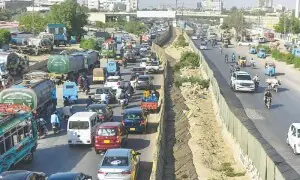
But it is during the monsoon months that the existential impact of real estate fever becomes truly apparent. Paved surfaces become inadvertent reservoirs for rainwater, where in the past unpaved ground would have absorbed it. The underpasses and flyovers constructed to ease vehicular flows (and improve real estate values) block the natural flow of water, rendering the few remaining stormwater drains redundant.
These trends are highly visible in Lahore, where such real estate development remained the norm for decades, but they are now afflicting other cities as well. In the absence of meaningful regulation of urban growth that keeps water drainage and climatic factors in mind, images of submerged towns will become even more commonplace across the country.
This year, such images came in droves from the Potohar plateau, an area where the commodification of nature is of an even more extreme form. Rather than just eating into agricultural land, real estate developers in Rawalpindi and adjoining districts have built across seasonal river paths and floodplains, cut open and flattened hills, blocked natural drainage channels, and radically altered the local topography. It come as no surprise, then, that the most visceral impact of rainfall this past week was felt in areas that were built on the floodplain and river path of the seasonal Soan river.
DHAs and Bahria Towns remain the primary ‘protagonists’ of this transformation, enabled by their capture of laws and bullying of municipal authorities, but many others now draw inspiration from them.
Merely travelling towards Islamabad via the Motorway shows how drastically the landscape stands changed, with under-construction housing developments dotting the landscape all the way to the Salt Range. They are solely being built for the purpose of feeding the insatiable appetite of speculators, investors and profiteers.
In his writings, Polanyi was clear that the unchecked exploitation of human labour would eventually produce a ‘double-movement’. Humans would fight back against their immiseration and seek a better bargain to reassert their humanity in a world that treated them merely as labour. This bargain eventually took the shape of mid-20th-century social democracy, which offered better labour protections and greater welfare for workers.
In the same vein, climate change and ecological catastrophe can be seen as nature’s double movement against its immiseration and exploitation at the hands of capitalist development.
The stark reality, though, is that while overworked labourers can be placated by being offered better wages, past destruction to our natural landscape cannot be reversed. At best, we can hope that immediate course correction limits the extent of nature’s revenge in the future.
The writer teaches sociology at Lums.
X: @umairjav
Published in Dawn, July 21st, 2025