0
0
KARACHI: The stock market continued its bullish run for the second straight week, crossing the 134,000-point threshold amid strong macroeconomic fundamentals and persistent buying by local mutual funds. A surge in workers’ remittances, robust auto sales, and improved foreign exchange reserves provided a solid backdrop for investor optimism, helping offset subdued participation and minor currency depreciation.
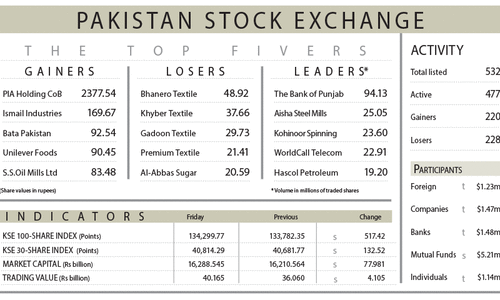
The benchmark KSE-100 index closed at 134,299.77, gaining 2pc or 2,351 points on a weekly basis. According to Topline Securities Ltd, the rally was largely driven by mutual funds, which recorded net inflows of $30m month-to-date as of Friday’s close. The average traded volume stood at 948m shares, while traded value amounted to Rs38.8bn.
Key macro indicators underpinned market sentiment. Workers’ remittances rose to a historic $3.4bn in June, up 8pc year-on-year, taking full-year FY25 inflows to a record $38.3bn — a 27pc increase over the previous year. Concurrently, the State Bank of Pakistan’s foreign exchange reserves surged by $1.8bn to $14.5bn for the week ending July 4, marking a 39-month high.
The auto sector further supported market gains. As per the Pakistan Automotive Manufacturers Association (PAMA), car sales in June rose 64pc year-on-year and 47pc month-on-month to 21,773 units. Full-year FY25 sales grew 43pc to 148,000 units, buoyed by pre-buying ahead of a proposed GST increase on smaller vehicles.
Unprecedented remittances and fund inflows drive market momentum; caution looms ahead
Arif Habib Ltd reported that investor confidence also benefited from diplomatic and economic developments, including reports of a proposed trade and tariff framework with the United States and a $2bn investment deal with Azerbaijan, signed during the ECO Summit. Investors also tracked a production boost reported by OGDCL at the Rajian-05 well and signing Pakistan-Russia discussions over reviving the Pakistan Steel Mills.
On the monetary front, the government raised Rs1.41tr through a T-bill auction amid total participation of Rs2.7tr. Yields on 12-month paper declined by 13bps, reflecting stable investor expectations. Meanwhile, Rs1.045tr out of the allocated Rs1.1tr development budget for FY25 was utilised, indicating improved fiscal execution.
Sector-wise, commercial banks were the largest contributors, adding 1,329 points to the index, followed by the cement sector (304 points), the automobile sector (150 points), the textiles sector (147 points), and the pharmaceutical sector (124 points). On the other hand, exploration and production (E&P) firms lost 82 points, miscellaneous sectors 78 points, fertilisers 56 points, technology 47 points, and oil marketing companies (OMCs) 39 points.
Among individual stocks, United Bank Ltd contributed 417 points to the index, followed by Meezan Bank (297), MCB Bank (171), Habib Metropolitan Bank (150), and Bank Alfalah (148). In contrast, Bank Al-Habib pulled the index down by 103 points, with other negative contributors including Engro Fertilisers (86), Pakistan Services (78), Mari Petroleum (60), and Pakistan Petroleum Ltd (54).
According to AKD Securities, optimism was supported by expectations of strong corporate earnings and favourable macro data. However, market participation remained tepid, with a 2pc decline in average weekly volumes and a 6.3pc fall in traded value to $136.5m.
Foreign investors remained net sellers, offloading $5.76m during the week, compared to $15.33m a week earlier. Most of the selling was concentrated in commercial banks ($3.8m) and FMCGs ($1.2m). On the local side, mutual funds and individual investors were net buyers, with inflows of $30.91m and $14.08m, respectively. Meanwhile, companies and banks collectively offloaded $17.6m.
On the currency front, the rupee depreciated slightly by 0.17pc to close at Rs284.46 against the dollar. Other significant developments included the early retirement of Rs500bn SBP debt, Rs208bn raised through floating-rate PIBs, and a 7.2pc YoY increase in textile exports during FY25. NEPRA also announced a negative fuel cost adjustment of Rs4.03/kWh for K-Electric consumers.
The outlook remains broadly positive, with analysts at Arif Habib Ltd and AKD Securities citing strong earnings potential, macroeconomic stability, and attractive valuations as key drivers. The KSE-100 index currently trades at a forward price-to-earnings ratio of 6.8x for 2026, below its 10-year average of 8.0x. However, analysts caution that intermittent profit-taking and investor wariness ahead of earnings announcements may create short-term volatility.
Published in Dawn, July 13th, 2025