• Salman Akram Raja says eight-judge order gave directions for ‘democratic justice’
• SIC wasn’t a parliamentary party when PTI members joined it, remarks Justice Hilali
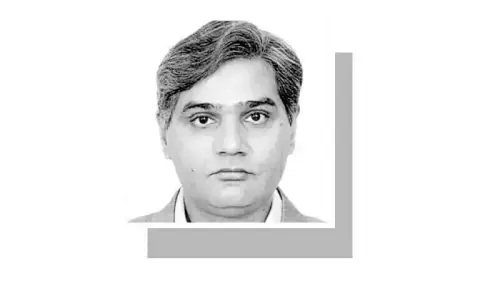
ISLAMABAD: Parliament would be more representative and reflective of people’s will if reserved seats were allocated to the PTI, Salman Akram Raja argued before the Supreme Court on Thursday.
The senior counsel, representing the Sunni Ittehad Council (SIC), made these arguments before the Constitutional Bench, which resumed the hearing of review petitions filed against the July 2024 reserved seats verdict.
Mr Raja argued the eight judges — who had ruled in favour of awarding reserved seats to PTI — and two judges — who declared the PTI a parliamentary party — realised a “political reality” that’d make the parliament more representative.
The intent of the Constitution, Mr Raja argued, was to make the legislature more democratic and not “just fill the reserved seats by doling out women or non-Muslim candidates to political parties”.
“I will humbly and forcibly say that both judgments — by eight judges and two judges — have moved towards a direction for democratic justice,” the counsel emphasised.
He claimed the parliament would become unrepresentative if some parties were given more reserved seats than the party that actually won the elections.
The counsel argued that the parties that challenged the eight-judge majority verdict have “not presented” a single ground to suggest why the judgement was wrong.
He said the petitioners “were not seeking justice, but rather injustice”, and therefore the Supreme Court should ensure justice.
The counsel described the majority judgment as a “well-considered verdict”, the crux of which suggested that under Article 187 of the Constitution, the Supreme Court exercises both plenary and inherent jurisdiction.
“Thus, nothing stops this court from doing complete justice if it considers that the conduct of the Feb 8 elections was not something that fulfils the requirement of law,” argued Mr Raja.
The counsel emphasised that the bench was sitting to ensure the democratic rights of people are granted and not to punish a political party for their mistakes.
Political vs parliamentary party
During the hearing, Justice Musarrat Hilali asked the counsel about the legal provisions for a political party that lost its common election symbol over failure to conduct timely intra-party elections, despite being given the opportunity to hold such polls.
The counsel retorted that the political party will still remain a “party” and after elections, it will have the right to publish a list of candidates for reserved seats and issue tickets to its candidates.
“The only difference will be that it will not be given a common election symbol.”
Justice Hilali again highlighted the difference between a political party and a parliamentary party, stating the elected members should have joined a parliamentary party.
But the independents — who won with the backing of PTI — joined SIC when it was not a parliamentary party.
“Therefore, their joining or not joining the SIC will be of no benefit,” Justice Hilali emphasised.
The counsel reminded the judge that the Supreme Court had already held that the joining or non-joining of SIC would have no impact, since these independent members belonged to PTI and were therefore entitled to reserved seats.
According to Mr Raja, the July 12, 2024 judgment had declared these lawmakers as PTI-backed candidates.
“It is the duty of the court to take judicial note of all the surrounding facts,” the counsel said, adding this was done by the eight-judge majority judgment.
Later, Mr Raja concluded by stating he “will rest his case for the people of this country”.
‘Persecution’
Arguing next, senior counsel Hamid Khan, also representing SIC, reminded the bench that he had already applied for a general adjournment till Aug 5 since he was on vacation.
But Justice Aminuddin Khan, who was heading the 11-judge bench, declined the request, stating no adjournment had been granted in the present case.
Mr Khan then commenced his arguments, describing the reserved seats case as one of the few cases in which the “entire jurisprudence was wrapped up and changed”.
The counsel also described the Jan 13, 2024, Supreme Court judgment — to deny the PTI its bat symbol — as “unprecedented”.
The verdict left the most popular party high and dry, Mr Khan argued.
Subsequently, PTI candidates were asked to contest the elections since the party had not boycotted the polls.
“I want to establish how a political party was persecuted from different sides,” Mr Khan emphasised, adding the eight judges who authored the majority judgment were “forced” out of the Constitutional Bench.
Published in Dawn, June 27th, 2025