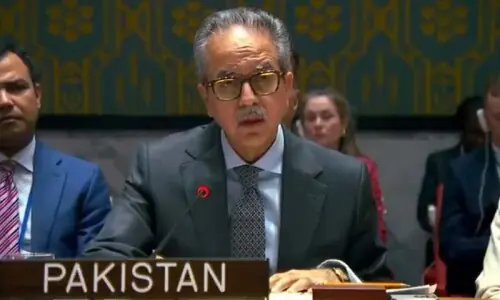
Pakistan was appointed as the vice chair of the UN Security Council’s (UNSC) Counter-Terrorism Committee on Wednesday.
The committee was established by UNSC resolution 1373 (2001), adopted unanimously on September 28, 2001, after the September 11 terrorist attacks in the United States.
The committee, comprising all 15 UNSC members, is tasked with monitoring implementation of the above resolution, which requested countries to implement several measures intended to enhance their legal and institutional ability to counter terrorist activities at home, in their regions and around the world.
Pakistan was also appointed head of the UNSC committee established pursuant to resolution 1988 (2011), which oversees the implementation of the sanctions measures on the Afghan Taliban.
In a press release, the Pakistan Mission to the UN called the appointments a “significant diplomatic development”.
It added that Pakistan was also appointed as the co-chair of the UNSC’s Informal Working Group (IWG) on documentation (working methods) and the newly established IWG on Sanctions.
The IWG on documentation focuses on improving the UNSC’s working methods, transparency, efficiency and inclusiveness.
The IWG on Sanctions issues aims to review and enhance the design, implementation, and effectiveness of UN sanctions regimes.
“These appointments represent an acknowledgement of Pakistan’s active engagement with the United Nations system, including its constructive role as an elected member of the Security Council,” the press release said, adding, “They are also an international recognition of Pakistan’s counter-terrorism efforts”.
Pakistan, it said, remained committed to working with the UN and fellow member states in advancing the principles and purposes of the UN Charter as well as playing its part in the global fight against terrorism in collaboration with its international partners.
Pakistan began a two-year term as a non-permanent UNSC member on the first day of the new year.
This marks Pakistan’s eighth term on the council, providing an opportunity to shape discussions on pivotal international issues, but also posing significant challenges.
Elected in June to replace Japan, Pakistan occupies one of the two Asia-Pacific seats on the UNSC. It will preside over the council in July, a key opportunity to set the agenda and foster dialogue.
While only permanent members hold veto power in the council, non-permanent members wield significant influence in terrorism-related sanctions committees, as decisions are made by consensus under established norms.
Pakistan’s term coincides with heightened tensions in conflict zones such as Gaza, held Kashmir and Syria.