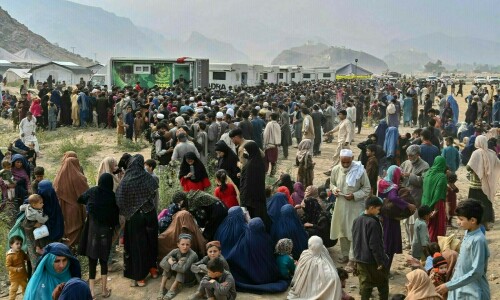
ISLAMABAD: Over 18,000 Afghan nationals returned to their country from the twin cities of Rawalpindi and Islamabad in January this year, with repatriations in the second fortnight of the month slightly higher than the first fortnight.
According to the International Organisation for Migration (IOM), the pace of deportation of Afghan nationals from the Islamabad Capital Territory (ICT) and Rawalpindi has increased.
Between January 16 and 31, 291 heads of households were interviewed through a flow monitoring registry (FMR) form, while 9,846 Afghan returnees were identified through border crossing points of Torkham, Chaman, Ghulam Khan, Badini, and Bahramcha.
Since September 15, 2023, at least 824,568 individuals have returned to Afghanistan while two per cent (18,577) of this total has returned since January 2025, the IOM said.
The majority of returnees are individuals between 18 and 59 years of age (46 per cent) and individuals between 5 and 17 years of age (30 per cent). Of the children under 10 who crossed the border, 502 had received polio vaccination.
The biweekly report said that 10pc of the returnee households were women-headed households, adding that no child-headed households were recorded during the said period. More men (52 per cent) than women (48 per cent) returned during the reporting period.
Agency says over 18,000 Afghans repatriated last month, majority between 18 and 59 years of age
According to the report, fear of arrest (78 per cent) and inability to pay house rent (34 per cent) are the most common reasons for the return cited among the heads of households returning to Afghanistan.
The inability to pay household utilities (30 per cent), no employment (26 per cent), and communal pressure to return (9 per cent) were also cited among reasons. It noted that the fear of arrest and communal pressure to return have both increased in the past two weeks.
Final destination
On the other hand, 89 per cent of Afghans have reported family reunions as the reason for choosing their final destination and 67 per cent noted the availability of assistance in Afghanistan as another reason. At least 17pc of returnees also indicated that they wanted to obtain nationality in Afghanistan.
During the interviews, a large majority of respondents reported finding income opportunities (98 per cent), arranging for livelihoods (89 per cent), resettlement in a new city (87 per cent), and shelter (71 per cent) as the most important challenges they foresee upon return in Afghanistan.
A relatively lower percentage of respondents identified the availability of medicine and health facilities (36 per cent), access to education (35 per cent), and availability of clean drinking water (32 per cent) as their primary challenges. Only a small number of respondents identified security (8 per cent) as a challenge.
On average, returnees pay $153 from their place of origin in Pakistan to their final destination in Afghanistan. The cost from the border to their final destination in Afghanistan ($86) is higher than the cost from their place of origin in Pakistan to the border ($67), said the report, adding that the majority used pick-ups (67 per cent) and trucks (18 per cent) to travel to their final destination.
All Afghan returnees reported moving with personal belongings. “Ninety-seven per cent reported carrying cash, followed by household items (95 per cent) and productive assets (53 per cent),” the report said.
The IOM said that the majority of returnees came from Balochistan (43 per cent), followed by Khyber Pakhtunkhwa (28 per cent) and Sindh (20 per cent). A small share also came from Punjab (7 per cent) and ICT (2 per cent). The districts of origin in Pakistan are usually located close to the border, such as Quetta (24 per cent) and Killa Abdullah (10 per cent).
A substantial share of returnees also come from Karachi (20 per cent) and Peshawar (19 per cent), which are located far away from the border in Sindh and KP, respectively. In Afghanistan, most returnees also go to provinces that are located closer to the border, including Kandahar (32 per cent), Nangarhar (23 per cent) and Kabul (13 per cent).
Published in Dawn, February 19th, 2025