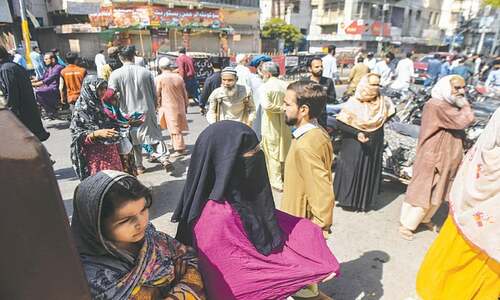
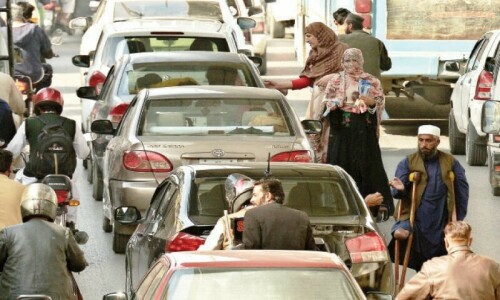
The Sindh High Court’s (SHC) constitutional bench has ordered the Karachi traffic police to take action against beggars at the city’s traffic signals, it emerged on Wednesday.
A total of 205 professional beggars were arrested across Karachi from March to October last year as the city administration continued its crackdown on organised begging.
A two-judge constitutional bench of the SHC, comprising Justice Mohammad Karim Khan Agha and Justice Adnan-ul-Karim Memon, presided over a hearing a day ago on a petition filed by Sumaira Mohammadi regarding the issue of begging.
According to the court order, dated Jan 28 and a copy of which is available with Dawn.com, the petitioner’s main grievance was that “certain transgender persons are begging at traffic lights and other public places and causing nuisance and harassment to [the] public at large”.
The bench ordered the traffic police inspector general (IGP) to “ensure that no begging is allowed in Karachi by any person whatsoever whether they be male, female, children or transgender”.
The petitioner’s application was subsequently disposed of.
Sindh IG Ghulam Nabi Memon told Dawn.com that all possible efforts would be made to eliminate the “menace of beggary” under relevant laws.
He said the traffic police were directed to take action against beggars even though the primary function of the force was the smooth regulation of traffic, with limited resources at their disposal.
Memon said effective actions against beggars required the coordination of all stakeholders. He said the high court had given its order and the police would implement it but it was a temporary solution.
The Sindh IG said coordination between the social welfare department, child protection authority and NGOs working on the issue would be required for effective action.
A similar order was issued by a Karachi sessions court in May last year, wherein it directed the city’s police chief to reactivate the police’s Anti-Beggary Unit.
It also ordered that action be taken against professional beggars at traffic intersections and other public spaces in the metropolis.
Authorities spurred into action last August as they began vigilant screening of passengers travelling to Middle Eastern states amid growing discontent over the increased numbers of Pakistanis involved in begging.
In November, Interior Minister Mohsin Raza Naqvi informed the Saudi deputy interior minister that the names of around 4,300 beggars were placed on the Exit Control List as a zero-tolerance policy had been adopted against beggars going to Saudi Arabia.