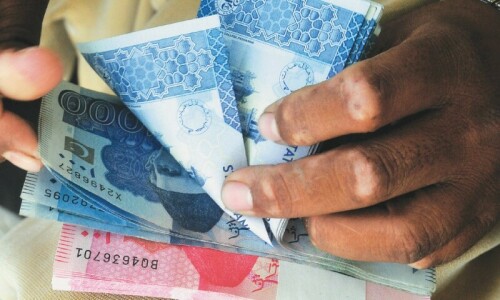
A FRIEND in need is a friend indeed. China, Saudi Arabia, and the UAE have lived up to the adage, rescuing Pakistan multiple times in recent years by propping up its international reserves through large cash deposits and loans, as well as rolling over their debt, to help it access IMF funds in order to avert a sovereign default.
Of late, though, they appear a bit hesitant to lend a helping hand as promptly. Little wonder these nations have not yet intimated the IMF of their decision to roll over their combined existing debt of $12bn for another year. This is said to be one of the reasons the Fund removed Pakistan from the agenda of its Aug 30 Executive Board meeting where it was expected to sign off on the recently concluded staff-level agreement for a new bailout package of $7bn over the next 37 months.
Earlier, these countries had turned down a request from Islamabad to extend the maturity of these loans for a period of three to five years to allow ‘predictability’ through the IMF programme tenure. The other factor delaying the loan’s approval pertains to Islamabad’s failure to arrange funds well in time to plug an external financing gap of $2bn, which both the finance minister and State Bank governor had earlier described as an easy task. Strapped for cash, Pakistan has now reached out to Riyadh for an additional debt of $1.5bn on top of the existing $5bn deposits, as well as Middle Eastern banks for the rest of the money to bridge the external financing gap. Unless the government is able to secure these funds, the IMF Executive Board might not close the deal even in September.
Pakistan will eventually secure the required debt rollovers from the friendly states, as well as fresh Saudi funds — and possibly commercial loans — that will give it access to IMF dollars and unlock other multilateral financing. Still, the experience of dealing with the IMF and bilateral lenders during the last few years underlines the country’s decreasing geopolitical influence that was once considered sure insurance for significant financing from a range of Western and Arab lenders and donors whenever required.
Today, we find ourselves in a situation similar to where Sri Lanka was a year ago after it declared bankruptcy. It took months and firm commitments from bilaterals like China before the IMF concluded a loan deal with Colombo. For the last three years, our foreign policy has mostly revolved around just one point: how to borrow and from where to borrow. The situation has become untenable. It is time we tried to change and stand on our feet rather than look outside for charity. This can be very tiring for our friends.
Published in Dawn, August 26th, 2024