Govt remains ‘very committed to structural reforms’ under IMF, says finmin


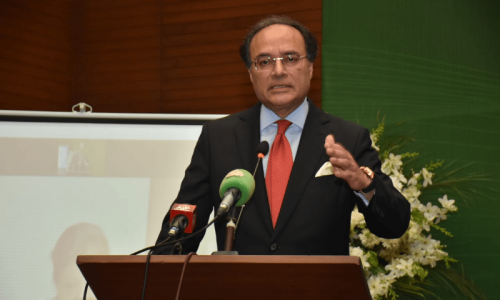
Finance Minister Muhammad Aurangzeb on Thursday said that the government remained “very committed” to the International Monetary Fund (IMF)‘s structural reforms amid uncertainty regarding the IMF’s $7 billion bailout schedule.
Speculation arose when the country’s name did not show up in the IMF executive board’s schedule for August 28. Previously, the finance minister had anticipated IMF board approval by the last week of August, contingent on confirmation of about $12bn in debt rollovers from China, Saudi Arabia, and the UAE. However, aside from a $1bn rollover by the UAE, the remaining $11bn in debt extensions have yet to materialise.
The IMF’s executive board is now expected to approve Pakistan’s $7 billion bailout programme in September, while the finance minister has said that the government was in “constant contact with the IMF”.
“The fund will help bring further permanence to this macroeconomic stability and under that, we remain very committed,” he said at the inaugural ceremony of the Buna-Raast Connectivity Project today.
On the remittances side, the finance minister said that the informal market still captured a “sizable share of the remittances” and that they “must do more”, remembering the administrative measures that were taken previously curb illegal channels in September.
“Addressing this challenge is a pre-priority for reducing economic leakages,” he said, adding that “digitalisation is not an end in itself its a means to an end — it brings transparency, it brings client friendliness and it certainly helps reduce leakages in the system.”
Leakages, he said, were not just in the context of remittances but also in the tax and power system.
“We call it leakages but all of this is ultimately about corruption and people processed technology,” he said.
Five-year economic revival plan in the works

Meanwhile, Prime Minister Shehbaz Sharif said that he would unveil a five-year economic revival plan in the coming weeks after months of deliberating with the stakeholders.
The prime minister said the “home-grown” economic programme would envisage measures to boost the country’s economy by uplifting agriculture, information technology and other untapped sectors.
“Our program is under discussion and I will announce it very soon. Great work has gone into it. It involves discussions and deliberations with all stakeholders over the last many months,” he said. “Recently, we have finalised its broad parameters. By next week or so, we will finalise it. I will go to the people to announce the programme for the next five years.”
Highlighting the challenges of reforms in the Federal Board of Revenue (FBR) and power sector, he said he was personally monitoring the digitisation of FBR and that the government was hopeful of positive outcomes of power sector reforms.
“There is no magic band. It is all about hard work, sacrifice, blood and sweat,” he said. “God willing, you will see we will have dividends and will find our place in the comity of nations through hard work, hard work and hard work.”
Under the Buna-Raast connectivity project, the Raast payment mechanism is being linked with the Arab Monetary Fund’s Buna system to facilitate millions of overseas Pakistanis in Arab countries to send remittances through a swift, affordable, and effective mechanism.
The prime minister said that besides easing the remittance-sending process digitally, it would also help boost the country’s foreign exchange and further strengthen the already cordial relations between Pakistan and the Arab world.
Calling it a great step forward in promoting financial transactions through modern techniques, he said the project would expand the reach of Pakistan’s digital payment infrastructure.
“This signifies how 21st-century Pakistan is moving ahead by augmenting modern technologies in the people’s lives. This is the first cross-border real-time payment system linkage that will make remittances more affordable and accessible,” he said.