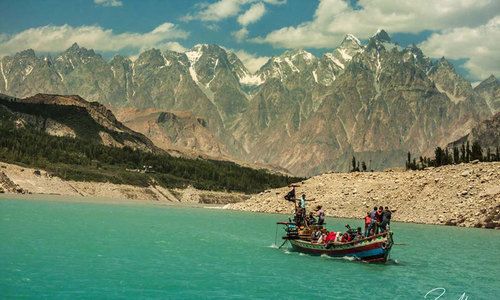
HUNZA: On the steep slope of a glacier jutting through the Hunza valley, Tariq Jamil measures the ice’s movement and snaps photos. Later, he creates a report that includes data from sensors and another camera installed near the Shisper glacier to update his village an hour’s hike downstream.
The 51-year-old’s mission: mobilise his community of 200 families in Hassanabad to fight for a future for their village and way of life, increasingly under threat from unstable lakes formed by melting glacier ice.After all the sensors are installed, village representatives will be able to monitor data through their mobiles, Mr Jamil says.
“Local wisdom is very important: we are the main observers. We have witnessed many things,” he added.
Hassanabad is part of the UN backed Glacial Lake Outburst Flood ( GLOF) II project to help communities downstream of melting glaciers adapt.
When glacial lakes overfill or their banks become unsound, they burst, sparking deadly floods that wash out bridges and buildings and wipe out fertile land throughout the Hindu Kush, Karakoram, and Himalayan mountain ranges.
Himalayan glaciers are on track to lose up to 75 per cent of their ice by the century’s end due to global warming, according to the International Centre for Integrated Mountain Development (ICIMOD).

Amid a shortfall in funding for those most vulnerable to the impacts of climate change, village residents say they urgently need increased support to adapt to threats of glacial lake floods.
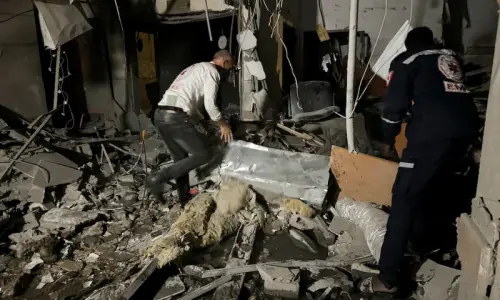
Over the past three years, residents repeatedly evacuated just in time to avoid loss of life, and many fear a flood while they sleep. Others struggle financially as their land and homes were destroyed, most recently in 2022.
In Hassanabad, Jamil and 23 volunteers, trained in first aid and evacuation planning, actively monitor the glacier, consulting with experts each summer.
Seeking international funding, they aim to expand the barrier wall 20-fold. Additionally, they seek interest-free loans for rebuilding homes with stronger materials and enhancing mobile reception for improved monitoring feed access.
“The needs are enormous,” said Karma Lodey Rapten, Regional Technical Specialist for Climate Change Adaptation at the United Nations Development Program (UNDP).
Pakistan is the only country to receive adaptation funding from the Green Climate Fund — the Paris Agreement’s key financing pot — to ease the risk of such floods.
The $36.96m GLOF II initiative, concluding this year, serves as a global model for regions confronting glacial lake flood threats, including the Peruvian Andes and China, following Bhutan’s collaborative efforts.
Since 2017, weather stations and sensors, managed by Islamabad and UNDP, monitor factors like rainfall and water levels. GLOF II employs village speakers for warnings and infrastructure like barriers.
Published in Dawn, November 24th, 2023