0
0
KARACHI: Global media watchdog Reporters Without Borders (RSF) has called on the Pakistan government to repeal “several draconian laws supposedly designed to combat ‘disinformation’, ‘cybercrimes’ and ‘spying’ that it [previous government] forced through parliament shortly before its [assembly] dissolution”.
“The government should instead work with civil society on real reforms that would preserve press freedom and the right to information,” RSF said in a statement.
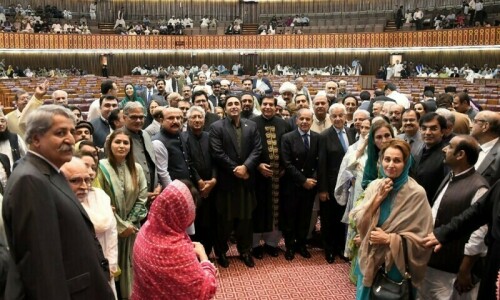
The watchdog said it was amid “scenes of legislative chaos” hours before parliament’s dissolution that PM Shehbaz Sharif’s government “pulled off the feat” of getting both chambers to hastily adopt controversial changes to Pemra Ordinance, “which open the way to more censorship”.
Shortly before that, the government also managed to rush through adoption of its Official Secrets Amendment Act, 2023, “which could also be widely used to harass journalists”, RSF said.
Pakistan urged to rethink E-Safety Authority bill, changes to secrets, Pemra laws
“And even after its departure, it could be seen as another draconian bill, the previously introduced E-Safety Authority Bill 2023 if passed, into a law soon. All of these laws, drafted without consultation with civil society, pose serious risks to press freedom. Instead of improving the situation of the media, they threaten them with censorship,” it said.
RSF said it had found that the amendments “contain only a few meagre advances”. It said the amendments “alarm more than they reassure. In fact, the Pemra, whose main duty since 2002 has been to approve electronic media licences in accordance with constitutional criteria, could as a result of these amendments become a full-blown censorship tool in the hands of the government.”
It noted that Pemra is now given “very broad discretionary power” to suspend any media outlet or revoke its licence for spreading “fake news.” And instead of being fined up to Rs1 million rupees, a media outlet could now be fined up to Rs10m.
As for amendments to the Official Secrets Act, the RSF said Section 8-A of the law, which introduces the notion of “enemy” [of the state], “makes no distinction between a spy and a person who has disseminated sensitive information in the public interest”.
Besides, the government approved an electronic security bill that would create a new digital media regulator, the Digital Security Authority, composed of members appointed by government.
“If parliament passes the law, the government intends to give this new authority the almost-Orwellian power to record and monitor digital media content. And, with regards to (broadly defined) ‘fake news,’ it would have powers similar to those that the Pemra has over the broadcast media,” RSF said.
Published in Dawn, August 17th, 2023