US-China rivalry



PAKISTAN, like much of the world, is worried about how the worsening US-China rivalry would impact its relations with both countries. There are no clear answers. While this rivalry may mirror traditional great power competition, there are also important differences.
Analogies like ‘a new Cold War’ are misleading. The Soviet Union was America’s adversary; China is a rival. The USSR was economically weak with limited international engagement; China is an economic powerhouse and fully engaged globally. Countries were aligned or nonaligned during the Cold War; now they have overlapping and shifting alliances.
Yet a new world order has not quite emerged. We are in a transitional order that affects and is being affected not only by the US-China rivalry, but also by Russian assertiveness, Europe’s struggle for autonomy, and the ambitions of middle powers. No foreign policy taboo is sacred anymore. It is this scramble to stake an advantageous position in the coming world order that is causing international turbulence, and anxiety among countries like Pakistan that lack the strength to shape the global environment but are vulnerable enough to be harmed by it.
What affects Pakistan most is the US-China rivalry. Great Power competition has come a long way from the non-nuclear weapons world that engaged in global wars without inhibition.
Along with nuclear weapons came the prospect of mutually assured destruction that has deterred wars, at least among the big powers. And now in the era of globalisation and economic interdependence the risk of mutually assured destruction of the global economy has raised the cost of even limited Great Power conflict.
No foreign policy taboo is sacred anymore.
No wonder Washington wants to keep the rivalry with China within bounds. Speaking at the Stimson Centre recently, the US Ambassador to China Nicholas Burns said “we’re ready to talk” and expressed the hope that China would “meet us halfway”.
Treasury Secretary Janet Yellen and National Security Adviser Jake Sullivan in recent speeches have insisted that the controls placed on advanced semiconductor exports to China were narrowly focused, and intended only to address national security concerns. Sullivan said “we are not cutting off trade”.
The US rivalry with China is essentially two-tiered; one aimed at maintaining America’s technological and military superiority, the other at ensuring a level playing field in economic competition. The US does not need to go to war to maintain its technological and military superiority. It is doing so by denying high technology, especially the type that can limit China’s capability for AI and military advancement.
The US-China rivalry may be all-encompassing but at its core is economic competition. Washington is worried by China’s deepening economic inroads globally and its assertive military posture in the region. China has an edge in geo-economics, America in geopolitics and military power.
The geopolitical alliances that the US has built, such as AUKUS (Australia-UK-US) and the QUAD (Australia-Japan-India-US), and the Indo-Pacific Strategy are meant to develop enough military leverage to ensure that China does not play the US out in economic competition. They are basically deterrents as are the tensions over Taiwan that has become a strategic asset for Washington in any potential military conflict with China.
How will all this impact Pakistan? Our strategic relationship with China is necessary but insufficient to address our economic and security challenges. We also need the US, an important bilateral economic partner that has traditionally been a valuable security provider. Washington has been unreliable but remains relevant to Pakistan’s needs given our limited alternatives. Regardless, an alienated America has the capacity to harm Pakistan directly or through India.
Pakistan is relevant to Washington as a partner in regional security as well as a potential spoiler in geopolitical competition. As long as Pakistan meets Washington’s desired ends without compromising its own interests it will not come under pressure to choose between the US and China.
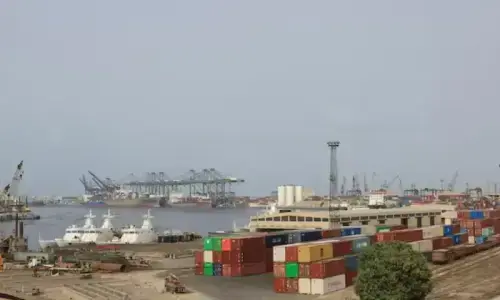
But the situation might change if the economic equation becomes overly weighted in China’s favour, and the US-China competition comes to a virtual ‘hand to hand fight’. Pakistan — especially if it is no longer needed by Washington and is also seen as helping China undermine vital US economic or geopolitical interests, for instance, in any military use of Gwadar by Beijing — may then be asked by the US, or even by China, to choose.
Pakistan should gain internal strength to enhance its appeal so that neither the US nor China can afford to lose it. A weak Pakistan would need both and be constantly worried about having to make a choice one day.
The writer, a former ambassador, is adjunct professor Georgetown University and Visiting Senior Research Fellow, National University of Singapore.
Published in Dawn, May 17th, 2023