PM Shehbaz rejects summary to increase petrol prices: minister


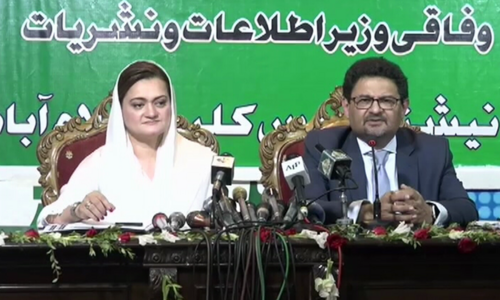
Prime Minister Shehbaz Sharif has rejected the Oil and Gas Regulatory Authority's (Ogra) summary for increasing the prices of petroleum products, Information Minister Marriyum Aurangzeb shared on Thursday.
"[We] cannot punish the people for the previous government's worst incompetence, incapability and blatant mistakes," Aurangzeb said in the statement.
The Imran Khan-led government had agreed to the strict conditions of the International Monetary Fund (IMF) to raise petrol prices in order to get a loan, she said. "Every effort is being made to not increase the burden on the public already troubled by inflation," she added.
The price of petrol and high speed diesel will remain Rs149.86 and Rs144.15 per litre, respectively. Kerosene and light diesel oil will also continue to be sold for Rs125.56 and Rs118.31 per litre, respectively.
This is the second time the prime minister rejected Ogra's proposal for a price hike.
The move comes days after the International Monetary Fund (IMF) said the government had "agreed that prompt action is needed to reverse the unfunded subsidies which have slowed discussions for the 7th review".
Finance Minister Miftah Ismail returned to Pakistan on Monday after negotiating a deal with the IMF that may give some space to the new government to make a "people friendly" budget in June.
But an IMF statement issued after the talks indicates the deal does not equip the government with the tools it needs to clear, what Ismail described as, "the landmines planted" by the PTI government, i.e., facing the consequences of withdrawing fuel subsidies given by his predecessors.
The previous PTI government had announced a four-month freeze (until June 30) on petrol and electricity prices on February 28 as part of a series of measures to bring relief to the public.
The PML-N led coalition government had severely criticised the previous Imran-led government for first failing to control fuel prices in the country and later for "derailing" the IMF programme through fuel subsidies.
Earlier this month, Ismail, during his Washington visit, told US think tank Atlantic Council that the government will have to increase the price of petroleum products to get Pakistan's economy back on track and to revive the stalled bailout programme with the IMF.
The IMF in 2019 approved a $6 billion loan over three years for Pakistan but disbursement has been slowed by concerns about the pace of reforms.
"They (IMF) have talked about removing the subsidy on fuel. I agree with them," Ismail, himself a former IMF economist, had said at the Atlantic Council. "We can't afford to do the subsidies that we're doing. So we're going to have to curtail this."
Officials of the IMF [will visit][5] Pakistan in May to discuss issues regarding the subsidies being given by the government on petrol and electricity, according to a press release issued by the Finance Division on Sunday.
3 statements
Earlier in the day, the information minister issued two statements within a short span of time creating confusion about petroleum prices.
Initially, Aurangzeb stated that the prime minister had rejected the summary to increase fuel prices as he did not want to "punish" the public for the previous government's "incompetence, incapability and mistakes".
The prime minister cannot increase the burden on a public already troubled by inflation, she added.
However, shortly afterwards, the information minister issued another statement, saying, "The statement regarding petrol prices is withdrawn. It's being updated and will be issued later."
Subsequently, she issued a third statement saying the premier had rejected the summary and elaborating on the reasons.