Tarin tries to allay fears, says exports and remittances will help reduce trade gap


 50
50

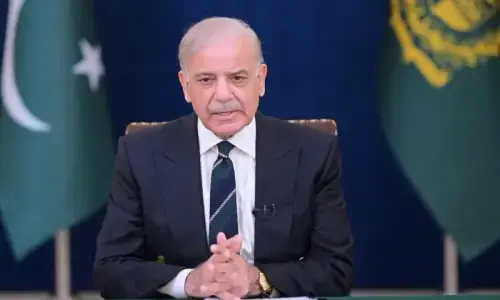
Adviser to the Prime Minister on Finance and Revenue Shaukat Tarin on Friday tried to allay fears over the state of the economy and said that Pakistan's exports and remittances will help to reduce the country's trade gap.
Tarin's press conference comes days after the trade deficit saw a steep rise of 162.4 per cent during November, driven largely by a more than triple increase in imports compared to exports.
This caused the Pakistan Stock Exchange's benchmark KSE-100 index to bleed 2,134.99 points or 4.71 per cent, the highest number of points in a day since March 2020.
Simultaneously, the dollar appreciated further to set a new record on Thursday, closing at Rs176.42 after gaining 94 paisa.
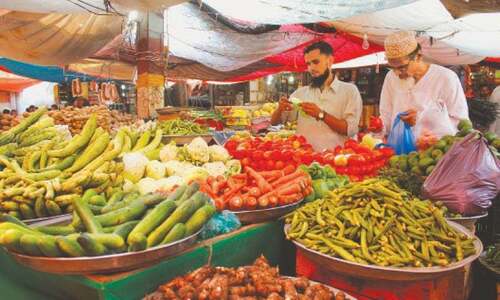
In addition, inflation during the month of November also edged up to 11.5pc from 9.2pc, the highest increase noted in the past 20 months.
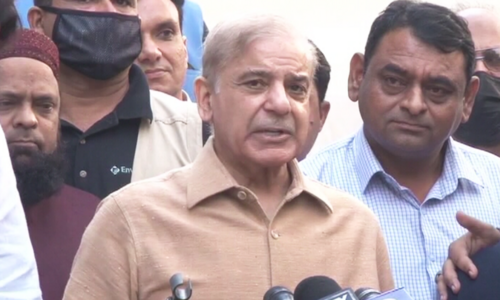
Speaking to the media in Islamabad alongside Adviser to the Prime Minister on Commerce and Investment Abdul Razak Dawood, Tarin said that the country was witnessing inflation due to a rise in the global prices of commodities.
"India is also facing the same situation. Their trade deficit is $20 billion today compared to $10bn ten years ago. And the reason for that is price escalation," he said.
Comparing imports for October and November, Tarin said that the import bill went up from $6.3bn to $7.5bn. He stated that imports had increased in value and gone down in terms of quantity.
"There is a 72pc increase in the import of petroleum products in terms of value and an 11pc increase in terms of volume," he said.
Likewise, crude petroleum imports increased 86pc in value and only five per cent in quantity while palm oil and soya bean increased 75pc in value and only five per cent in volume. Pulses grew by 34pc in value and only five per cent in quantity, he said.
Tarin said that the situation would not last and said that the "disequilibrium" would get fixed once global prices stabilise.
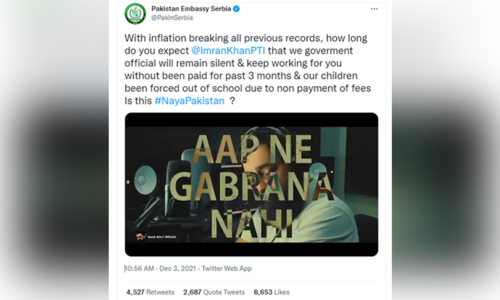
Tarin stated that the government often uses the phrase "Ghabranay ki baat nahin hai" (there is nothing to worry about) as it is necessary to see where the country's economic fundamentals are headed. "Our economic fundamentals are growing perfectly."
He said that people had a tendency to "get dramatic" which caused the stock market to fall by 2,000 points. "[But] there was little coverage when the stock market rose for two days."
Addressing the common man, Tarin said that the country's economy was "headed in the right direction". "We understand that the middle class and the lower middle class is suffering, but they need to be patient for a little more," he said, adding that international prices will nosedive soon.
"As soon as prices go down, our exports and remittances will collectively help to reduce the trade gap," he said.
Meanwhile, Dawood highlighted that the country's exports in November stood at $2.9bn from $2.7bn in October. "Hopefully, our exports will reach $3bn in December," he said.
"In October, our imports were $6.3bn and they increased to $7.7bn in November. Similarly, there was a surge in the import of machinery. It means the size of our industries is increasing and I don't think there is a reason to worry," he added.
Additional input from APP